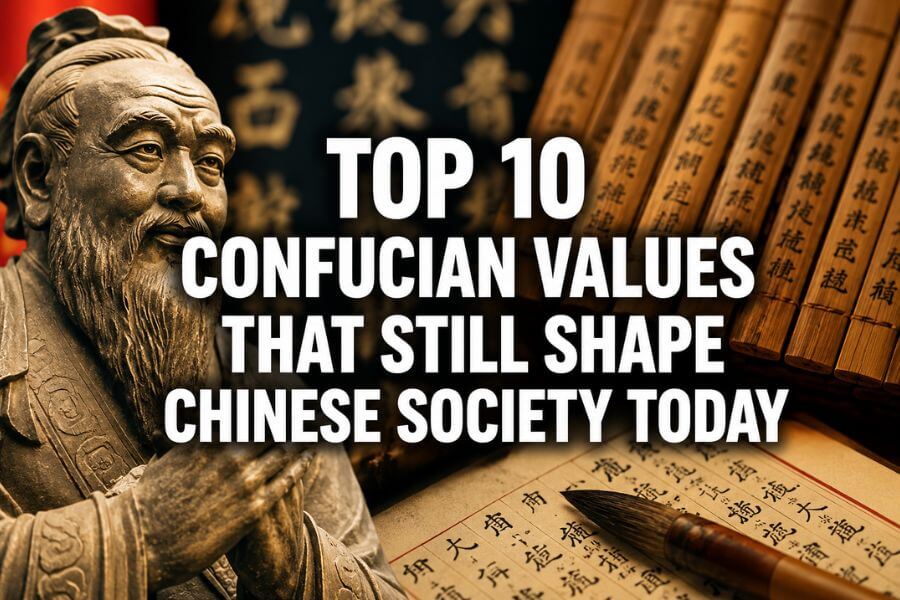
If you spend time in China or learn about Chinese culture, you quickly notice that many daily habits, social expectations, and family traditions are deeply connected to Confucian values. Even though modern China has changed rapidly through technology, business, and urban life, many ideas from the teachings of Confucius still influence how people think and behave today.
Confucianism is more than an old philosophy. It shapes relationships, education, respect for elders, work ethic, family life, and even the way people communicate. These values have survived for thousands of years because they continue to help people maintain social harmony and strong communities.
In this article, you will discover the top Confucian values that still shape Chinese society today and why they continue to matter in modern life.
Quick Summary Table 📘
| Rank | Confucian Value | Main Idea | Modern Influence |
|---|---|---|---|
| 1 | Filial Piety | Respect and care for parents | Family responsibility |
| 2 | Respect for Education | Learning improves society | Competitive school culture |
| 3 | Harmony | Avoid unnecessary conflict | Social stability |
| 4 | Respect for Hierarchy | Know your role in society | Workplace and family structure |
| 5 | Loyalty | Stay faithful to relationships | Business and personal trust |
| 6 | Self Discipline | Control emotions and behavior | Professionalism and public conduct |
| 7 | Collective Thinking | Group success matters | Team oriented culture |
| 8 | Ritual and Manners | Proper behavior is important | Etiquette in daily life |
| 9 | Hard Work | Effort leads to success | Strong work ethic |
| 10 | Moral Leadership | Leaders should act ethically | Expectations of authority figures |
How We Ranked These Values 🧭
We ranked these Confucian values based on several important factors:
- How visible the value is in modern Chinese society
- Its influence on family life and relationships
- Its role in schools and workplaces
- How often the value appears in everyday behavior
- Its historical importance in Chinese culture
- Its influence on younger generations today
- How strongly the value affects social expectations
- Its continued relevance in modern cities and rural communities
1. Filial Piety or Respect for Parents 👨👩👧
Filial piety is probably the most famous Confucian value in Chinese culture. In Chinese, this idea is called “xiao,” and it focuses on honoring, respecting, and caring for your parents and older family members.
Even in modern China, many adults feel a strong responsibility to support their parents financially and emotionally. It is common for children to help aging parents, live close to family members, or send money home after finding a good job.
This value affects many important life decisions. For example, young people may choose careers that make their parents proud or delay personal dreams to support family needs. Parents also expect children to show gratitude for sacrifices made during childhood.
You can see filial piety during major Chinese holidays such as the Lunar New Year, when millions of people travel long distances to reunite with family. Family gatherings are considered extremely important because maintaining close family bonds is a core social value.
Filial piety also influences how older people are treated in public. Elders are often given respect in conversations, public seating, and decision-making within families.
Although younger generations are becoming more independent, family responsibility remains deeply rooted in Chinese society today.
2. Respect for Education 📚
Confucianism strongly teaches that education improves both the individual and society. Because of this belief, academic success remains one of the most respected achievements in Chinese culture.
Parents often invest enormous amounts of time, money, and energy into their children’s education. Many students attend extra tutoring classes, study late into the night, and face intense pressure to perform well in school.
The highly competitive national college entrance exam, known as the Gaokao, reflects this Confucian respect for learning. Families often view education as the path to social mobility, stability, and honor.
Teachers are also treated with significant respect. In many classrooms, students are expected to listen carefully, avoid interrupting, and value the teacher’s authority.
This educational mindset has helped China develop a highly skilled workforce and strong academic performance in subjects such as mathematics and science.
At the same time, the pressure connected to education can create stress for students. Even so, the cultural belief that hard study leads to success continues to shape modern Chinese society in a powerful way.
3. Harmony and Social Stability ☯️
Confucianism teaches that harmony is necessary for a stable society. Instead of encouraging open confrontation, the philosophy promotes balance, cooperation, and peaceful relationships.
This value still affects communication styles in China today. Many people prefer indirect communication to avoid embarrassing others or creating public conflict. Maintaining “face,” or protecting dignity and reputation, is closely connected to social harmony.
In workplaces, employees may avoid openly disagreeing with managers in public meetings. In families, relatives often try to keep the peace even during disagreements.
Harmony also appears in community life. People are encouraged to think about how their actions affect the group rather than focusing only on individual desires.
This does not mean Chinese people never argue or disagree. However, there is often greater social pressure to solve problems quietly and respectfully instead of through direct confrontation.
The value of harmony helps explain why cooperation and relationship building are often highly valued in Chinese business and social culture.
4. Respect for Hierarchy and Authority 🏛️
Confucianism places strong importance on understanding social roles and respecting authority. In traditional teachings, society functions best when everyone understands their responsibilities and behaves appropriately.
This value still influences modern Chinese workplaces, schools, and families. Older family members often hold decision-making power, while younger members are expected to show respect.
In business settings, managers and senior employees are usually treated with formal respect. Junior employees may hesitate to challenge senior staff openly.
Titles, age, and experience often carry significant weight in professional and social situations. Many conversations and interactions still reflect awareness of hierarchy.
This cultural mindset can create organized and disciplined environments. At the same time, it may sometimes limit open debate or encourage people to avoid questioning authority.
Even with modernization and globalization, respect for hierarchy remains one of the strongest Confucian influences in Chinese society today.
5. Loyalty and Trustworthiness 🤝
Confucianism teaches that loyalty is essential for strong relationships and social stability. Loyalty applies not only to family but also to friends, employers, coworkers, and communities.
Trust is extremely important in Chinese culture. Long-term relationships are often valued more than quick transactions or short-term gains.
In business, personal connections and trust networks can strongly influence partnerships and opportunities. Building trust may take time, but once relationships become strong, they can last for many years.
Loyalty also affects friendships. Chinese friendships are often deep and long-lasting, with strong expectations of mutual support during difficult times.
Within families, loyalty means standing by relatives and helping them through challenges. Family members are expected to protect and support each other whenever possible.
This Confucian value continues to shape how many people approach relationships, both personally and professionally.
6. Self Discipline and Emotional Control 🧘
Confucian teachings encourage people to control emotions, behave responsibly, and maintain dignity. Public self-control is often viewed as a sign of maturity and wisdom.
In Chinese society, emotional restraint is commonly respected. People may avoid showing strong anger, frustration, or sadness in public situations.
This value influences workplaces, classrooms, and public behavior. Remaining calm and composed is often considered more admirable than reacting emotionally.
Self-discipline also connects closely with personal improvement. Confucianism teaches that individuals should constantly work on becoming better people through learning, reflection, and ethical behavior.
Many Chinese students and workers are taught from a young age to stay focused, work hard, and avoid laziness or impulsive behavior.
This emphasis on discipline has helped shape a culture known for persistence, patience, and long-term thinking.
7. Collective Thinking Over Individualism 🌐
Confucian culture often prioritizes the needs of the group over individual desires. Family reputation, community harmony, and collective success are considered highly important.
This value influences many areas of life in China. In schools, teamwork and cooperation are often encouraged. In workplaces, employees may focus on group goals instead of personal recognition.
Family decisions may also involve multiple generations rather than only the individual making the choice.
Compared to highly individualistic societies, Chinese culture often places greater emphasis on shared responsibility and social unity.
This collective mindset can create strong support systems and close communities. However, it may also create pressure for individuals to follow social expectations rather than personal preferences.
Even as younger generations become more independent, collective thinking still remains deeply connected to traditional Confucian values.
8. Ritual, Etiquette, and Proper Manners 🎎
Confucianism teaches that proper behavior and rituals help maintain order and respect in society. These rituals are not only religious ceremonies but also everyday manners and social customs.
You can see this influence in greetings, gift giving, dining etiquette, and formal interactions. Respectful language and polite behavior are often highly valued.
For example, offering tea to elders, using both hands to give gifts, and seating arrangements during meals may all reflect traditional cultural values.
Business meetings and formal events also involve many unwritten etiquette rules. Showing proper manners demonstrates respect and social awareness.
Confucian teachings believe that good behavior creates stronger relationships and a more harmonious society.
Even though younger generations may follow customs less strictly than older generations, etiquette still plays an important role in modern Chinese culture.
9. Hard Work and Perseverance 💼
Confucian values strongly connect success with effort and persistence. Hard work is viewed as a moral quality rather than simply a way to earn money.
This belief continues to shape Chinese education and work culture today. Many people are taught from childhood that determination and sacrifice are necessary for achievement.
Long study hours, competitive work environments, and dedication to career goals often reflect this cultural mindset.
Many Chinese parents encourage children to stay humble, avoid complacency, and continuously improve themselves.
This work ethic has contributed to China’s rapid economic growth and global competitiveness over recent decades.
However, modern discussions about work-life balance are becoming more common, especially among younger workers who want healthier lifestyles.
Even so, perseverance and dedication remain widely respected qualities in Chinese society.
10. Moral Leadership and Responsibility 👑
Confucianism teaches that leaders should govern through morality and personal example rather than fear alone. A good leader should act ethically, responsibly, and fairly.
This expectation still affects how many Chinese people view authority figures today. Leaders are often expected to demonstrate wisdom, discipline, and responsibility.
In families, parents are expected to guide children through good examples. In schools, teachers are expected to behave honorably. In business, managers are often judged not only by success but also by character.
Confucian philosophy teaches that when leaders behave morally, society becomes more stable and harmonious.
This idea continues to influence expectations surrounding leadership in many parts of Chinese society.
Conclusion 🏮
Confucian values continue to shape Chinese society in ways that many outsiders may not immediately notice. From family loyalty and respect for elders to education, discipline, and social harmony, these ideas remain deeply connected to everyday life in modern China.
Even as technology, globalization, and modern lifestyles transform the country, many traditional values still influence how people communicate, work, study, and build relationships.
Understanding these Confucian values can help you better understand Chinese culture, social expectations, and the mindset behind many daily behaviors. Whether you are traveling to China, working with Chinese businesses, or simply learning about the culture, these traditions provide important insight into one of the world’s oldest civilizations.
Frequently Asked Questions ❓
Is Confucianism still officially practiced in China?
Confucianism today is more of a cultural and philosophical influence than an official religion for most people. However, its teachings still shape education, family values, and social behavior throughout Chinese society.
Why is family so important in Chinese culture?
Family importance comes largely from Confucian teachings about filial piety, loyalty, and responsibility. These ideas encourage people to prioritize family relationships and support older generations.
Do young Chinese people still follow Confucian values?
Many young people still follow Confucian values, although often in more modern ways. Respect for education, family support, and hard work remain common beliefs among younger generations.
How does Confucianism affect Chinese business culture?
Confucianism influences business through respect for hierarchy, trust building, loyalty, and long-term relationships. Personal reputation and professional respect are often very important in business interactions.
What is the biggest criticism of Confucian values today?
Some critics believe certain Confucian traditions can create pressure to obey authority too strictly or prioritize social expectations over personal freedom. Others feel modern society needs a balance between tradition and individuality.