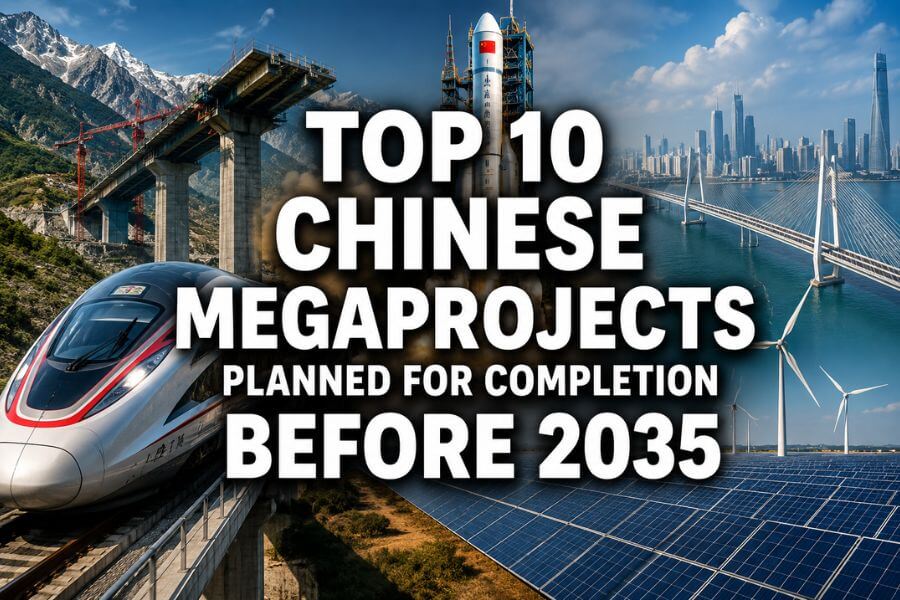
China is building some of the biggest and most ambitious infrastructure projects the world has ever seen. From massive high-speed rail systems to giant space stations and futuristic energy networks, these megaprojects are designed to reshape transportation, technology, trade, and daily life before 2035.
If you follow global development trends, you have probably noticed how quickly China moves when it comes to large-scale construction. Entire airports rise in just a few years. Railways connect distant cities at record speed. Huge clean energy projects stretch across deserts and coastlines. These projects are not only about national pride. They are also meant to boost economic growth, improve logistics, strengthen energy security, and increase China’s influence around the world.
In this article, you will discover the top Chinese megaprojects expected to be completed or reach major milestones before 2035. Some are already under construction, while others are entering key development stages. Together, they show where China is heading in the coming decade.
Quick Summary Table 🚄
| Rank | Megaproject | Main Purpose | Expected Completion |
|---|---|---|---|
| 1 | Sichuan Tibet Railway | Ultra challenging high speed rail link | Early 2030s |
| 2 | South to North Water Diversion Expansion | Water redistribution system | Ongoing through 2035 |
| 3 | BeiDou Global Navigation Expansion | Advanced satellite navigation network | Before 2035 |
| 4 | Xiong’an New Area | Future smart mega city | Major phases by 2035 |
| 5 | China Space Station Expansion | Permanent orbital research hub | Early 2030s |
| 6 | Coastal Nuclear Power Expansion | Clean energy generation | Through 2035 |
| 7 | Western China Renewable Energy Bases | Solar and wind super hubs | Early 2030s |
| 8 | Beijing Shanghai Maglev Line | Ultra fast magnetic rail system | Proposed before 2035 |
| 9 | Greater Bay Area Integration | Mega urban economic region | Major integration by 2035 |
| 10 | Deep Sea Research and Mining Network | Ocean exploration infrastructure | Before 2035 |
How We Ranked These Megaprojects 🏗️
We ranked these projects using several important factors:
- Overall construction scale
- Economic impact on China and global trade
- Technological innovation
- Difficulty of engineering and logistics
- Environmental and energy significance
- Influence on transportation and urban growth
- Long-term strategic value
- Estimated cost and investment size
- Expected effect on millions of people
- Likelihood of major progress before 2035
1. Sichuan Tibet Railway 🏔️
The Sichuan Tibet Railway may become one of the greatest engineering achievements of the modern era. This rail line aims to connect Chengdu in Sichuan Province to Lhasa in Tibet across some of the harshest terrain on Earth.
You are looking at a project that cuts through mountains, earthquake zones, deep valleys, and freezing high-altitude regions. Engineers must build thousands of bridges and tunnels to make the railway possible. Some sections sit more than 14,000 feet above sea level.
Once completed, travel times between Chengdu and Lhasa could drop dramatically. What currently takes days could eventually take only hours.
The project is important for several reasons. It strengthens transportation access to western China, boosts tourism, improves logistics, and supports economic growth in remote areas. It also demonstrates China’s confidence in tackling extreme infrastructure challenges.
Many experts believe this railway could become as famous as the Qinghai Tibet Railway, but it would be even more difficult to build.
2. South to North Water Diversion Expansion 💧
Northern China struggles with water shortages, while southern China has much larger freshwater supplies. The South to North Water Diversion Project was created to solve that imbalance on a gigantic scale.
This massive system moves water across hundreds of miles through canals, tunnels, reservoirs, and pumping stations. It is already one of the largest water engineering projects in human history.
Before 2035, China plans to continue expanding and modernizing the system to improve water delivery efficiency for major northern cities and industrial regions.
The project supports agriculture, manufacturing, and urban populations that depend on reliable water supplies. Without it, water stress in northern China could become a much larger economic problem.
At the same time, the project remains controversial because of environmental concerns and the relocation of local communities. Still, its scale and national importance make it impossible to ignore.
3. BeiDou Global Navigation Expansion 🛰️
China’s BeiDou satellite navigation system is often compared to GPS, but the country wants it to become far more advanced by 2035.
The next generation of BeiDou aims to provide ultra-precise positioning, navigation, and communication services across the world. It will support everything from smartphones and shipping to military operations and autonomous vehicles.
You may already use apps or devices connected to satellite navigation every day without thinking about it. China sees this technology as critical for future economic independence and national security.
The upgraded BeiDou network is expected to offer stronger global coverage, better accuracy, and improved integration with artificial intelligence systems.
As smart cities and self-driving transportation expand, satellite navigation systems like BeiDou will become even more valuable.
4. Xiong’an New Area 🏙️
Xiong’an New Area is one of China’s boldest urban development plans. Located southwest of Beijing, this futuristic city is designed to reduce pressure on the overcrowded capital while becoming a model for sustainable urban living.
Unlike many cities that grow naturally over time, Xiong’an is being carefully planned from the ground up. The government wants it to feature green transportation, advanced digital systems, energy-efficient buildings, and strong environmental protections.
You can think of it as a giant experiment in designing the city of the future.
Major infrastructure construction is already underway, including rail lines, government offices, housing developments, and business districts. By 2035, officials expect Xiong’an to become a major economic and technological center.
The project also represents China’s desire to lead in smart city development and urban innovation.
5. China Space Station Expansion 🚀
China’s space ambitions continue growing rapidly, and the expansion of its space station is one of the country’s most important long-term scientific projects.
The Chinese Space Station, also called Tiangong, is expected to receive additional modules, upgraded technology, and expanded research capabilities before 2035.
This orbital laboratory allows astronauts to conduct experiments in medicine, physics, biology, and materials science under zero gravity conditions.
China hopes the station will become an important international research platform in the coming years. As global interest in space exploration increases, the station could play a major role in future lunar and deep space missions.
For China, this project is about more than science. It is also about proving that the country can compete with the world’s leading space powers.
6. Coastal Nuclear Power Expansion ⚡
China is building nuclear reactors faster than almost any other country. By 2035, the nation plans to dramatically expand its coastal nuclear power network to reduce dependence on coal and improve energy security.
Many new reactors are being constructed along the eastern coastline near major industrial and population centers. These plants are designed to produce massive amounts of electricity with lower carbon emissions.
As you probably know, China’s energy demand is enormous. The country powers giant factories, megacities, data centers, and transportation systems that require constant electricity.
Nuclear energy is seen as one solution for balancing economic growth with climate goals.
The expansion also pushes China further into advanced reactor technology, including smaller modular reactors and next-generation safety systems.
7. Western China Renewable Energy Bases 🌞
China is investing heavily in giant renewable energy hubs across its western deserts and open plains. These regions receive strong sunlight and powerful winds, making them ideal for massive clean energy production.
Some projects include enormous solar farms that stretch farther than the eye can see. Others combine wind turbines, battery storage systems, and ultra-high voltage transmission lines.
The goal is simple but ambitious. China wants Western renewable energy bases to supply electricity to major eastern cities thousands of miles away.
Before 2035, these projects are expected to become some of the largest renewable energy systems on Earth.
This push is also important for global climate efforts. Since China is the world’s largest energy consumer, any shift toward cleaner energy has worldwide effects.
8. Beijing Shanghai Maglev Line 🚅
A future magnetic levitation rail line between Beijing and Shanghai could completely transform travel inside China.
Unlike traditional trains, maglev systems use magnetic force to eliminate friction. That allows trains to travel at extremely high speeds while remaining smooth and quiet.
If fully completed before 2035, passengers could potentially travel between China’s two biggest economic centers in only a few hours.
The project is still surrounded by technical and financial debates because maglev infrastructure costs are extremely high. However, China has already shown major interest in advanced rail technology and continues testing high-speed prototypes.
For travelers, business leaders, and logistics companies, such a line could change how people move across the country.
9. Greater Bay Area Integration 🌉
The Greater Bay Area project aims to connect major cities like Guangzhou, Shenzhen, Hong Kong, and Macau into one highly integrated economic region.
This plan includes bridges, tunnels, railways, airports, ports, technology hubs, and digital infrastructure. The idea is to create a mega region capable of competing with places like Silicon Valley and Tokyo Bay.
You can already see signs of this integration through massive transportation links like the Hong Kong Zhuhai Macau Bridge.
By 2035, officials hope the region will operate more smoothly as a connected economic powerhouse where people, goods, money, and technology move efficiently across city borders.
The project could affect hundreds of millions of people through trade, finance, tourism, and manufacturing growth.
10. Deep Sea Research and Mining Network 🌊
China is investing heavily in deep-sea technology, including underwater research stations, exploration vessels, and seabed mining systems.
The oceans contain valuable minerals that may become increasingly important for batteries, electronics, and renewable energy technologies. China wants to secure access to these future resources.
Before 2035, the country plans to improve its ability to explore and potentially extract materials from deep underwater environments.
This project also supports scientific research into marine ecosystems, climate patterns, and underwater geology.
Deep-sea development is still controversial because scientists worry about environmental damage to fragile ocean ecosystems. Even so, many governments see the oceans as the next frontier for strategic resources.
Conclusion 🌐
China’s megaprojects planned before 2035 show just how ambitious the country has become in infrastructure, technology, energy, and scientific research.
Some projects focus on solving practical problems like water shortages and clean energy demand. Others are designed to push the limits of engineering and innovation. Together, they reveal a country preparing for a future shaped by smart cities, advanced transportation, renewable power, and global technological competition.
Whether you admire these projects or question their environmental and economic costs, one thing is clear. Their impact will likely be felt far beyond China’s borders.
Over the next decade, these developments could influence global trade, transportation, climate policy, and even space exploration in ways that affect millions of people around the world.
Frequently Asked Questions ❓
Which Chinese megaproject is the most expensive?
The South to North Water Diversion Project is widely considered one of the most expensive infrastructure projects in Chinese history because of its enormous scale, engineering complexity, and long construction timeline.
Why is China investing so heavily in megaprojects?
China uses megaprojects to support economic growth, improve national infrastructure, increase energy security, strengthen global competitiveness, and create jobs across multiple industries.
Are these megaprojects environmentally friendly?
Some projects focus heavily on renewable energy and cleaner transportation, while others raise environmental concerns related to construction, ecosystem disruption, and resource use. The environmental impact varies by project.
Will China complete all these projects before 2035?
Some projects are expected to be fully completed before 2035, while others may only reach major milestones by then. Large-scale megaprojects often face delays because of technical, financial, or environmental challenges.
Which project could have the biggest global impact?
The renewable energy expansion projects may have the largest worldwide effect because they influence global carbon emissions, energy markets, and climate-related technology development.