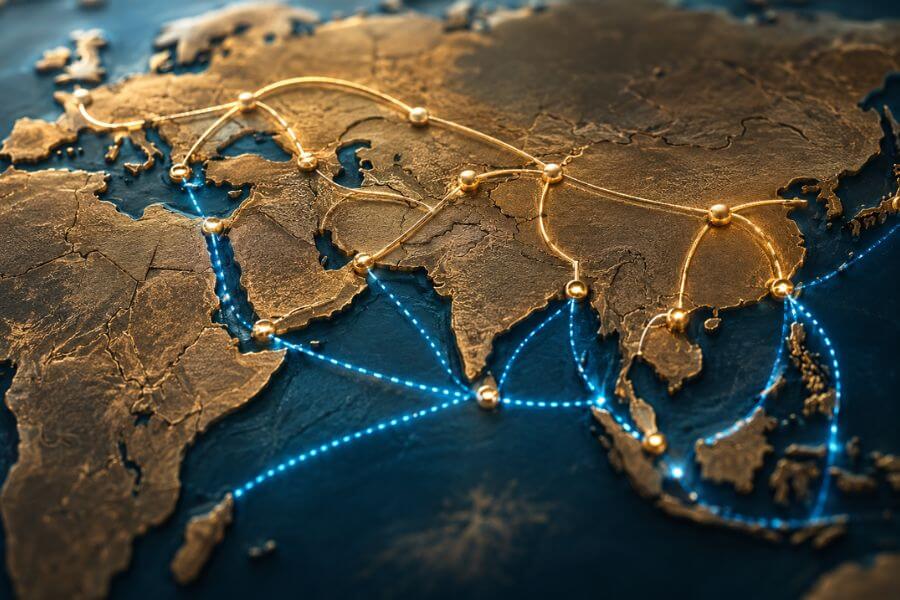
When people talk about China’s Belt and Road Initiative (BRI), they usually focus on giant loans, railways, ports, and political influence. But the story is much bigger than that. Since its launch in 2013, the Belt and Road Initiative has become one of the largest international development projects in modern history. It stretches across continents, connects hundreds of cities, and affects billions of people.
If you have only heard the headlines, you are probably missing some of the most surprising facts about the project. Some of these facts challenge common assumptions, while others reveal just how massive the initiative really is.
In this article, you’ll discover ten jaw-dropping facts about China’s Belt and Road Initiative that rarely get attention but help explain why it continues to shape the global economy in unexpected ways.
Quick Summary Table 📊
| # | Fact | Why It’s Surprising |
|---|---|---|
| 1 | More countries joined than expected | Participation reaches across multiple continents |
| 2 | It is not just about roads | Projects include digital, energy, and health sectors |
| 3 | Some routes revive ancient trade paths | Modern infrastructure follows historic connections |
| 4 | Ports are a major focus | Maritime projects are as important as railways |
| 5 | Energy projects dominate spending | Power infrastructure receives huge investments |
| 6 | The Digital Silk Road is expanding fast | Technology has become a major pillar |
| 7 | The project affects billions of people | Population impact is enormous |
| 8 | Many projects are located far from China | Reach extends deep into other regions |
| 9 | The initiative keeps evolving | New priorities emerge over time |
| 10 | Its scale is difficult to compare | Few global projects come close in size |
How We Ranked These Facts 🧠
We selected these facts based on several important factors:
- Global significance
- Economic impact
- Historical importance
- Scale and reach
- Public awareness level
- Long-term influence
- Uniqueness compared to other international projects
- Ability to challenge common misconceptions
1. More Countries Have Participated Than Most People Realize 🚆
Many people assume the Belt and Road Initiative mainly involves countries located near China. In reality, participation has spread far beyond Asia.
Countries across Africa, Europe, Latin America, and the Middle East have joined projects or signed cooperation agreements. This means the initiative reaches regions that many people never associate with China’s infrastructure strategy.
What makes this especially surprising is that some participating nations are located thousands of miles from China. The initiative has grown into a global network rather than a simple regional project.
When you look at a world map of participating countries, the scale becomes much more impressive than most headlines suggest.
2. It Is Not Actually Just About Roads and Railways 🚄
The name “Belt and Road” makes many people picture highways and train tracks. While transportation infrastructure remains important, the initiative has expanded into many other sectors.
Projects now include:
- Power plants
- Telecommunications networks
- Industrial parks
- Hospitals
- Data infrastructure
- Renewable energy facilities
- Educational partnerships
This broader scope means the initiative influences economic development in ways that go far beyond transportation.
If you think the BRI is only about moving goods from one place to another, you are seeing only a small part of the picture.
3. Many Routes Follow Ancient Trade Corridors 🏺
One fascinating aspect of the Belt and Road Initiative is its connection to history.
Several modern transportation routes closely mirror sections of the ancient Silk Road that connected China with Central Asia, the Middle East, and Europe centuries ago.
These historic trade networks helped spread:
- Goods
- Ideas
- Technologies
- Cultures
- Religions
China’s modern initiative intentionally draws inspiration from this legacy. The goal is not simply to build infrastructure but also to recreate major trade connections that once shaped global commerce.
This blend of ancient history and modern development is one of the most overlooked aspects of the entire project.
4. Ports Matter Just As Much As Railways ⚓
Most media coverage focuses on rail lines crossing continents. However, ports are among the most important components of the Belt and Road Initiative.
China has supported port development projects across numerous coastal regions around the world.
Why does this matter?
Because most international trade still moves by sea. Shipping remains one of the cheapest ways to transport large amounts of goods across long distances.
Improved ports can:
- Reduce shipping times
- Increase trade efficiency
- Support local economies
- Create logistics hubs
- Expand export opportunities
For many countries, upgraded ports may have an even greater economic impact than new railways.
5. Energy Projects Often Receive More Investment Than Transportation ⚡
One of the least discussed facts about the BRI is the enormous amount of money directed toward energy infrastructure.
Many Belt and Road investments involve:
- Hydropower plants
- Solar facilities
- Wind farms
- Electrical grids
- Transmission systems
- Conventional power stations
Reliable energy is essential for economic growth. Factories cannot operate efficiently without electricity, and cities need dependable power systems to expand.
In many cases, energy projects form the foundation that allows other infrastructure investments to succeed.
Without electricity, even the best roads and railways cannot unlock their full economic potential.
6. The Digital Silk Road Is Becoming a Major Force 💻
When the Belt and Road Initiative first launched, technology was not the main focus.
Today, digital infrastructure has become one of its fastest-growing components.
The Digital Silk Road includes projects involving:
- Fiber optic cables
- Data centers
- E-commerce systems
- Smart city technologies
- Telecommunications networks
- Digital payment platforms
As economies become increasingly connected online, digital infrastructure is becoming just as important as physical infrastructure.
This shift demonstrates how the initiative continues adapting to changing economic realities.
7. Billions of People Live in Regions Connected to the Initiative 👥
Perhaps the most astonishing fact is the number of people affected by Belt and Road projects.
The initiative touches regions that collectively contain a massive share of the world’s population.
This means improvements in:
- Transportation
- Energy access
- Digital connectivity
- Trade networks
can potentially influence the daily lives of billions of people.
Very few international development programs operate at a scale large enough to affect such a significant portion of humanity.
That alone makes the Belt and Road Initiative historically remarkable.
8. Some Projects Are Located Surprisingly Far From China 🌎
Many people assume Belt and Road projects stay concentrated around China’s borders.
The reality is very different.
Projects have appeared in regions including:
- Eastern Europe
- North Africa
- South America
- The Middle East
- Island nations
- Parts of Sub-Saharan Africa
This geographic diversity demonstrates that the initiative has evolved into a truly international strategy.
The distance involved often surprises people who only associate the BRI with nearby Asian trade routes.
9. The Initiative Has Changed Significantly Since 2013 🔄
Another overlooked fact is that today’s Belt and Road Initiative looks different from the version launched more than a decade ago.
Over time, priorities have shifted toward areas such as:
- Sustainability
- Renewable energy
- Digital infrastructure
- Financial efficiency
- Higher quality projects
Large international programs rarely stay static, and the BRI is no exception.
Understanding its evolution is important because many criticisms and assumptions are based on earlier phases rather than its current direction.
The initiative continues adapting to economic conditions, political realities, and global development trends.
10. Its Scale Is Almost Impossible to Compare With Other Projects 🌟
Many people hear about the Belt and Road Initiative without fully appreciating its sheer size.
The initiative spans:
- Multiple continents
- Hundreds of projects
- Numerous industries
- Vast transportation networks
- Diverse economic sectors
Few international infrastructure efforts in modern history have attempted something comparable.
Whether you support it, criticize it, or remain undecided, the scale alone makes it one of the most ambitious global development initiatives ever attempted.
That level of ambition is what continues to attract worldwide attention.
Conclusion 🎯
China’s Belt and Road Initiative is far more complex than the simple image of roads and railways that often appears in news coverage.
It stretches across continents, includes digital technology and energy development, revives historical trade routes, and potentially affects billions of people. Its enormous geographic reach and constantly evolving priorities make it one of the most significant international projects of the 21st century.
Whether viewed as an economic opportunity, a geopolitical strategy, or a mix of both, the Belt and Road Initiative continues to reshape global trade and infrastructure in ways that many people still underestimate.
The more closely you examine it, the more surprising facts you uncover.
Frequently Asked Questions ❓
Is the Belt and Road Initiative still expanding today?
Yes. While the pace and focus of projects have evolved, new partnerships and investments continue to emerge. Recent efforts often place greater emphasis on sustainability, technology, and higher-quality infrastructure.
Why is it called the Belt and Road Initiative?
The “Belt” refers to land-based economic corridors, while the “Road” refers to maritime shipping routes. The name draws inspiration from the ancient Silk Road trading networks.
Which regions benefit the most from Belt and Road projects?
The answer varies by project type. Transportation corridors, energy infrastructure, and digital networks can provide benefits to countries across Asia, Africa, Europe, the Middle East, and other participating regions.
Does the Belt and Road Initiative focus only on developing countries?
No. While many projects are located in developing economies, cooperation and investments have also involved countries with more advanced economies.
Why does the Belt and Road Initiative receive so much global attention?
It receives attention because of its massive scale, economic impact, strategic importance, and potential influence on international trade, investment, and geopolitical relationships for decades to come.