Key Takeaways
- COVA Online Registration: All applicants in the United States must use the official China Online Visa Application website to fill out forms and upload documents.
- No Travel Bookings Required: Since early 2024, United States citizens applying for a tourist visa are generally exempt from providing round-trip flight tickets, hotel reservations, or travel itineraries.
- The 10-Year Multi-Entry Benefit: United States passport holders are typically eligible for a ten-year multiple-entry tourist visa, allowing stays of up to sixty days per entry.
- Jurisdiction Enforcement: You must submit your physical passport and documents to the specific Chinese Embassy or Consulate-General that serves your home state.
- In-Person Submission: Once your online application status changes to a status indicating your passport is ready for submission, you or a designated agent must drop off your physical passport at the visa office. Mail-in services directly to consulates are not supported.
Getting to Know the Chinese Tourist Visa
Dreaming of walking along the winding stones of the Great Wall, exploring the neon-lit skyscrapers of Shanghai, or seeing giant pandas in Chengdu? To turn that dream into a reality, your very first step is securing a travel document known as the Chinese Tourist Visa, or the L Visa. This specific travel document is designed solely for international travelers who want to explore the country for vacation, sightseeing, or personal family visits.
For citizens of the United States, this travel document comes with a major benefit. Thanks to reciprocal agreements, most qualified American applicants receive a multiple-entry visa that remains valid for up to ten years. This means once you have this stamp in your passport, you can hop on a plane to China multiple times over the next decade without ever needing to reapply, provided your passport remains valid. Each individual stay generally allows you to explore for up to sixty days at a time.
It is vital to recognize that this document does not allow you to conduct business, attend university, or engage in paid employment while inside the country. If you attempt to work on an L Visa, you can face hefty fines or immediate deportation. Always ensure your travel goals match this specific category before moving forward with the paperwork.
Checking Your Passport Requirements
Before you open a single digital form or take a new portrait, you must take a close look at your physical passport. The Chinese government enforces strict guidelines regarding the condition and lifespan of your travel document. If your passport fails to meet these exact benchmarks, the electronic system or the consular officer will reject your submission immediately.
The Six-Month Rule
Your United States passport must possess a minimum of six months of validity remaining beyond your intended date of entry into China. For example, if you plan to touch down in Beijing on October 1, 2026, your passport cannot expire before April 1, 2027. If your expiration date falls anywhere inside that window, you must renew your United States passport through the domestic postal system before attempting to apply for your Chinese travel document.
Blank Visa Pages
Take a look inside your passport book and count the completely empty pages. You need a minimum of two blank pages facing each other. These pages must be entirely clear of any entry stamps, exit stamps, or small ink marks from previous international trips. The physical visa sticker takes up an entire page, and the border officers require adjacent space for entry and exit stamps when you pass through customs. Keep in mind that the amendment pages at the very back of an American passport book do not qualify as official visa pages.
Passport Condition and Style
Your passport book must be in pristine structural condition. If the plastic coating over your biographical photograph is peeling, if the stitching is loose, or if there is visible water damage on any page, the consulate will turn you away. Furthermore, the Chinese government does not accept twelve-page emergency United States passports for standard tourist visa processing. You must use a regular, full-size electronic passport book.
Navigating the Online Application System
The days of filling out paper documents with a black ink pen are long gone. The modern application workflow is completely digitized through the China Online Visa Application portal. This secure online platform manages your biographical data, cross-references your family history, and serves as the repository for your uploaded documents.
Setting Up Your Digital Account
Your journey begins by visiting the official portal hosted by the Ministry of Foreign Affairs. Look for the registration button in the upper-right corner of the screen. You will need a functioning, secure email address to establish your user account. Once you input your email, the system will send you a verification link or a one-time passcode. After activating your account and setting up a secure password, you can log in to start a fresh digital application form.
Filling Out the Nine Comprehensive Sections
The digital application form is incredibly detailed and requires absolute honesty. The questionnaire is split into nine distinct sections. You can save your progress as a draft and return to it later, which is highly recommended given the sheer volume of information required. The data must be typed in clear capital letters using English.
- Section One: Personal Information. This covers your full legal name exactly as it appears on your passport page, your birth date, your place of birth, and your current marital status. You must also disclose if you have ever held Chinese citizenship or any other foreign nationalities.
- Section Two: Type of Visa. Here, you select the L category for tourism. You will also input your desired visa validity and the number of days you plan to stay during your initial visit. Most American citizens select the maximum ten-year multiple-entry option.
- Section Three: Work Information. You must document your complete employment history spanning the past five years. This requires the formal legal names of your employers, their physical addresses, your monthly income, and a clear description of your daily job duties. Avoid using industry jargon or vague abbreviations.
- Section Four: Education Background. This requires you to list your highest level of schooling completed after high school. You must provide the name of the institution, your major field of study, and the exact dates of attendance.
- Section Five: Family Information. Expect to input the full names, nationalities, occupations, and physical locations of your parents, your spouse, and any children. Even if your parents are retired or deceased, their historical biographical details must be included.
- Section Six: Information on Your Travel. You will detail your estimated arrival date, the specific cities you wish to tour, and where you intend to sleep. Since the hard requirement for flight and hotel bookings was dropped for United States citizens, you can provide an estimated, logical plan of travel.
- Section Seven: Information on Previous Travel. This section asks if you have ever traveled to China in the past, held a previous Chinese visa, or traveled to any other international countries within the past twelve months. If you have an old visa, you will need to input its unique serial number.
- Section Eight: Other Information. This segment consists of security questions regarding your criminal background, any history of infectious diseases, or past visa denials from any global nation.
- Section Four: The Final Declaration. You must state whether you completed the form yourself or if a family member or travel agency filled it out on your behalf. You then check the box confirming that all details are true and correct.
Meeting the Strict Digital Photo Standards
One of the most common reasons an online application gets flagged or rejected by the digital system is an incorrect biographical photograph. The online portal utilizes automated facial recognition software to analyze your uploaded picture. If the lighting, dimensions, or angles are slightly off, the system will prevent you from moving forward to the document upload stage.
Size and Layout Benchmarks
The photograph must be a crisp, color image taken within the past six months. The dimensions must measure exactly forty-eight millimeters high by thirty-three millimeters wide. Your face must be centered perfectly within the frame, with the width of your head measuring between fifteen and twenty-two millimeters. The height of your face, from the bottom of your chin to the top of your hair, must fall between twenty-eight and thirty-three millimeters.
Background and Lighting Filters
The background must be solid, pure white. The system will reject images that feature off-white, light blue, grey, or textured backdrops. There cannot be any shadows falling across your face or casting onto the wall behind you. Ensure the lighting is evenly balanced across your skin tone so that your natural facial features are fully visible without overexposure.
Clothing and Appearance Rules
You should dress in dark, casual clothing that contrasts sharply against the white background. Do not wear white shirts, light cream tops, uniforms of any kind, or clothing with large military-style patterns. You cannot wear glasses, sunglasses, hats, caps, headbands, or heavy hair accessories in the photo. Religious head coverings are permitted only if they do not cover any part of your forehead, chin, or cheeks. Your ears must be visible, your mouth must be completely closed with no teeth showing, and your eyes must look directly into the camera lens.
Gathering Your Essential Supporting Documents
Once your biographical questionnaire is complete and your photo passes the automated check, you must compile a specific set of supporting documents. These items must be scanned and uploaded to the online portal as clear image files. PDF formats are generally blocked by the upload system, so stick to high-quality JPEG images.
Digital Scans of Your Passport
You must upload a crystal-clear, color scan of your main passport biographical page. This is the page containing your photograph, full name, and passport number. The scan must include all four corners of the page, and there cannot be any glare from the camera flash obscuring the text or numbers. You must also scan and upload a completely blank visa page from inside your current book to prove you have room for the physical sticker.
State-Issued Proof of Residency
The Chinese consulates divide the United States into specific geographic zones based on where you reside. To prove you are applying to the correct office, you must upload a photocopy of a document verifying your home address. Acceptable documents include a valid state driver’s license, a state identification card, a recent utility bill for water, electricity, gas, or home internet, or a recent bank statement showing your residential address. If you are applying for a minor child who does not have these documents, you must upload the residency documents of the parents alongside the child’s birth certificate.
Documentation for Former Chinese Citizens
If you were born in China but have since become a naturalized citizen of the United States, you must provide extra documentation during your very first visa application. You are required to upload a scan of your original Chinese passport showing your Chinese legal name. If your legal name changed upon naturalization, you must also provide the official court order or marriage certificate document detailing that change. If you have held a Chinese visa in the past, you simply need to upload a scan of that old visa sticker.
Understanding Consular Jurisdictions
The Chinese Embassy and its various Consulates-General enforce strict geographic borders within the United States. You cannot simply walk into any office that happens to be close to your vacation destination or workplace. You must submit your physical passport to the specific visa office assigned to the state where you legally live.
The Washington Embassy Zone
The main Chinese Embassy is located in Washington, District of Columbia. This office handles all online applications and physical passport drop-offs for residents living in the capital city, alongside Delaware, Idaho, Kentucky, Maryland, Montana, Nebraska, North Carolina, North Dakota, South Carolina, South Dakota, Tennessee, Utah, Virginia, West Virginia, and Wyoming.
The New York Consular Zone
The Consulate-General in New York City manages a massive population across the northeastern part of the country. If your permanent residence is located in Connecticut, Maine, Massachusetts, New Hampshire, New Jersey, New York, Ohio, Pennsylvania, Rhode Island, or Vermont, your application must route through this Manhattan office.
The Chicago Consular Zone
The Consulate-General in Chicago oversees the heart of the Midwest. This office holds jurisdiction over residents living within the states of Illinois, Indiana, Iowa, Kansas, Michigan, Minnesota, Missouri, and Wisconsin.
The San Francisco Consular Zone
Perched on the west coast, the San Francisco Consulate-General manages a major portion of the Pacific region. This visa office processes all tourist applications originating from northern California, Alaska, Nevada, Oregon, and Washington state.
The Los Angeles Consular Zone
Further south, the Los Angeles Consulate-General handles applications for residents of southern California, Arizona, Hawaii, New Mexico, and all United States Pacific island territories.
The Houston Jurisdiction Clarification
It is important to note that while the physical Chinese Consulate in Houston remains inactive, its historical geographic jurisdiction is managed by the main Embassy in Washington. If you reside in Texas, Arkansas, Florida, Georgia, Louisiana, Mississippi, Oklahoma, or Alabama, you will complete your online portal paperwork under the Washington Embassy track, and your physical documents must go to the capital city.
Submitting Your Physical Passport
After you submit your electronic form and upload all required image files, your application enters a preliminary digital review status. You must monitor your account daily for updates. Once the consular staff reviews your digital files and finds everything in order, your status will change to a phrase stating your passport is ready to be submitted. At this moment, you transition to the physical stage of the process.
The No-Appointment Drop-Off Protocol
As of the current timeline, most Chinese consular offices in the United States have eliminated the old appointment booking system for dropping off passports. Once you receive your digital green light, you can walk straight into the visa office during their designated morning business hours. You do not need to book a date or a specific time slot on a calendar.
In-Person Submission Options
The consulates do not accept physical passports sent directly through the United States Postal Service or commercial courier networks like FedEx or UPS. Your documents must be delivered by hand to the visa service windows. You have three main ways to accomplish this requirement:
- Walk-In Yourself: You can travel to the consular office in your jurisdiction, pass through the security checkpoint, take a numbered ticket, and hand your passport to the officer at the window.
- Entrust a Trusted Representative: You can authorize a family member, a trusted friend, or a work colleague to drop off your passport for you. They will need to bring your printed application summary page and a copy of their own identification.
- Hire a Professional Visa Agency: If you live far away from your regional consulate and cannot afford the time or expense of a road trip or flight, you can mail your secure documents to a private, third-party visa expediting agency located in that consulate’s city. A professional courier from that agency will then walk your passport to the window on your behalf.
What to Bring to the Visa Window
When you or your representative arrive at the physical consular window, you must present a specific bundle of hard-copy items:
- Your original, physical United States passport containing your blank pages and six months of validity.
- A printed copy of your online application confirmation page, complete with the unique alphanumeric barcode generated by the portal.
- Your physical, valid state-issued driver’s license or identification card to verify your identity and jurisdiction.
- Any old passports containing past Chinese visas if you are applying for a renewal or visa continuation.
Processing Timelines and Financial Fees
Once your physical passport is securely inside the hands of the consular staff, the waiting period begins. Understanding the financial costs and timeline parameters helps you avoid unnecessary travel anxiety as your departure date approaches.
Standard and Expedited Timeframes
The typical processing time for a Chinese tourist visa is four business days from the moment your physical passport is accepted at the window. For instance, if you successfully drop off your documents on a Monday morning, your passport will generally be ready for pickup on Thursday afternoon. If you are facing an urgent travel scenario, you can request expedited processing at the window, which reduces the waiting period to two or three business days for an additional financial fee.
The Visa Fee Structure
The consular fees for a Chinese visa are fixed based on your nationality rather than the length of the visa or the number of entries. For United States passport holders, the standard visa fee is one hundred and forty dollars. If you opt for expedited service, you must pay an additional fee. It is important to know that these fees are paid only when you pick up your finished visa, not when you drop it off.
Accepted Payment Instruments
The consulates are highly specific about how they accept money. They do not accept cash, personal checks, or corporate checks. You must pay using a valid credit card, such as Visa or Mastercard, or a pre-purchased cashier’s check or money order made out to the exact name of the specific Chinese Consulate-General you are utilizing. Ensure your credit card is active and matches the legal name on your identification.
Collecting Your Completed Visa
When your processing timeline wraps up and your online portal status shifts to show your passport is ready for collection, it is time to return to the consular building. This final step requires your physical presence or the coordination of your designated agent.
The Pick-Up Receipt Safe Keeping
When you dropped off your passport at the window, the consular officer handed you a small, physical piece of paper known as a pick-up receipt. This receipt features a unique tracking number and lists the exact date you can return to collect your items. This slip of paper acts like cash. Anyone who holds this physical receipt can walk into the consulate and claim your passport. Keep it in a secure location, as losing it will cause major administrative delays and require extra identity verification steps.
Verifying the Sticker Details
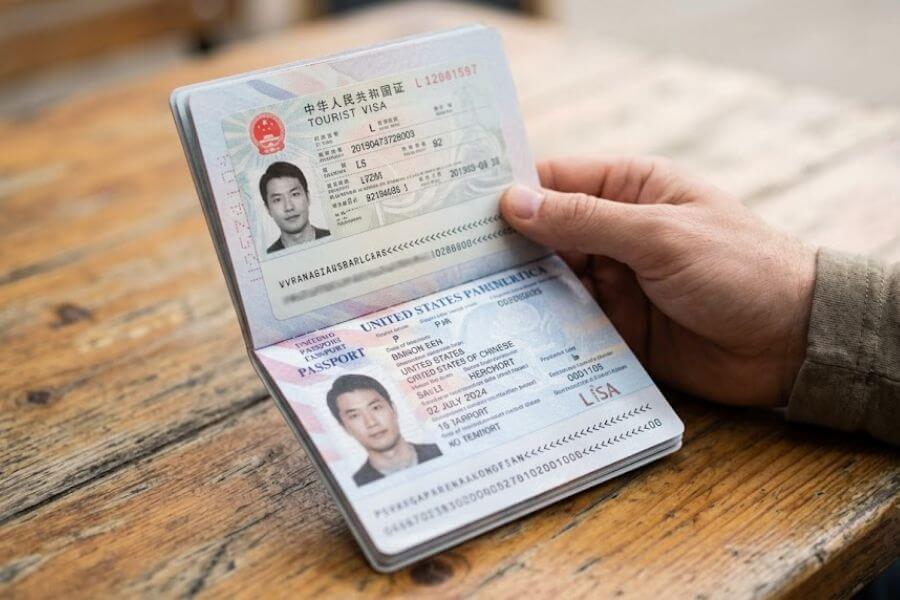
The moment the window clerk hands your passport back to you, step away from the line and open the book to examine the new colorful sticker. Do not leave the building until you have double-checked every single character printed on the visa face.
| Visa Field Name | What to Verify | Expected Standard for US Citizens |
| Category | Visa Class | Must print the letter L |
| Entries | Number of Visits | Should display M for multiple entries |
| Enter Before | Expiration Date | Should be exactly ten years from issuance date |
| Duration of Stay | Days per visit | Typically displays 60 days after entry |
| Passport Number | Identity Match | Must match your United States passport number exactly |
If you spot a typographical error, a misspelled name, or an incorrect passport digit, hand the book right back to the consular officer at the window. They will correct the mistake in their database and print a fresh sticker without charging you any additional fees.
Stepping Across the Chinese Border
Congratulations, your ten-year tourist visa is officially resting inside your passport book. However, your responsibilities do not end when your plane takes off from the United States. To ensure a smooth journey once you touch down on Chinese soil, you must follow a few final rules.
The Digital Arrival Card System
Foreign nationals traveling to China can complete their mandatory arrival card information digitally before boarding their flight. This digital option allows you to bypass the long paper-form lines at the airport customs counters. You can input your passport details, flight number, and destination address into the official National Immigration Administration portal ahead of time, generating a quick-response code on your smartphone to scan at the border gate.
The Twenty-Four-Hour Hotel Registration Law
China enforces a strict law requiring all international visitors to register their temporary physical accommodation with local law enforcement within twenty-four hours of arrival. If you are staying at a standard commercial hotel, an international hostel, or a registered resort, you do not need to worry about this rule. The front desk staff will scan your passport bio page and your visa sticker during check-in, automatically transmitting your data to the local police database.
However, if you choose to sleep at a private apartment, a residential home rented through an online marketplace, or the house of a local friend, you must handle this step yourself. You and your host must walk into the neighborhood police station with your physical passports, property deeds, or lease agreements to fill out a temporary residence form by hand. Failing to complete this step can lead to significant financial penalties or issues when you try to leave the country.
Carrying Your Identification
While exploring the historical alleys of Beijing or the shopping districts of Guangzhou, you must always carry your original physical passport with you. Local authorities have the legal right to request identification from foreign tourists at any time. A digital photo on your phone or a paper photocopy is not considered a valid substitute for the actual booklet. Keep your passport tucked safely inside an inner pocket or a secure travel pouch as you enjoy your journey.
Frequently Asked Questions
Can I apply for my tourist visa if I am currently living outside my home state?
You must apply to the specific Chinese consulate that holds jurisdiction over your official state of legal residence. If you are temporarily attending college or working in a different state, you can submit your application to the consulate serving that specific area, but you must provide hard proof of your local ties. This means uploading a copy of your current student identification card, an official university enrollment letter, or a long-term residential lease matching your current location. If you cannot provide this proof, you must route your application back through your home jurisdiction.
What should I do if my passport expires before my ten-year Chinese visa does?
This is a common scenario given the long lifespan of the tourist visa. If your United States passport is about to expire, do not panic, and do not attempt to peel the visa sticker out of your old book. Simply apply for a new United States passport through the standard domestic channels. When you pack your bags for your trip to China, you must carry both your expired passport containing the valid Chinese visa sticker and your brand-new, active United States passport book. The gate agents and border officers will inspect both documents together. Just ensure that your personal biographical data, such as your middle name and the spelling of your last name, matches perfectly across both books.
Is it possible to mail my passport directly to the consulate for processing?
The Chinese Embassy and its regional Consulates-General in the United States do not accept any physical visa applications or passports sent via postal mail or private courier services. If you mail your passport book directly to a consular office building, it will be rejected, marked as undeliverable, or sent back to you without a visa. You must either walk your document to the window in person, ask a trusted friend or family member to drop it off, or contract a private, professional visa expediting company to handle the physical delivery step on your behalf.
Do children and infants require their own separate tourist visa to visit China?
Every single traveler entering the country needs their own individual travel document, regardless of their age. Even a newborn infant must possess an independent United States passport and a matching Chinese visa sticker. When filling out the online form for a minor under the age of sixteen, a parent or legal guardian must complete the paperwork on their behalf and sign the final digital declaration section. Additionally, when submitting physical documents, you must include a copy of the child’s formal birth certificate alongside photocopies of both parents’ valid passports and state identification cards.