Whether you want to start a side business, launch an online store, or simply buy products directly from the manufacturing source, Alibaba is the massive digital marketplace that makes it possible. Navigating this vast network of international suppliers can feel like stepping into a whole new world. This deep dive will give you the complete roadmap to find great products, talk with suppliers, and get your items delivered safely to your doorstep in the United States.
Key Takeaways
Before you read the details, here is the golden rulebook for buying from Alibaba:
- Always Use Trade Assurance: Never send money outside Alibaba. Trade Assurance acts as a safety shield that protects your money until your goods arrive safely.
- Look for Gold Suppliers and Verified Status: Only buy from established businesses that have been on the platform for years and have passed independent inspections.
- Order Samples First: Never buy a large order without testing a single item first to check the quality with your own hands.
- Understand Shipping Terms: Learn your Incoterms like FOB and DDP so you know exactly who is paying for the boat or airplane, the customs duties, and the local delivery truck.
- Communicate Clearly and Safely: Keep all your chats inside the Alibaba messaging center so you have written proof if a problem ever pops up.
What is Alibaba and How Does It Actually Work?
Alibaba is a giant website that connects regular people and businesses with manufacturers, factories, and wholesale companies. Most of these suppliers are based in China, but you can find them all over the globe. Unlike online stores where you buy one t-shirt or a single pair of headphones, Alibaba is built for wholesale buying. This means you are usually buying items in bulk quantities.
When you buy in bulk, the price per item drops drastically. A water bottle that costs fifteen dollars at a local store in the United States might only cost two dollars on Alibaba. The catch is that you usually have to buy a minimum number of units. This number is called the Minimum Order Quantity, or MOQ.
Alibaba itself does not make products or ship them. It acts like a digital matchmaking service. It gives factories a place to display their items and gives you the tools to chat with them, negotiate prices, and pay securely. Because you are dealing directly with factories across the ocean, the process looks very different from standard online shopping. It requires patience, clear communication, and a basic understanding of international trade.
Setting Up Your Account the Right Way
Before you start looking at cool products, you need to set up your profile. This is your digital first impression. Suppliers on Alibaba get hundreds of messages every single day. They often ignore messages that look like spam or come from accounts that look fake.
When you sign up, use your real name and a professional-sounding email address. If you do not have an official business name yet, you can use your own name followed by “Sourcing” or “Trading.” Fill out your profile completely. Add a profile picture if you feel comfortable, and state clearly that you are an online retailer or a product researcher looking for long-term manufacturing partners in the United States.
Taking five minutes to make your profile look serious will pay off instantly. When a supplier sees a complete, professional profile, they will reply to your questions much faster. They will also take your price negotiations more seriously because they believe you might become a loyal, repeating customer who orders thousands of items in the future.
Finding Trustworthy Suppliers and Avoiding Scammers
The search bar on Alibaba is your portal to millions of products. But typing in a word like “backpack” will bring up thousands of suppliers. How do you know which ones are honest businesses and which ones are sketchy middlemen? You have to use the built-in search filters to weed out the bad options.
Use the Trade Assurance Filter
The absolute first box you should check on the left side of your screen is the Trade Assurance filter. This is non-negotiable. Trade Assurance is a free program run by Alibaba that protects your order from the moment you pay until the goods arrive at your door. If a supplier refuses to use Trade Assurance, close the tab and walk away immediately. There is zero reason for an honest supplier to avoid this protection.
Look for the Gold Supplier Badge
A Gold Supplier is a business that pays a premium membership fee to Alibaba to prove they are serious about their trade. While this badge alone does not guarantee perfection, it tells you that the company is a legitimate operation that has invested real money into their Alibaba presence. Look for suppliers who have held this Gold status for at least three to five years. A company that has been around for a long time is much less likely to disappear with your hard-earned money.
Demand Verified Suppliers
The ultimate stamp of approval on Alibaba is the Verified Supplier badge. This means a top-tier independent inspection company has physically walked into the factory. They checked the building, looked at their machinery, verified their business licenses, and confirmed that the factory can actually make the items they claim to sell. When you work with a Verified Supplier, you significantly reduce the risk of dealing with a fake company or a low-quality trading house.
Check the Supplier Online Profile and Reviews
Click on the company name and explore their main page. Look at their response rate, which tells you how fast they reply to messages. Aim for companies with a response rate above eighty-five percent. Read the reviews left by other buyers, especially those from the United States. Look for comments about communication speed, production delays, and material quality. If you see multiple complaints about items arriving damaged or looking completely different from the pictures, pass on that supplier.
Demystifying Factory Types: Manufacturers vs. Trading Companies
When you look at suppliers, you will come across two main types of businesses: manufacturers and trading companies. Knowing the difference between them is vital for your budget and your peace of mind.
What is a Manufacturer?
A manufacturer is the actual factory that owns the machines, employs the workers, and physically builds the product from raw materials. Buying straight from a manufacturer gives you the lowest possible price per item because there is no middleman taking a cut of the profit. It also makes it much easier to customize products, change colors, or add your custom logo because you are talking directly to the people making the item. The downside is that manufacturers usually have much higher Minimum Order Quantities because turning on giant machines for a small order is not worth their time.
What is a Trading Company?
A trading company does not make anything themselves. Instead, they act as a local middleman. They buy products from various smaller factories that do not know how to sell to foreigners, and then they list those items on Alibaba. Trading companies usually charge slightly higher prices because they need to make a profit too. However, they offer a few great benefits. They often have much lower Minimum Order Quantities, and they can help you bundle different types of products from separate factories into one single shipment.
Which Type Should You Choose?
If you have a large budget and want to create a totally unique product with custom packaging, look for a manufacturer. If you are starting out with a smaller budget, want to buy a few different types of items, and need lower order requirements, a trading company is often the perfect match for your business goals.
The Art of Professional Communication
Once you have a list of three to five great suppliers, it is time to reach out to them. The way you write your first message sets the tone for your entire relationship. Remember, many suppliers use translation software to read your English messages. You must keep your language clear, direct, and incredibly simple.
Do not write a massive paragraph of text. Instead, break your message down into clear, bulleted questions. Start with a friendly introduction, state the exact product you are looking at, and ask your initial questions one by one. Here is a solid list of things you should always ask in your very first message:
- What is your standard Minimum Order Quantity for this product?
- What is the cost per unit if I buy fifty units? What is the price for five hundred units?
- Can you add a custom logo to this item, and what is the extra cost?
- What is the standard production time for an order of this size?
- Are you able to send a single sample to the United States, and how much will that cost including shipping?
Keep your messages polite but professional. Avoid using slang words, local idioms, or confusing acronyms. If a supplier gives you vague answers or avoids answering your specific questions, it means they are either not paying attention or they are hiding something. Move on to a supplier who gives you clear, direct numbers and honest details.
The Sample Ordering Phase: Your Most Critical Step
Never skip the sample phase. It does not matter if the online pictures look stunning, and it does not matter how sweet the sales representative sounds over chat. You must hold the physical item in your hands before you send hundreds or thousands of dollars for a bulk order.
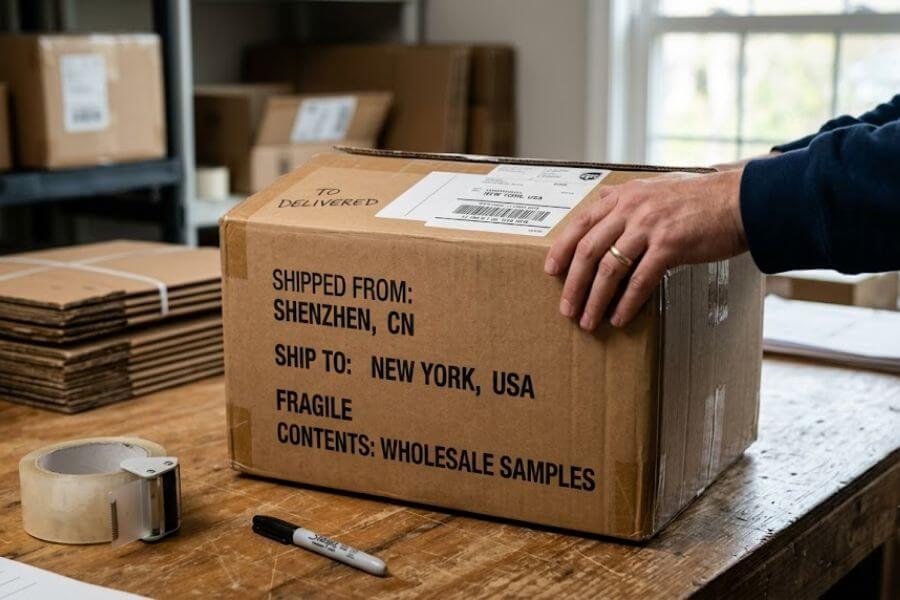
Suppliers will almost always charge you for a sample. While the product itself might only cost two dollars, shipping a single item across the ocean via express air courier usually costs anywhere from fifty to one hundred and fifty dollars. This is completely normal. Look at this expense as a cheap insurance policy. It is much better to spend one hundred dollars to find out a product is poor quality than to spend three thousand dollars on a mountain of unsellable trash.
When your sample arrives in the United States, test it aggressively. If it is a piece of clothing, wash it multiple times to see if it shrinks, fades, or falls apart at the seams. If it is an electronic device, plug it in, use every feature, and leave it running to see if it overheats. Drop it, stretch it, and use it exactly like a real customer would. If you find flaws, take clear photos and videos. Share them with the supplier to see if they can fix those issues during the main manufacturing run.
Understanding Pricing and Negotiating Fairly
Everything on Alibaba is open for negotiation, but you must be fair and realistic. If a supplier lists an item for five dollars, you cannot expect them to sell it to you for fifty cents just because you ask nicely. If you push for a price that is way too low, the factory will not lose money. Instead, they will simply use cheaper, lower-quality raw materials or thinner plastics to match your low price, leaving you with an inferior product.
When you negotiate, leverage the power of future growth. Do not just ask for a discount on your first small order. Instead, explain that you are launching a brand and testing the market. Tell them that if the quality of the first batch meets your high standards, you plan to order much larger quantities every single quarter. This gives the factory a real reason to give you a slight break on your initial order because they see you as a valuable long-term asset to their business.
Always ask for a breakdown of the costs. Find out exactly how much money goes toward the raw product, how much goes toward custom labeling, and how much goes toward the shipping boxes. Having these individual numbers makes it much easier to see where you can save a little bit of money without hurting the overall quality of the item.
Master the Rules of Shipping: Decoding Incoterms
Shipping is usually the most confusing part of buying from Alibaba. When products cross international borders, someone has to handle the boats, airplanes, truck drivers, customs paperwork, and taxes. To make this easy, the global trade world uses standardized three-letter codes called Incoterms. These codes tell you exactly where the supplier responsibility ends and where your responsibility begins. Let us look at the four most common shipping terms you will see on Alibaba.
EXW (Ex Works)
Under EXW terms, the supplier simply makes the products and leaves them sitting on their factory loading dock. Everything else is up to you. You have to hire a company to pick up the boxes, drive them to the foreign port, put them on a plane or ship, clear them through United States customs, and bring them to your house. This is a lot of work and is generally a terrible choice for beginners.
FOB (Free On Board)
FOB means the supplier will pack the goods, load them onto a truck, and drive them to the local sea port or airport in their country. They will also handle the local export customs paperwork. The moment the boxes are loaded onto the ship or airplane, the responsibility flips over to you. You are now in charge of the international journey, the United States customs fees, and the final delivery to your door. This is a very common option for businesses that use their own preferred shipping companies.
CIF (Cost, Insurance, and Freight)
With CIF shipping, the supplier pays for the goods to travel across the ocean or through the air to a major port in the United States, like the Port of Los Angeles or New York. They also pay for basic insurance against damage. However, once the ship docks in America, you have to take over. You are responsible for paying the heavy port fees, unloading charges, import duties, and hiring a local truck to bring the items from the port to your home.
DDP (Delivered Duty Paid)
For beginners and small business owners, DDP is the absolute gold standard of shipping terms. Under DDP, the supplier handles literally everything. They manufacture the products, arrange the international transport, pay all the export and import taxes, handle the United States customs clearance paperwork, and have a delivery service like UPS or FedEx drop the boxes right at your front door. It is a true hands-off, stress-free shipping experience. It costs more upfront, but it prevents any surprise bills from showing up later.
| Incoterm | Who Pays International Freight? | Who Handles US Customs? | Who Delivers to Your Door? | Best For |
| EXW | Buyer | Buyer | Buyer | Advanced Buyers with Logistics Networks |
| FOB | Buyer | Buyer | Buyer | Intermediate Buyers Using Freight Forwarders |
| CIF | Seller | Buyer | Buyer | Mid-size Businesses Near Major Ports |
| DDP | Seller | Seller | Seller | Beginners and E-commerce Store Owners |
Air Freight vs. Ocean Freight: Balancing Time and Budget
You have to choose how your goods will physically travel from Asia to the United States. Your choice will depend on the weight of your items, the total size of your boxes, and how quickly you need the inventory to arrive.
Air Express Courier
If your order is relatively small and weighs less than two hundred pounds, air express is usually your best option. This involves companies like DHL, FedEx, or UPS flying your boxes across the world. The best part about air express is the blazing fast speed. Your products will usually arrive at your home in the United States within five to seven business days. The process is fully automated, and you can track your boxes online every step of the way. The downside is that air shipping is expensive, making it a poor choice for heavy or large items.
Ocean Freight
If you are buying large furniture, hundreds of heavy metal water bottles, or thousands of books, air shipping will completely destroy your profit margins. In this scenario, you need ocean freight. Your boxes will be packed into a giant metal cargo container and loaded onto a massive ship traveling across the Pacific Ocean.
Ocean freight is incredibly cheap compared to air shipping, but it takes a massive amount of patience. A cargo ship can take anywhere from thirty to forty-five days to travel from a port in China to a port in the United States. Once the ship arrives, it can take another week for the port workers to unload the containers and clear customs. You must plan your inventory months in advance if you choose to ship by sea.
Navigating US Customs, Duties, and Taxes
Every time you bring products from another country into the United States, those items must pass through the watchful eyes of United States Customs and Border Protection. You cannot just sneak commercial goods into the country without declaring them.
The Role of the HTS Code
Every single product in the world has a specific classification number called a Harmonized Tariff Schedule code, or HTS code for short. This number tells the customs officers exactly what the item is and what materials were used to make it. Different products carry different tax rates. For example, plastic toys might have a zero percent tax rate, while cotton clothing might have a fifteen percent tax rate. Ask your supplier for the exact HTS code of your product so you can look up the duty rates ahead of time and calculate your exact expenses.
Understanding the Section 321 De Minimis Rule
Here is a brilliant piece of United States customs law that can save you a fortune when you are first starting out. Under a regulation known as Section 321, any shipment entering the United States with a total declared value of eight hundred dollars or less can enter completely duty free. This means if your total order, including the product cost, is under eight hundred dollars, you will not have to pay a single penny in import taxes or deal with complex customs paperwork. This makes small-scale testing incredibly affordable.
Working with a Customs Broker
If your bulk order is worth more than twenty-five hundred dollars, it triggers a formal customs entry process. This requires a legal document called a customs bond. Do not try to figure this paperwork out on your own. It is confusing, and a single mistake can result in your goods being seized or fined at the border.
Instead, hire a licensed professional called a customs broker. If you choose DDP shipping, your supplier or their shipping partner will automatically include a broker in the service. If you are shipping via FOB or CIF, you can hire an independent customs broker in the United States for a couple of hundred dollars. They will handle all the complex legal filings, pay the duties on your behalf, and make sure your inventory glides through the border without a hitch.
The Trade Assurance Checkout Process Step by Step
When it is finally time to pull out your wallet and pay for your bulk order, you must follow the official Alibaba Trade Assurance process. Never let a supplier talk you into using an outside payment method. Let us look at exactly how to execute a safe payment inside the platform.
Step 1: Review the Official Order Contract
The supplier will generate a digital invoice inside your Alibaba account dashboard. Do not just look at the total price and click buy. Open the detailed view and read every line carefully. Ensure the contract lists the exact number of items, the correct colors, the precise materials, the chosen Incoterms, and the agreed-upon shipping deadline date. If you discussed specific quality standards in your chat, make sure those details are written directly into the contract text. If a dispute happens later, Alibaba will only look at what is written in this contract, not what you said in a casual chat.
Step 2: Choose Your Payment Method
Alibaba offers several secure ways to pay for your Trade Assurance order. You can use a standard credit card, which is fast and secure but carries a transaction fee of around three percent. For large orders worth thousands of dollars, a bank wire transfer, also known as a T/T transfer, is usually better because it charges a low flat fee. Alibaba also supports modern payment options like Apple Pay and PayPal. Pick the method that makes you feel most comfortable and matches your budget.
Step 3: Understand the Two-Part Payment System
For most bulk orders, factories do not expect you to pay one hundred percent of the cost upfront. The standard industry practice is a thirty-seventy split. You pay a thirty percent deposit to jumpstart the manufacturing process. The factory will use this cash to buy the raw materials and start building your items. The remaining seventy percent balance is paid only after the production is totally finished and the goods pass a quality inspection, right before they are loaded onto the ship or plane.
Protecting Your Investment with Third-Party Inspections
Imagine waiting forty days for a massive ocean shipment to arrive at your home in the United States, only to open the boxes and realize that half of the items are broken, scratched, or the wrong color. Sending them back to Asia is financially impossible. You would be stuck with a massive financial loss. How do you prevent this nightmare? You hire an independent, third-party inspection company to check the goods before they leave the factory floor.
An inspection is surprisingly affordable. For around two hundred to three hundred dollars, you can hire a professional inspection company like QIMA or V-Trust. These companies have native inspectors located in every major manufacturing city in Asia.
On the day production wraps up, the inspector will walk directly into the factory. They will pull random boxes off the assembly line, count the items to ensure the total number is correct, test the products using specialized tools, and check the packaging strength. They will send you a highly detailed digital report packed with hundreds of high-resolution photos and videos within twenty-four hours.
If the report shows everything is flawless, you can confidently send the final seventy percent payment balance to the supplier. If the inspector uncovers serious defects, you can tell the supplier that you will not release the final payment until they fix those specific errors. This gives you massive leverage and guarantees that only top-quality goods leave the factory doors.
What to Do When Your Shipment Arrives in the USA
The delivery truck has just pulled up to your property, and the driver is unloading your boxes. Your exciting journey is almost complete, but your job is not quite done yet. You need to act quickly to ensure everything is perfect.
As the driver unloads the boxes, carefully inspect the outside of the cardboard cartons. If you notice any crushed corners, large holes, or water damage, take clear pictures immediately before signing the delivery receipt. Note any visible outer box damage on the delivery paperwork. This provides crucial proof if items inside were smashed during transit and you need to file an insurance claim.
Bring the boxes inside and start opening them immediately. Do a physical head count to verify that you received the exact number of items you paid for. Pick random products from different boxes and test them out to make sure they function beautifully.
Alibaba gives you a specific window of time, usually around fifteen days after delivery, to file a formal dispute if something is wrong with your Trade Assurance shipment. Do not leave the boxes sitting in your garage or warehouse unopened for weeks. Check them immediately so you can raise any concerns with the supplier or Alibaba support while your safety window is still wide open.
Building a Lucrative Long-Term Relationship with Suppliers
The most successful global importers do not constantly hop from one supplier to another looking for the absolute cheapest price. Instead, they find one excellent, reliable supplier and treat them like an essential business partner.
When you find a factory that delivers great quality on time, protect that relationship. Pay your invoices promptly, communicate with kindness, and praise their hard work when an order turns out beautifully. As your order volume grows over the months and years, your loyalty will pay off significantly.
Factories will often reward their favorite repeat customers with major perks. They might lower your Minimum Order Quantities for new product rollouts, give you preferential production scheduling during busy holidays like Chinese New Year, offer extended payment terms, or give you first access to brand new, cutting-edge item designs before they are released to the general public. A strong, respectful bond with your supplier is a massive competitive advantage for your brand.
Frequently Asked Questions
Can a regular person buy from Alibaba, or do I need an official registered business license?
You do not need an official business license or a registered company name to buy products on Alibaba. Anyone can sign up for a free account, browse the marketplace, and chat with suppliers. When a supplier asks for your business details, you can simply explain that you are an independent online retailer or an entrepreneur starting a new product line. The factories care much more about your ability to meet their Minimum Order Quantities and pay your invoices on time than they do about your official government paperwork.
What should I do if a supplier asks me to pay them outside the Alibaba platform?
If a supplier asks you to send money directly to their private bank account, Western Union, or a personal digital wallet outside of Alibaba, refuse immediately. This is a massive red flag. The moment you move your money off the official Alibaba platform, you completely lose all your Trade Assurance protections. If the supplier runs off with your cash or sends you boxes filled with rocks, Alibaba cannot help you get your money back. Keep all communications and payments strictly inside the official Alibaba ecosystem to keep your funds secure.
How long does it usually take for products to arrive in the USA after I place an order?
The total timeline depends on your chosen shipping method and the factory production schedule. First, the factory needs time to make your goods, which typically takes anywhere from fifteen to thirty days. Once production wraps up, air express courier shipping will get the items to your United States doorstep in about five to seven business days. If you choose sea freight, the transit across the ocean, through customs clearance, and onto a local delivery truck usually takes an additional thirty to forty-five days. Always map out your inventory needs at least two to three months in advance.
What exactly happens if my products arrive broken, defective, or completely wrong?
If your shipment arrives with quality issues, take clear high-resolution photos and videos of the defects immediately. Open a formal dispute inside your Alibaba account dashboard before your protection window expires. Submit your evidence, including your third-party inspection reports and photos of the damage, directly to the Alibaba support team. Alibaba will review the contract terms you agreed upon. If they find the supplier failed to meet those specifications, they will step in and force a partial or full refund of your money through the Trade Assurance program.
Are there any specific items that are illegal or dangerous to import into the United States?
Yes, the United States has very strict rules about what can enter its borders. You must avoid importing counterfeit goods, fake designer logos, weapons, illegal substances, and unregulated medical devices. Items that come into contact with food or skin, like kitchenware, cosmetics, and baby toys, often require special safety certificates from agencies like the Food and Drug Administration or the Consumer Product Safety Commission. Always research local United States safety regulations for your specific product category before placing a bulk order to ensure your inventory does not get seized and destroyed by customs officers.