Key Takeaway
Booking bullet train tickets in China is simple once you know how the system works. The official 12306 platform or reliable third-party apps make it seamless for foreign travelers using a passport. Plan ahead, book early, and understand the difference between seat classes to ensure a smooth, ultra-fast journey across the country.
Imagine boarding a vehicle that glides so smoothly your coffee cup never ripples, while the landscape outside blurs past at two hundred miles per hour. This is the reality of traveling on China’s massive high-speed rail network. It connects almost every major city, from the historical streets of Beijing to the futuristic skyline of Shanghai, and even the mountain valleys of Guilin. If you want to explore this vast country like a local, mastering the online booking system is your first and most important step. Let us dive straight into how you can secure your seats from the comfort of your own screen.
Understanding the China Railway Network
Before you click buy, you need to understand what you are actually booking. China’s railway system is massive, clean, and incredibly punctual. High-speed trains are generally categorized by letters, which tell you exactly how fast you will be moving and what kind of experience to expect.
The Magic Train Letters
When you search for routes online, you will notice train numbers starting with G, D, or C.
- G-Trains (Gaoti): These are the absolute fastest trains on the tracks. They usually travel at speeds between 186 to 217 miles per hour (300 to 350 kilometers per hour). They connect the biggest metropolitan hubs and have the fewest stops. If you want to get somewhere in record time, always look for a G-train.
- D-Trains (Dongche): These are the second-fastest tier, usually running at around 124 to 155 miles per hour (200 to 250 kilometers per hour). They cover long distances and often include overnight sleeper options on certain routes. They are slightly cheaper than G-trains but still incredibly comfortable.
- C-Trains (Chengji): These are short-distance intercity trains. They connect neighboring cities, like Guangzhou and Shenzhen, or Beijing and Tianjin. They are fast, frequent, and operate almost like a high-speed subway system between major regions.
Traditional Slow Trains
You might also see letters like Z, T, or K, or just plain numbers. These are the traditional regular-speed trains. They are much slower, often taking twice as long as a high-speed train, but they are very cheap and offer a historic, classic rail experience. For the purposes of this guide, we are focusing entirely on the fast, modern G, D, and C options.
Choosing the Right Booking Platform
You have a few great choices when it comes to booking your tickets online. Each option has its own set of advantages depending on how comfortable you are with navigating international payment systems or official government apps.
The Official 12306 Website and App
China Railway operates an official platform called 12306. It comes in both a website format and a mobile app version.
- The Pros: This is the direct source. There are zero service fees, processing charges, or hidden markups. You get real-time seat availability, and refunds or changes happen instantly. The app now has a fully translated English version specifically designed for international travelers.
- The Cons: The registration process can sometimes feel a bit strict. You have to input your passport information exactly as it appears, and the platform goes through a verification phase that can take anywhere from a few minutes to a few hours.
Third-Party Travel Agencies
If you prefer an interface that feels more familiar to international hotel or flight booking sites, third-party apps like Trip.com or China Highlights are excellent alternatives.
- The Pros: These platforms are fully optimized for global users. They accept almost every international credit card without issue, offer twenty-four-seven customer service in multiple languages, and allow you to submit booking requests weeks before the official tickets even go on sale.
- The Cons: They charge a small service fee per ticket, usually ranging from two to five dollars. While this is minor, it can add up if you are booking multiple trips for a large family.
Comparing Your Online Booking Options
| Feature | Official 12306 App | Trip.com / Third-Party |
| Service Fee | Absolutely None | Small fee per ticket |
| Language Support | English and Mandarin | Multiple global languages |
| Advance Requests | Only when window opens | Pre-booking available early |
| Payment Options | WeChat, Alipay, Visa, Mastercard | International Cards, PayPal, Apple Pay |
| Support Hours | Specific daytime hours | Twenty-four-seven support |
The Step-by-Step 12306 Registration Process
Since the official 12306 app is the cheapest and most direct way to buy tickets, let us walk through exactly how to set up your account. Doing this before your trip will save you a massive amount of stress.
Downloading the App
Search for “12306” in your smartphone app store. Look for the official blue icon featuring the white railway logo. Download it and open the settings to toggle the language to English if it does not automatically detect your phone’s system language.
Entering Your Personal Information
Click on the registration tab. You will need to fill out a form with extreme accuracy.
- Account Details: Choose a secure username and password that you will easily remember.
- Name Format: Enter your name exactly as it appears on the machine-readable zone at the bottom of your passport. Do not use spaces if your middle name is fused together with your first name on your document. Avoid punctuation marks.
- Document Type: Select “Passport” from the drop-down menu.
- Passport Number: Double-check every single digit. A single typo means you will not be allowed past the station security gates.
- Contact Information: Enter your email address and your mobile phone number. The app accepts international phone numbers, so just make sure to select your correct country code from the list.
Understanding Passport Verification
Once you submit your form, the system checks your identity. In the past, travelers had to take their physical passport to a station window to get verified. Now, the system handles this electronically. It usually takes a short while for the status next to your name to change from “Reviewing” to “Verified.” You cannot purchase tickets until this status updates to green, so do not wait until the day of travel to sign up.
Mastering the Booking Timeline
Timing is everything when it comes to Chinese train travel. With over a billion people living in the country, popular routes can sell out within seconds of becoming available.
The Fifteen-Day Window
Official ticket sales open exactly fifteen days before the departure date at a specific time, which varies depending on the departure station. If you want to travel on the twentieth of the month, you need to be ready to buy on the fifth of that month.
Pre-Booking Strategies
If you are using a third-party app, you do not have to wait for the fifteen-day mark. You can input your desired dates and train numbers months in advance. The app will hold your money and your information in a queue. The absolute second the official railway system opens the fifteen-day window, the app’s automated software will instantly try to grab the seats for you. This is a brilliant stress-free option for high-demand holiday seasons.
Peak Travel Seasons to Avoid
There are times of the year when buying a train ticket becomes a competitive sport. If possible, try to avoid traveling during these massive holiday periods:
- Spring Festival (Chinese New Year): This occurs around January or February. It is the largest human migration on earth, as hundreds of millions of people go home to visit family. Tickets are nearly impossible to get.
- Golden Week: This starts on October first and lasts for seven days. The entire nation goes on vacation, and tourist spots, as well as trains, are completely packed.
- Labor Day Holiday: This happens around the first week of May and sees a massive surge in regional travel.
Decoding the Seat Classes
High-speed trains offer several tiers of comfort. Knowing what you are paying for helps you choose the right balance between your budget and your desire for personal space.
Second Class
This is the standard option and the most popular way to travel. The seats are arranged in a three-by-two layout across the aisle.
- What to Expect: The seats are clean, comfortable, and offer significantly more legroom than a standard economy airplane seat. Every row generally has access to a power outlet located underneath the middle seat or near the floor. It can get a bit noisy because it is popular with families and group travelers, but it is an outstanding, cost-effective choice.
First Class
If you prefer a quieter environment and a bit more breathing room, upgrade to first class. The layout here is a spacious two-by-two configuration.
- What to Expect: The seats are wider, plushier, and recline further. You get a larger tray table, a deeper footrest, and sometimes a small complimentary snack or bottle of water. The cabins are noticeably quieter, making it ideal if you need to get some work done on your laptop or want to take a peaceful nap.
Business Class
This is the ultimate luxury experience on rails. It is often more expensive than a domestic flight ticket, but it feels like a private first-class airplane cabin. The layout is usually a one-by-two or one-by-one setup.
- What to Expect: The seats can transition into completely flat beds at the touch of a button. You are provided with noise-canceling headphones, a soft blanket, real slippers, and high-quality hot meals served by dedicated attendants. Business-class passengers also get access to private VIP lounges at the railway stations, allowing you to skip the main crowded waiting halls entirely.
Comparison of High-Speed Train Seat Classes
| Seat Class | Seating Layout | Legroom Level | Noise Level | Price Multiplier |
| Second Class | Three-by-two | Generous | Moderate to Loud | Baseline Price |
| First Class | Two-by-two | Extra Wide | Quiet and Calm | Around 1.6x |
| Business Class | One-by-two / Flat | Maximum Bed | Silent and Private | Around 3.0x |
Navigating the Payment Process Online
Paying for things online in China used to be a major hurdle for visitors, but the digital landscape has opened up tremendously for international travelers.
Using International Credit Cards
Both the official 12306 app and major third-party apps now accept international Visa, Mastercard, JCB, and Diners Club cards. When you reach the payment screen, simply select the international card option. You will likely trigger your bank’s two-factor authentication system, so make sure you can receive text message codes or code generator notifications while you are completing the purchase.
Mobile Wallets: Alipay and WeChat Pay
If you want to feel like a true local, set up Alipay or WeChat Pay on your phone before you travel. You can link your international credit card to these Chinese digital wallets.
- Why it helps: Once linked, you can pay for your train tickets inside the 12306 app with a single click or by scanning a quick-response code. It is incredibly fast, rarely fails, and prevents your home bank from blocking transactions out of suspicion of overseas fraud.
Managing Your Bookings, Changes, and Refunds
Plans change, especially when you are exploring a new country. The digital railway system makes altering your journey remarkably flexible, provided you follow a few basic rules.
Changing Your Ticket
If you miss your train or want to leave earlier, you can alter your ticket online. You are allowed one free change per ticket to a different train on the same route, as long as you make the change before the train departs or within a specific time window after departure if seats are available. If the new ticket is cheaper, the system automatically refunds the difference. If it is more expensive, you pay the extra amount.
The Refund Policy
If you need to cancel your trip entirely, you can do so directly in the app. The cancellation fees depend heavily on how close you are to the departure date.
- Over eight days out: Free cancellation with a full refund.
- Forty-eight hours to seven days out: A small fee of five percent of the ticket price.
- Twenty-four to forty-eight hours out: A fee of ten percent of the ticket price.
- Less than twenty-four hours out: A fee of twenty percent of the ticket price.The money is always credited back to the exact payment method you used to purchase the ticket, though it can take a few business days to show up on international card statements.
Understanding the E-Ticket System
The days of standing in long station lines to pick up paper train tickets are completely gone. China’s railway network runs entirely on a paperless passport-based electronic ticket system.
How Your Passport Acts as Your Ticket
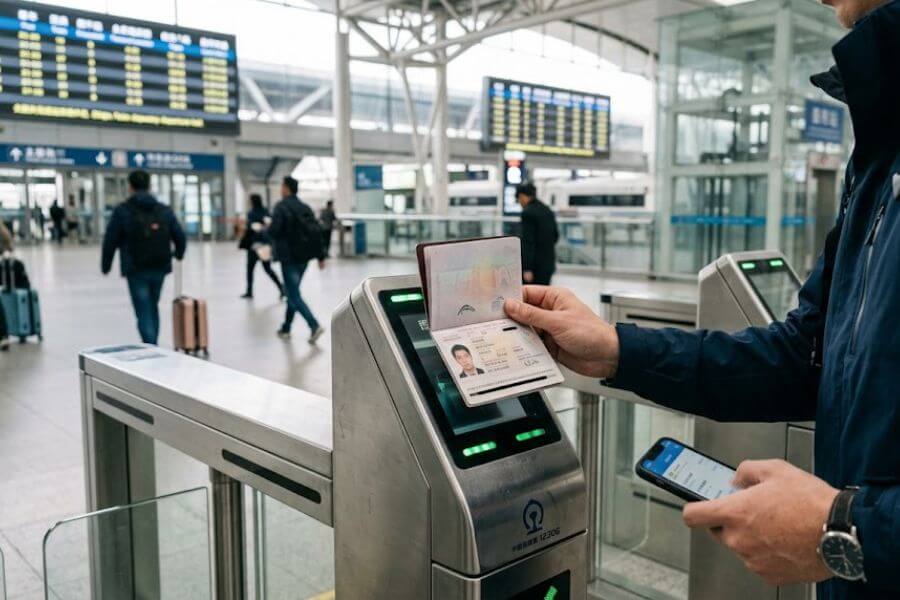
When you complete an online booking, your ticket is digitally tied directly to your passport number. There is no physical document to print, and there is no special mobile barcode that you need to scan at the gate. Your passport is your ticket.
Going Through Station Security
When you arrive at the high-speed railway station, follow these steps to get to your train smoothly:
- The Main Entrance: Look for the security lanes. Some lanes are automated with facial recognition screens, but these are only for citizens with Chinese national identity cards. Look for the manual lane, which is usually marked for staff or passengers using global passports.
- The Identity Check: Hand your physical passport to the station officer. They will scan it using a digital reader, verify your photo, and check it against the nationwide database. Your electronic ticket will pop up on their screen, and they will wave you through to the security baggage scanners.
- The Boarding Gate: Once inside the giant departure hall, look at the big overhead screens to find your train number and its corresponding boarding gate. When the gate opens, walk down the manual passport lane again, let the attendant scan your document, and head down to the platform.
Survival Tips for the Station and Onboard Experience
Booking the ticket is only half the adventure. Knowing what to expect once you step inside the massive concrete and glass railway stations will make you feel completely confident.
Arrive with Time to Spare
High-speed railway stations in China are structured much like international airports. They are massive, often multi-story buildings that require walking long distances. Arrive at least forty-five to sixty minutes before your scheduled departure time. Boarding gates close strictly around three to five minutes before the train leaves the station, and they will not hold the doors for anyone.
Finding Your Car and Seat Number
Look at your digital booking confirmation on your phone. You will see two vital numbers: your coach number (Checi) and your seat number (Zuowei).
- Platform Markings: When you walk down to the outdoor platform, look at the floor. You will see colored tracks and digital signs painted on the ground indicating exactly where each coach number will stop. Stand in line at your corresponding coach number so you can step right onto the train without fighting through a crowd inside the narrow aisles.
- Seat Letters: Seats in second class use letters A, B, C, D, and F. A and F are always window seats, while C and D are aisle seats. B is the middle seat in the three-row section.
Luggage Storage and Rules
There are no strict baggage weight checks like you experience at an airport, but you do need to be able to carry and lift your own bags.
- Where to put it: Small and medium bags fit perfectly onto the overhead racks that run along the entire length of the cabin. Large, heavy suitcases can be placed in the dedicated luggage racks located at the front or back of each individual passenger car.
Food, Drinks, and Onboard Comforts
High-speed trains are built for long journeys, meaning your basic needs are well looked after.
- Hot Water Dispenser: Every single car is equipped with a clean hot water machine located near the restrooms. Bring a reusable insulated bottle or a container of instant noodles, which is what the majority of local passengers do.
- The Dining Car: There is usually a central dining car on the train that sells packaged snacks, hot tea, coffee, and pre-packaged microwaved bento boxes containing rice, vegetables, and meat.
- Restrooms: Every car features clean restrooms. Most trains provide both a Western-style sit-down toilet and a traditional Asian squat toilet. Always carry a small pack of pocket tissues and some hand sanitizer with you, as toilet paper can occasionally run out during long-distance journeys.
Frequently Asked Questions
Can I book high-speed train tickets if I do not speak any Mandarin?
Yes, you absolutely can. The official 12306 mobile application features a complete English interface that covers searching, account creation, and checkout. Third-party travel applications like Trip.com are also fully operational in English and several other global languages, offering multilingual customer care teams to handle any issues that might pop up during your trip.
What should I do if my passport name does not match my booking exactly?
If you realize there is a spelling mistake or your names are out of order on your booking, you should cancel the ticket immediately and rebook it with the correct information. The station gate officers check names with precision. If a single letter on their computer screen fails to match your physical passport page, security will deny you entry to the platform, and you will have to buy a brand-new ticket at the station window.
Is it possible to buy train tickets on the day of departure?
You can buy tickets on the exact day of your travel either online or at the station ticket windows, provided there are empty seats left. However, popular fast routes between major business hubs or tourist hot spots fill up days in advance. Relying on last-minute purchases is highly risky if you have a strict schedule or a flight to catch.
How do I know which railway station to choose in cities with multiple options?
Mega-cities like Shanghai, Beijing, and Guangzhou have several different train stations, often named after cardinal directions like Beijing South or Shanghai Hongqiao. High-speed trains almost exclusively use the modern, newly built stations that include words like “South,” “East,” or “West.” When booking online, check which station connects directly to your hotel via the local subway network to save yourself a long, expensive taxi ride after you arrive.
What happens if I accidentally miss my scheduled high-speed train?
If you miss your departure, do not panic. Open your mobile app or head straight to a manual station ticket window. If there are other trains running along that exact same route later that day, you can alter your ticket to a later time slot completely free of charge. Note that this option expires at midnight on the day of your original departure, and it depends entirely on whether the later trains have open seats available.