Key Takeaways
- The Top Choices: ICBC, Bank of China, and China Construction Bank are your best bets due to their extensive experience with international clients and robust mobile apps.
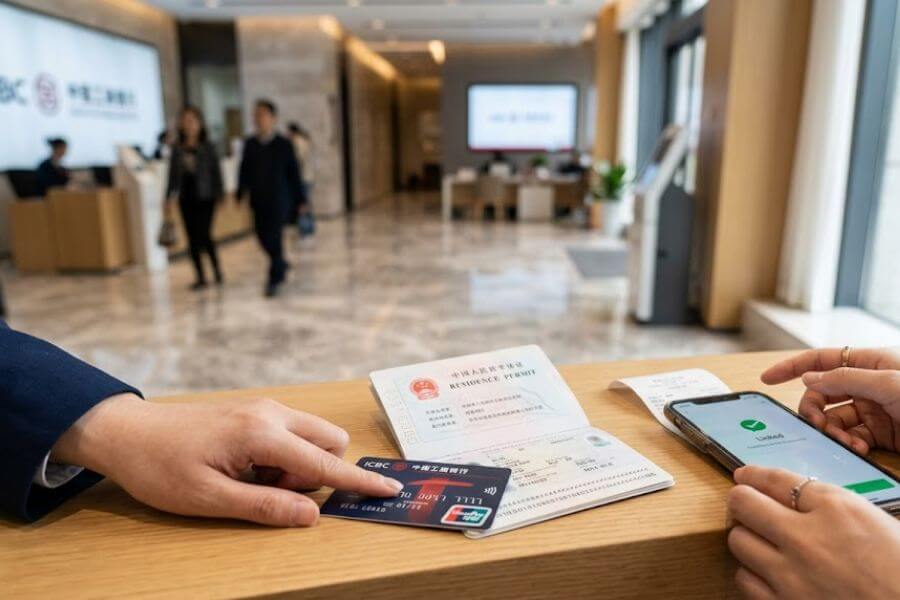
- Essential Documents: You absolutely must bring your valid passport, a long-term visa (residence permit, student visa, or work visa), a local Chinese phone number, and proof of your tax status from your home country.
- The Magic Link: A Chinese bank account is the single key that unlocks local mobile payment giants like WeChat Pay and Alipay, which you need for daily life.
- Preparation Wins: Always request a debit card that uses the UnionPay network and explicitly ask the clerk to activate international roaming capabilities for your online banking.
The Reality of Cash in the Modern Chinese Economy
Imagine walking into a sleek, brightly lit coffee shop in downtown Shanghai. You smell the freshly ground espresso beans, hear the steam wand hissing, and see a line of people tapping their smartphones against small plastic stands. You reach into your pocket, pull out a crisp, red one-hundred-yuan bill, and hand it to the young barista. The barista looks at the bill, looks up at you with a wide eye, and then calls over a manager to hunt for physical change in a dusty drawer.
This scenario happens every single day to travelers and new arrivals across mainland China. The country has skipped the credit-card era almost entirely, moving directly from paper bills to a completely digital marketplace. Today, everything from a bundle of fresh scallions at a neighborhood street market to a luxury electric vehicle is purchased through a smartphone screen.
As a newcomer, you might manage to get around for a few days by linking an international credit card to a local payment application. However, you will quickly hit a wall. International cards frequently face random rejections, carry annoying foreign-exchange fees, and cannot be used to receive money from local friends, pay utility bills, or collect a salary. If you plan to live, study, work, or spend an extended period in the country, setting up a local financial account is not just a convenient choice. It is the very first thing you need to do to make your daily life run smoothly.
The Major Banking Institutions You Should Consider
The financial landscape in China is enormous, but a few massive state-owned institutions handle the vast majority of retail consumers. These institutions have tens of thousands of physical branches, massive networks of automated teller machines, and English-language interfaces on their smartphone software. Choosing the right one depends heavily on your specific location and your long-term goals.
Industrial and Commercial Bank of China (ICBC)
This institution is currently the largest bank on the entire planet by total assets. Because of its sheer size, you can find an ICBC branch on almost every major street corner in urban centers, as well as in smaller regional towns.
Their front-line staff in primary cities are highly accustomed to processing applications for international students and corporate employees. The ICBC mobile software is comprehensive and offers full translation layers for English speakers. If your employer does not mandate a specific institution for your monthly salary deposits, starting your journey at a major ICBC branch is an excellent and reliable path.
Bank of China (BOC)
This institution historically handles the highest volume of international currency exchanges and cross-border financial transactions. If you plan to regularly wire funds back to your family in your home nation, or if you expect to receive wire transfers from international sources, this institution is an outstanding option.
Their employees generally score very high on English language proficiency tests, and their physical documentation often includes clear bilingual layouts. Their smartphone software handles multi-currency wallets exceptionally well, allowing you to hold American dollars, Euros, or British pounds alongside your local currency.
China Construction Bank (CCB)
This is another colossal institution that ranks among the top financial entities globally. CCB is famous for its ultra-modern interior branches and highly efficient automated self-service kiosks.
While some branches restrict foreigners from using automated kiosks for initial setups due to passport-scanning limitations, their traditional counter service is excellent. CCB maintains magnificent relationships with local universities and housing complexes, making it a favorite choice for international youth who are moving into student dormitories or renting their very first off-campus apartments.
Agricultural Bank of China (ABC)
Do not let the rural-sounding name fool you. This institution possesses a massive footprint across the entire nation, including the most glamorous parts of Tier-1 metropolises like Beijing, Shenzhen, and Guangzhou.
ABC is incredibly stable and offers stellar customer service. However, because its historical focus was regional development, you might find that fewer front-line staff members speak fluent English outside of the primary international business districts. If you are living in a more suburban area or a smaller city, ABC might be the most convenient physical location near your doorstep.
Gathering Your Essential Document Portfolio
You cannot simply walk into a branch with a smile and a pocket full of cash. The regulatory environment in China is incredibly strict regarding identity verification and anti-money-laundering protocols. If you are missing even one specific piece of paper, the teller will politely but firmly ask you to leave and return another day. You must organize your physical portfolio carefully before you make your trip.
Your Original Valid Passport
A basic photocopy or a digital scan on your smartphone will never suffice. You must present your physical passport book, and it must be in excellent physical condition with no tears or severe water damage. The bank staff will physically scan your photo page and your current entry stamp into their corporate computer network. Make sure your passport has at least six months of remaining validity before its official expiration date.
A Valid Long-Term Visa or Residence Permit
The days of opening accounts on a casual tourist visa are completely gone. To satisfy modern compliance laws, you need to show that you have a legal right to stay in the country for an extended duration. This means your passport should contain a valid Z Visa (for employment), an X1 Visa (for long-term study), or a formal Foreigner Residence Permit sticker. Some branches might accept an X2 short-term student visa if you possess an official support letter from a recognized university, but this varies wildly by location.
A Local Mainland Chinese Phone Number
This is a critical requirement that catches many newcomers off guard. Your bank account will be permanently tied to a mobile phone number for identity verification, transaction alerts, and login confirmations. This number must be a mainland Chinese number registered under your exact legal name at a local telecom carrier like China Mobile, China Unicom, or China Telecom. You must visit a phone shop and complete your real-name registration with your passport before you attempt to visit a financial branch.
Proof of Your Tax Residency Status
Due to global financial reporting frameworks like the Common Reporting Standard and the Foreign Account Tax Compliance Act for American citizens, financial institutions must record where you owe taxes. You need to know your official Tax Identification Number from your home nation. For Americans, this is your Social Security Number. For citizens of other nations, it might be a national identity number or a specific tax code. You do not always need a physical tax document, but you must know the exact number to fill out the required international declaration forms.
Supplemental Supporting Documents
Depending on the specific branch policy and your visa type, the teller might ask for additional proof of your local address and activities. It is highly smart to bring your official university enrollment letter, your corporate employment contract, and your temporary residence registration form from the local police station. Having these items ready prevents unnecessary delays and proves to the bank managers that you are a legitimate resident with real ties to the local community.
Step-by-Step Walkthrough of the Branch Visit
Visiting a massive financial branch in a foreign land can feel incredibly intimidating, especially if you do not speak the local language fluently. Understanding the exact sequence of events helps you maintain your confidence and ensures you do not miss any vital tasks during your appointment.
+-------------------------------------------------------------------+
|                     PRE-VISIT PREPARATION                         |
|  Gather passport, visa, tax ID, and active Chinese SIM card       |
+-------------------------------------------------------------------+
                                  |
                                  v
+-------------------------------------------------------------------+
|                       BRANCH ARRIVAL                              |
|  Enter during morning hours; request a "Personal Banking" ticket |
+-------------------------------------------------------------------+
                                  |
                                  v
+-------------------------------------------------------------------+
|                       COUNTER INTERVIEW                           |
|  Present documents, fill application forms, match name layout     |
+-------------------------------------------------------------------+
                                  |
                                  v
+-------------------------------------------------------------------+
|                     MOBILE AND SECURITY SETUP                     |
|  Input SMS codes, set 6-digit PIN, download official smartphone app|
+-------------------------------------------------------------------+
                                  |
                                  v
+-------------------------------------------------------------------+
|                        ACCOUNT ACTIVATION                         |
|  Deposit initial cash, collect physical debit card, test logins   |
+-------------------------------------------------------------------+
Choosing the Optimal Time and Location
Do not just choose the smallest sub-branch hidden down a quiet residential alleyway. Instead, look for a primary city branch or a location situated directly next to a major university campus or an international business park. These specific locations handle foreign passport holders on a daily basis, and their staff will be far more familiar with the specialized computer menus required for international names.
Plan to arrive early in the morning on a weekday, preferably around nine o’clock or ten o’clock. Avoid the lunch hour between twelve o’clock and two o’clock, as staff numbers drop significantly for shift rotations, causing wait times to skyrocket.
Navigating the Lobby and Getting a Ticket
When you walk through the heavy glass doors of the building, you will be greeted by a lobby manager standing near a touchscreen ticket machine. Approach this manager, hold up your passport, and say “open account” or use your translation app to show the phrase kai hu.
The manager will select the correct option on the machine and hand you a small paper ticket containing a letter and a number. Look around the lobby for the electronic display boards and listen closely to the automated audio announcements. When your number flashes on the screen, walk directly to the designated counter window.
The Interview and Form Completion Process
Once you sit down at the counter, pass your physical passport and supporting documents through the security window to the teller. The teller will begin a long process of data entry. They will ask you to fill out a paper or digital application form.
The absolute most critical detail here is your name layout. Your name must be entered into the bank computer system in the exact sequence it appears on your passport photo page, including any middle names. If your passport displays your surname first, ensure the bank records it that way. Every single space and character must match perfectly, or you will encounter massive errors later when you try to connect your account to third-party mobile applications.
Setting Up Your Security Codes and Phone Verification
During the application process, the teller will ask you to look at a small digital keypad sitting on the counter. You will be prompted to type in a secure six-digit numerical personal identification number. China does not use four-digit codes for debit cards, so think of a memorable six-digit sequence before your visit.
Next, the computer system will send an automated text message containing a verification code to your Chinese mobile number. You must quickly read this code from your phone screen and type it into the keypad or read it aloud to the teller. This step confirms that your phone line is truly active and securely linked to your identity.
Making an Initial Deposit and Receiving Your Card
To finalize the process and activate your new account, you should make a small initial cash deposit. Handing over one hundred or two hundred yuan is traditional and covers any minor account management or card issuance fees.
The teller will then print your physical debit card, which will feature the distinct red and blue UnionPay logo. Take this card, sign the back of it with a pen if requested, and keep the official paper receipts safely in your bag. Before you walk away from the window, verify that you can log into the bank’s official smartphone application using your new account credentials.
Decoding Your Brand New Chinese Bank Card
Your new plastic card might look similar to the ones in your home country, but it operates on a completely unique national payment infrastructure that dictates how you can spend and receive funds.
| Card Feature | Local Standard | Functionality Notes |
| Primary Network | UnionPay | Accepted at every store, vending machine, and automated teller across the country. |
| Card Number Length | 16 or 19 Digits | Usually starts with the digits 62; matches local payment processing systems. |
| Security PIN | 6 Digits | Required for all terminal purchases and automated teller machine withdrawals. |
| International Access | Restricted By Default | Requires explicit permission from staff to process transactions outside mainland borders. |
The Dominance of the UnionPay Network
In most western countries, Visa and Mastercard rule the financial world. In China, China UnionPay is the undisputed king. Your debit card will use this domestic payment gateway.
This means your card works flawlessly inside the country, but it will generally not work on international shopping websites like Amazon or eBay unless those sites specifically cater to Chinese consumers. Do not expect to use this card to pay for subscription services based back in your home country. It is built strictly for the massive domestic marketplace.
Understanding Dual-Currency Options
Some institutions allow you to open a multi-currency account under a single card number. This means your account can hold Chinese Yuan alongside American Dollars or Hong Kong Dollars simultaneously.
If your parents want to wire money to you from abroad in a foreign currency, the funds will arrive safely in your foreign currency sub-wallet. You can then use your bank’s smartphone application to manually convert those foreign funds into local yuan whenever the exchange rate looks favorable.
Connecting to the Digital Ecosystem (Alipay and WeChat Pay)
Getting your physical debit card is only half the battle. To truly function in society, you must link this new account to the two dominant digital wallet networks: Alipay and WeChat Pay. Without these apps, you cannot call a taxi, order food delivery, or rent a public bicycle.
Setting Up Your Alipay Digital Wallet
Alipay is managed by the Ant Group and is incredibly popular for online shopping, train ticket bookings, and general retail transactions. Download the global version of the Alipay app from your mobile app store and register an account using your Chinese phone number.
Navigate to the section labeled “Me” and select the option for “Bank Cards.” Tap the button to add a new card and type in your card number. The app will ask for your full name.
This is where your previous preparation pays off. You must type your name in the exact capitalization, sequence, and spacing that the bank teller typed into their computer. If the bank used “JOHNATHANSMITH” with no spaces, you must type it exactly that way in Alipay. Once the names match, the app sends a quick confirmation text to your phone, and your account is instantly linked.
Setting Up Your WeChat Pay Wallet
WeChat is primarily a social media messaging platform, but its built-in digital wallet is used by everyone for peer-to-peer money transfers, split restaurant bills, and daily grocery runs. Open the WeChat app, go to the “Me” tab, and tap on “Services.” Inside this menu, select “Wallet” and then choose “Cards.”
Just like with Alipay, enter your card details and ensure your name matches the bank records down to the very last letter. WeChat will run a security check with your bank, and upon success, you can start sending digital money to your friends and scanning QR codes at local shops.
Critical Compliance Rules and Foreign Exchange Controls
The regulatory environment in China is highly unique, and the government monitors the movement of money across its borders very closely. As an international resident, you need to understand these rules so you do not accidentally freeze your account or break local financial regulations.
The Strict Limits on Bringing Money Out of the Country
China enforces comprehensive capital controls to prevent large amounts of wealth from leaving the domestic economy rapidly. For Chinese citizens, there is a strict annual cap on foreign currency conversions. For international residents, the rules are based entirely on legal tax documentation.
If you earn a salary within the country, you can convert your yuan back into a foreign currency and wire it home, but you must prove that you paid your local income taxes first. You will need to bring official tax certificates from the local tax bureau to the bank branch every single time you want to send a large cross-border wire transfer.
Keeping Your Account Activity Legitimate and Safe
Banks are incredibly sensitive about accounts that look like they are being used for commercial trading, cryptocurrency transactions, or unauthorized gray-market businesses. Never allow a stranger to use your account to deposit or transfer funds, and never accept large, unexplained deposits from people you do not know personally.
If the bank detects highly unusual patterns, such as thousands of small transfers happening at three o’clock in the morning, their automated security software will lock your card instantly. You will then have to visit a physical branch with your passport to explain your actions to a compliance officer.
Smart Troubleshooting and Daily Usage Tips
Even with the best preparation, you might hit an occasional snag while navigating the local financial system. Keeping a few practical strategies in mind will save you from major headaches down the road.
What to Do If Your Card Suddenly Stops Working
If you slide your debit card into an automated teller machine and a warning screen flashes in red text, do not panic. The most common cause for a temporary freeze is an outdated identity profile.
If your passport expires and you receive a brand new passport booklet from your national embassy, your bank account will automatically restrict certain transactions until you update your file. You simply need to carry both your old passport and your new passport into your nearest bank branch and ask the counter clerk to refresh your passport number and expiration date in their central system.
Protecting Your Mobile Banking Security
Because your entire life will be tied to your smartphone, you must guard your mobile device with extreme care. Set up strong biometric locks, like facial recognition or fingerprint scans, for both your banking app and your digital wallets.
If you ever happen to lose your physical smartphone while exploring the city, find a computer or borrowed phone immediately to log into your account portals and temporarily suspend your digital wallets. You should also call your mobile carrier right away to block your SIM card so nobody can intercept your verification text messages.
Dealing with Account Maintenance Fees
Most large Chinese institutions charge very tiny annual fees to maintain a basic debit card account, often around ten or twenty yuan per year. They might also charge a tiny fee if your monthly account balance drops below a specific threshold, such as three hundred yuan.
These fees are deducted automatically from your balance. To avoid any issues, simply keep a small financial cushion of a few hundred yuan in your account at all times, rather than draining the account completely down to zero.
Frequently Asked Questions
Can I open a Chinese bank account online before I physically arrive in the country?
No, you cannot complete this process from abroad. Chinese national security laws require strict in-person identity verification for all international passport holders. You must physically walk into a domestic branch within the borders of mainland China, present your original passport to a live bank employee, and have your photograph taken by their security cameras. Any online service or website that claims they can set up a fully functioning retail account for you before you cross the border is illegitimate and should be avoided entirely.
What should I do with my account when it is time for me to permanently leave China?
If you are finishing your university degree or wrapping up your corporate work contract and plan to leave the country for good, you should ideally close your account. Visit a local branch, withdraw any remaining cash balance, or transfer the funds to your international account, and explicitly tell the teller you want to close the file. Leaving an account open with zero balance can lead to a buildup of minor maintenance fees, and if your passport expires while you are away, the account will eventually enter a permanent frozen state that is incredibly difficult to resolve from overseas.
Will my Chinese UnionPay debit card work when I travel to other countries for vacation?
Yes, but only in specific locations that actively support the global UnionPay network. UnionPay has expanded its footprint dramatically across Asia, Europe, and North America. You can use your card to withdraw cash at international automated teller machines that display the UnionPay logo, and many luxury shops or airport duty-free stores in major global tourist destinations accept UnionPay directly. However, it will not work at standard everyday grocery stores or small restaurants in western countries that rely purely on Visa or Mastercard systems.
Can a family member back home deposit money directly into my Chinese account?
Yes, your family members can send funds to your account via an international wire transfer using your bank’s unique SWIFT code and your personal account number. When you open your account, ask the teller to print out a bilingual sheet containing the specific international incoming wire instructions for that branch. Give this sheet to your family. When the money arrives, it will usually land in your account as a foreign currency, and you will need to open your mobile banking app to manually approve the incoming transfer and convert it into local yuan.
Is there a minimum age requirement for a teenager to open an account independently?
In mainland China, individuals who are under the age of eighteen are classified as minors under financial regulations. While teenagers who are sixteen or seventeen can sometimes open a basic account if they can prove they have an independent source of income from a legitimate local job, most institutions require a parent or legal guardian to be physically present to sign the paperwork for anyone under eighteen. If you are a young student arriving for a high-school exchange program, your sponsoring school or university must provide a dedicated representative to assist you with the official sign-up process at the branch.