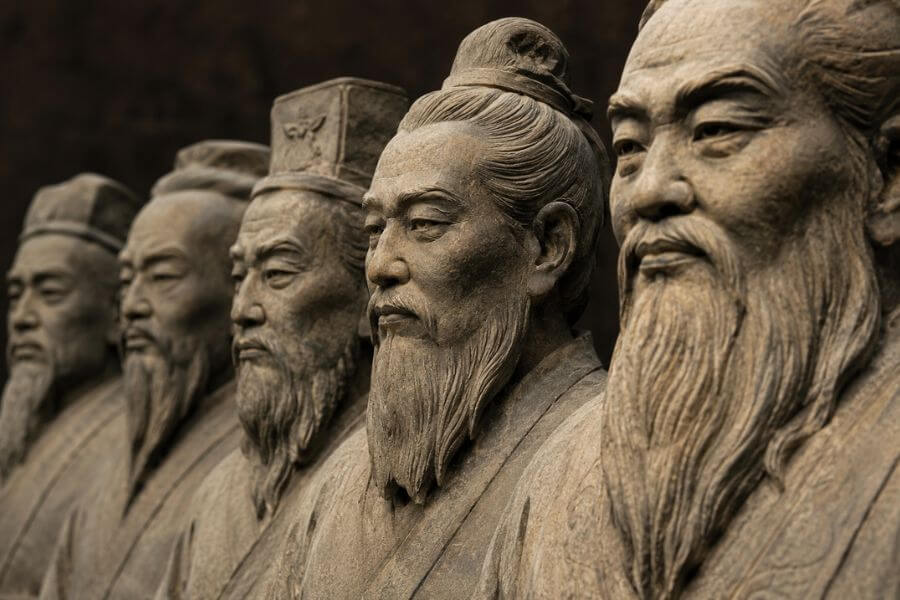
Chinese philosophy has influenced the way people think, govern, learn, and live for more than two thousand years. Even if you have never studied Chinese history, you have likely encountered ideas that originated from ancient Chinese philosophers. Concepts such as respect for family, balance in life, ethical leadership, education, and harmony with nature can all be traced back to these remarkable thinkers.
When you explore the teachings of China’s greatest philosophers, you discover ideas that continue to influence modern society, business, politics, education, and personal growth. Their teachings shaped dynasties, guided emperors, inspired scholars, and continue to attract readers around the world.
In this guide, you will learn about ten of the most influential Chinese philosophers whose ideas changed history and continue to inspire people today.
Quick Summary Table 🏮
| Rank | Philosopher | Time Period | Main Philosophy | Lasting Influence |
|---|---|---|---|---|
| 1 | Confucius | 551-479 BCE | Confucianism | Ethics, education, government |
| 2 | Laozi | 6th Century BCE | Daoism | Balance, nature, spirituality |
| 3 | Mencius | 372-289 BCE | Confucianism | Human goodness and governance |
| 4 | Zhuangzi | 369-286 BCE | Daoism | Freedom, creativity, wisdom |
| 5 | Xunzi | 310-235 BCE | Confucianism | Education and social order |
| 6 | Mozi | 470-391 BCE | Mohism | Universal love and meritocracy |
| 7 | Han Feizi | 280-233 BCE | Legalism | Law and state power |
| 8 | Wang Yangming | 1472-1529 | Neo-Confucianism | Self-cultivation and morality |
| 9 | Zhu Xi | 1130-1200 | Neo-Confucianism | Education and philosophy |
| 10 | Dong Zhongshu | 179-104 BCE | State Confucianism | Imperial government system |
How We Ranked These Philosophers 🔍
To create this list, we considered several important factors:
- Historical influence across multiple generations
- Impact on Chinese culture and society
- Contributions to government and education
- Global recognition and modern relevance
- Originality of philosophical ideas
- Influence on later thinkers and schools
- Lasting importance in modern discussions
- Role in shaping Chinese civilization
1. Confucius – The Father of Chinese Philosophy 🎓
Confucius stands at the center of Chinese intellectual history. Born during a period of political instability, he believed society could be improved through education, moral behavior, and respect for others.
His teachings focused on virtues such as kindness, honesty, loyalty, and respect for parents and elders. Rather than discussing supernatural matters, Confucius emphasized practical ways to create a better society.
One of his most important ideas was that leaders should rule through moral example rather than fear. According to Confucius, a good ruler inspires people through character and wisdom.
His philosophy became the foundation of Chinese education, government examinations, and social values for centuries. Students throughout China studied his teachings, and many government officials were selected based on their understanding of Confucian principles.
Even today, you can see his influence in discussions about education, leadership, family values, and personal responsibility.
2. Laozi – The Founder of Daoism 🌿
Laozi is traditionally regarded as the founder of Daoism, one of China’s most influential philosophical and spiritual traditions.
His famous work, the Dao De Jing, teaches that people should live in harmony with the natural flow of life. Instead of constantly struggling for control, Laozi encouraged individuals to embrace simplicity and balance.
One of his most famous concepts is “wu wei,” often translated as effortless action. This idea suggests that you achieve better results when you work with natural forces rather than against them.
Laozi’s teachings inspired generations of philosophers, artists, poets, and spiritual seekers. His emphasis on nature and simplicity remains highly relevant in today’s fast-paced world.
Many people still turn to Daoist ideas when seeking balance, peace, and personal fulfillment.
3. Mencius – The Champion of Human Goodness ❤️
Mencius was one of Confucius’ most important followers and helped expand Confucian philosophy.
His most famous belief was that human beings are naturally good. According to Mencius, people are born with a natural tendency toward kindness, compassion, and fairness.
He argued that governments should care for their citizens and create conditions that allow people to flourish. Leaders who neglected their people lost the moral right to govern.
Mencius often used stories and examples to explain his ideas, making his teachings accessible and memorable.
His optimistic view of human nature continues to influence debates about education, morality, and public policy.
4. Zhuangzi – The Philosopher of Freedom 🦋
Zhuangzi is one of the most creative and imaginative thinkers in Chinese history.
Building on Daoist ideas, he encouraged people to free themselves from rigid thinking and social expectations. His writings are filled with stories, humor, and thought-provoking parables.
One of his most famous stories involves dreaming he was a butterfly and later wondering whether he was a man dreaming of being a butterfly or a butterfly dreaming of being a man.
This story highlights his interest in perception, reality, and the limits of human knowledge.
Zhuangzi believed wisdom comes from flexibility, openness, and acceptance of life’s uncertainties. His ideas continue to attract readers who value creativity and independent thinking.
5. Xunzi – The Realist Thinker ⚖️
Unlike Mencius, Xunzi believed people are not naturally good. He argued that human beings have selfish tendencies that must be guided through education, laws, and social institutions.
Although this view may seem pessimistic, Xunzi believed people could become virtuous through learning and discipline.
He emphasized the importance of rituals, education, and strong institutions in maintaining social stability.
Many later political thinkers drew inspiration from his practical approach to governance and human behavior.
His ideas remain relevant in discussions about law, education, and the role of institutions in society.
6. Mozi – The Advocate of Universal Love 🤝
Mozi founded Mohism, a philosophy that challenged many traditional beliefs of his time.
He promoted the idea of universal love, arguing that people should care for everyone equally rather than favoring only family members or close friends.
Mozi believed many social problems resulted from favoritism and selfishness. He argued that treating all people fairly would create a more peaceful and prosperous world.
He also supported merit-based leadership, meaning leaders should be chosen for ability rather than family background.
Many of his ideas were remarkably progressive and continue to resonate with modern audiences.
7. Han Feizi – The Master of Legalism 🏛️
Han Feizi developed Legalism, a philosophy focused on law, order, and strong government authority.
He believed people generally act in their own self-interest. Because of this, he argued that clear laws and strict enforcement were necessary to maintain stability.
His ideas influenced the rulers of the Qin Dynasty, which unified China for the first time.
Although Legalism was often criticized for being harsh, it played an important role in building effective state institutions.
Many modern discussions about government power, law enforcement, and public administration still reflect themes found in Han Feizi’s writings.
8. Wang Yangming – The Philosopher of Inner Wisdom 🧠
Wang Yangming became one of the most influential thinkers of the Ming Dynasty.
He argued that moral knowledge already exists within every person. According to Wang, true wisdom comes from understanding your own conscience and acting upon it.
His philosophy emphasized self-reflection and personal responsibility.
Rather than simply memorizing books, Wang encouraged people to put moral principles into action.
His teachings influenced scholars throughout East Asia and continue to inspire people interested in personal development and ethical leadership.
9. Zhu Xi – The Great System Builder 📖
Zhu Xi was one of the leading figures of Neo-Confucianism and helped revive Confucian thought during the Song Dynasty.
He organized and interpreted classical texts in ways that shaped Chinese education for centuries.
His writings became standard materials for civil service examinations, influencing generations of students and government officials.
Zhu Xi sought to combine moral development with intellectual study. He believed understanding the world required both learning and self-improvement.
His influence on education is difficult to overstate, making him one of the most significant philosophers in Chinese history.
10. Dong Zhongshu – The Architect of State Confucianism 👑
Dong Zhongshu played a crucial role in transforming Confucianism into the official ideology of imperial China.
He convinced rulers that Confucian principles should guide government policy and education.
His ideas helped establish a political system that lasted for centuries. Under his influence, Confucian teachings became deeply integrated into state institutions.
Dong Zhongshu also developed theories connecting human behavior, government actions, and the natural world.
His work strengthened the relationship between philosophy and governance, shaping Chinese political culture for generations.
Conclusion 🌟
Chinese philosophy has produced some of the most influential thinkers in human history. From Confucius’ focus on ethics and education to Laozi’s teachings on harmony and Han Feizi’s ideas about law and government, these philosophers helped shape one of the world’s oldest civilizations.
As you explore their teachings, you may discover that many of their ideas remain surprisingly relevant today. Questions about leadership, morality, happiness, education, and social responsibility continue to challenge modern societies just as they did thousands of years ago.
Whether you are interested in history, philosophy, personal growth, or cultural studies, these ten philosophers provide valuable insights that have stood the test of time.
Frequently Asked Questions ❓
Which Chinese philosopher is considered the most influential?
Most historians consider Confucius the most influential Chinese philosopher because his teachings shaped education, government, family values, and social traditions throughout China for more than two thousand years.
How did Chinese philosophy differ from Greek philosophy?
Chinese philosophy generally focused more on ethics, social harmony, governance, and practical living, while Greek philosophy often explored logic, metaphysics, mathematics, and scientific inquiry.
Are Chinese philosophical teachings still relevant today?
Yes. Many ideas from Confucianism, Daoism, and other Chinese traditions continue to influence education, leadership, business practices, self-improvement, and cultural values around the world.
What is the difference between Confucianism and Daoism?
Confucianism emphasizes social responsibility, education, and moral behavior, while Daoism focuses on living in harmony with nature, simplicity, flexibility, and personal balance.
Why were philosophers so important in ancient China?
Philosophers helped shape political systems, educational institutions, social values, and cultural traditions. Their teachings often guided emperors, government officials, scholars, and ordinary citizens for centuries.