Learning Chinese can seem challenging at first, especially when you see thousands of unique characters. The good news is that you do not need to learn every character right away. In fact, a small group of commonly used Chinese characters can help you understand signs, menus, conversations, and basic written Chinese much faster.
Chinese characters are the building blocks of the language. Many words and phrases are formed by combining simple characters. By mastering the most important ones first, you create a strong foundation for future learning.
In this guide, you will discover the 10 most crucial Chinese characters everyone should know, why they matter, and how they are used in everyday life.
Quick Summary Table 📚
| Rank | Character | Pinyin | Meaning | Why It’s Important |
|---|---|---|---|---|
| 1 | 人 | Rén | Person | Appears in countless common words |
| 2 | 我 | Wǒ | I, Me | Essential for self-expression |
| 3 | 你 | Nǐ | You | Used in daily conversations |
| 4 | 大 | Dà | Big | Common descriptive character |
| 5 | 小 | Xiǎo | Small | Frequently paired with many nouns |
| 6 | 中 | Zhōng | Middle, China | Found in the name of China |
| 7 | 日 | Rì | Sun, Day | Important for dates and time |
| 8 | 月 | Yuè | Moon, Month | Essential for calendars and schedules |
| 9 | 水 | Shuǐ | Water | Common everyday vocabulary |
| 10 | 好 | Hǎo | Good | One of the most useful characters |
How We Ranked These Characters 🐉
We selected these characters using several important factors:
- Frequency of use in everyday Chinese
- Importance in beginner conversations
- Appearance in common words and phrases
- Relevance for reading signs and menus
- Value for building vocabulary quickly
- Ease of recognizing and remembering
- Practical usefulness for travelers and learners
- Presence in both spoken and written Chinese
1. 人 (Rén) – Person 👤
The character 人 means “person” or “human.” It is one of the most fundamental characters in Chinese and appears in countless everyday words.
Examples include:
- 人口 (Population)
- 工人 (Worker)
- 男人 (Man)
- 女人 (Woman)
The character itself resembles a person standing or walking, which can make it easier to remember.
Understanding 人 helps you recognize many people-related words. Since communication revolves around people, this character becomes useful almost immediately.
If you only learn a handful of Chinese characters, 人 should absolutely be one of them.
2. 我 (Wǒ) – I, Me 🗣️
The character 我 means “I” or “me.” It is one of the most frequently used characters in spoken and written Chinese.
Examples:
- 我是美国人 (I am American)
- 我喜欢中国菜 (I like Chinese food)
- 我知道 (I know)
Whenever you introduce yourself, share an opinion, or describe your experiences, you will use 我.
Because self-expression is central to communication, this character quickly becomes part of your daily vocabulary practice.
Learning 我 allows you to form complete sentences much earlier in your language journey.
3. 你 (Nǐ) – You 🤝
The character 你 means “you.” Together with 我, it forms the foundation of many simple conversations.
Examples:
- 你好 (Hello)
- 你好吗 (How are you?)
- 你叫什么名字 (What is your name?)
One of the first Chinese words most learners encounter is 你好, which literally combines “you” and “good.”
Because conversations involve both speakers and listeners, mastering 你 is essential for asking questions and interacting naturally.
It is impossible to build meaningful communication without understanding this important character.
4. 大 (Dà) – Big 🌎
The character 大 means “big,” “large,” or “great.”
Examples include:
- 大学 (University)
- 大家 (Everyone)
- 大城市 (Big city)
This character is easy to recognize because it resembles a person stretching their arms wide.
Beyond describing size, 大 often conveys importance, significance, or greatness.
Many high-frequency Chinese words contain this character, making it extremely valuable for beginners who want to expand their vocabulary quickly.
5. 小 (Xiǎo) – Small 🌱
The opposite of 大 is 小, which means “small” or “little.”
Examples:
- 小孩 (Child)
- 小猫 (Kitten)
- 小房子 (Small house)
Chinese often uses contrasting concepts to create meaning. Learning both 大 and 小 helps you understand basic descriptions and comparisons.
You will frequently encounter 小 in names, informal speech, and everyday situations.
It is simple, practical, and appears throughout beginner-level Chinese.
6. 中 (Zhōng) – Middle, China 🏮
The character 中 means “middle,” “center,” or “central.”
Its importance goes beyond basic vocabulary because it appears in the Chinese name for China:
- 中国 (Zhōngguó) = China
Other examples include:
- 中心 (Center)
- 中午 (Noon)
- 中间 (Middle)
This character provides cultural and linguistic value. Since it appears in one of the most important words in Chinese, every learner should recognize it early.
Understanding 中 also helps you decode many location and direction-related words.
7. 日 (Rì) – Sun, Day ☀️
The character 日 represents both “sun” and “day.”
Examples:
- 日期 (Date)
- 生日 (Birthday)
- 日历 (Calendar)
Time-related vocabulary is crucial for everyday communication. Whether you are discussing schedules, appointments, birthdays, or travel plans, you will encounter 日 regularly.
Historically, this character originated as a pictograph of the sun.
Its simple shape makes it one of the easiest characters for beginners to recognize and remember.
8. 月 (Yuè) – Moon, Month 🌙
The character 月 means “moon” and is also used to mean “month.”
Examples:
- 一月 (January)
- 月亮 (Moon)
- 月饼 (Mooncake)
Alongside 日, this character helps you understand dates, calendars, and seasons.
One fascinating aspect of Chinese is how many characters connect to ancient observations of nature. Months were traditionally measured by lunar cycles, which explains the relationship between the moon and the concept of a month.
Because scheduling and time management are part of daily life, 月 deserves a place among the most crucial Chinese characters.
9. 水 (Shuǐ) – Water 💧
The character 水 means “water.”
Examples:
- 水果 (Fruit)
- 喝水 (Drink water)
- 热水 (Hot water)
Water is one of the most common needs in everyday life, and the character appears in many practical words.
In addition, 水 often serves as a building block within more complex Chinese characters.
Its distinctive appearance makes it relatively easy to spot in written Chinese.
Whether you are ordering drinks, reading menus, or learning vocabulary, 水 appears frequently.
10. 好 (Hǎo) – Good ⭐
The character 好 means “good,” “well,” or “fine.”
Examples:
- 你好 (Hello)
- 很好 (Very good)
- 好朋友 (Good friend)
This character combines the symbols for “woman” and “child,” creating a concept traditionally associated with goodness and harmony.
Among all beginner characters, 好 may be one of the most rewarding because it appears in greetings, compliments, and everyday conversations.
Knowing 好 instantly helps you understand some of the most common Chinese expressions.
It is a small character with enormous practical value.
Conclusion 🎉
Learning Chinese does not require memorizing thousands of characters on day one. By focusing on a handful of highly useful characters, you can quickly build confidence and start recognizing patterns throughout the language.
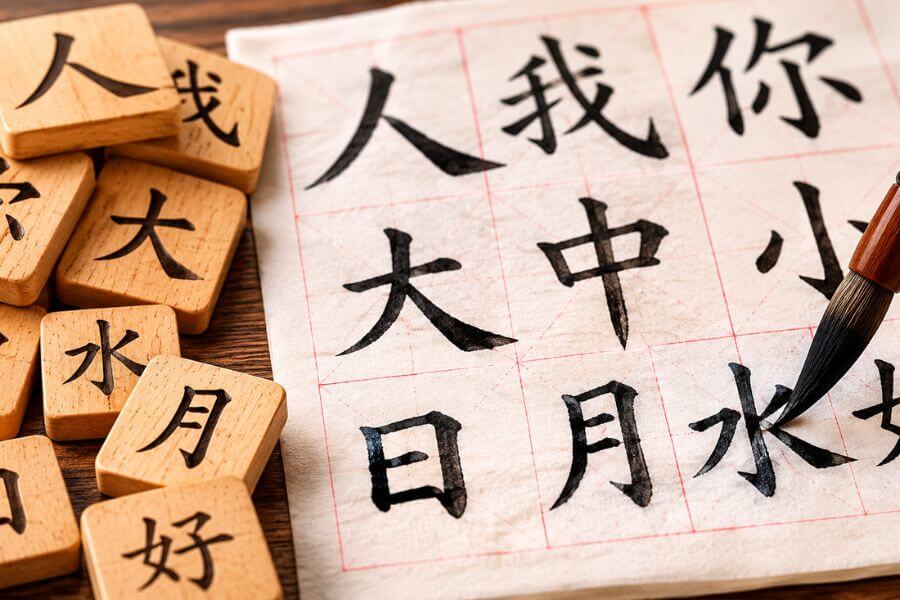
The characters 人, 我, 你, 大, 小, 中, 日, 月, 水, and 好 appear constantly in everyday Chinese. They help you understand conversations, read signs, expand vocabulary, and gain insight into Chinese culture.
As you continue studying, these foundational characters will appear again and again, making future learning easier and more enjoyable. Master them first, and you will have a strong starting point for your Chinese language journey.
Frequently Asked Questions ❓
How many Chinese characters does a beginner need to learn?
Most beginners can start understanding basic written Chinese after learning a few hundred characters. However, mastering the most common 50 to 100 characters provides a strong foundation.
Are simplified and traditional Chinese characters very different?
Some characters look identical in both writing systems, while others have different forms. The meanings and pronunciations generally remain the same.
What is the fastest way to memorize Chinese characters?
Practice writing them, use flashcards, learn their meanings in context, and review them regularly. Associating characters with real words helps memory retention.
Can I learn spoken Chinese without learning characters?
Yes, but learning characters significantly improves reading, writing, vocabulary development, and overall language comprehension.
Why do some Chinese words contain multiple characters?
Most modern Chinese words consist of two or more characters combined together. Each character contributes part of the meaning, creating a complete word or phrase.