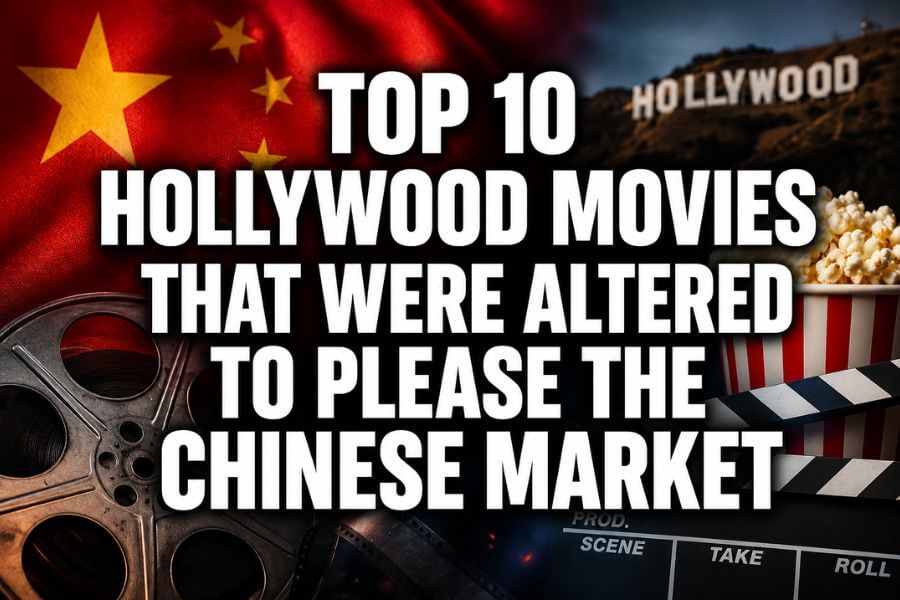
Over the last two decades, Hollywood has changed in a big way. Movie studios are no longer making films only for American audiences. Today, global box office numbers matter more than ever, and one of the biggest international movie markets is China.
Because of that, many Hollywood studios have adjusted storylines, removed scenes, changed characters, and even rewritten scripts to increase their chances of getting released in China. Sometimes these changes were small and barely noticeable. Other times, they completely changed the tone or message of the movie.
If you have ever watched a blockbuster and wondered why certain scenes felt strange, overly careful, or politically neutral, there is a good chance international market pressure played a role.
In this article, you will discover ten famous Hollywood movies that were altered to please the Chinese market. You will also learn why studios made those decisions and how audiences reacted around the world.
Quick Summary Table 📊
| Rank | Movie | Major Change Made | Why It Was Changed |
|---|---|---|---|
| 1 | Top Gun: Maverick | Taiwanese and Japanese flag patches removed then restored | Avoid political controversy |
| 2 | Doctor Strange | Tibetan character changed to Celtic | Avoid Tibet-related censorship |
| 3 | Red Dawn | Villains changed from Chinese to North Korean | Prevent backlash in China |
| 4 | World War Z | References to China removed | Improve release chances |
| 5 | Iron Man 3 | Added Chinese-exclusive scenes and actors | Appeal directly to Chinese audiences |
| 6 | Transformers: Age of Extinction | Heavy Chinese product placement and locations | Increase Chinese box office success |
| 7 | Pixels | Great Wall destruction scene removed | Avoid negative portrayal |
| 8 | Looper | Large portions set in Shanghai | Strengthen Chinese partnership |
| 9 | The Martian | Chinese space agency portrayed as heroic | Encourage positive reception |
| 10 | Mulan | Filming decisions and messaging created controversy | Secure approval and market access |
How We Ranked These Movies 🧠
We ranked these films based on several important factors:
- How significant the movie changes were
- Whether the edits affected the story or characters
- The level of involvement from Chinese authorities or studios
- Public reaction from audiences and critics
- Box office impact in China
- How obvious the changes were to viewers
- Long-term influence on Hollywood filmmaking
- Cultural and political sensitivity surrounding the edits
1. Top Gun: Maverick ✈️
When the first trailer for Top Gun: Maverick was released, eagle-eyed fans quickly noticed something strange. The famous bomber jacket worn by the character Maverick had changed. In the original 1986 film, the jacket displayed Taiwanese and Japanese flags. In the sequel, those patches had disappeared.
Many viewers believed the change happened because one of the movie’s financial backers had connections to the Chinese market. At the time, studios were extremely careful about anything involving Taiwan because Chinese censorship rules are very strict regarding the island’s political status.
The backlash online was immediate. Fans accused the studio of sacrificing artistic integrity for profit. The controversy became so large that the original patches were eventually restored in the final movie release.
What made this situation especially interesting was how visible the change was. It lasted only a few seconds in the trailer, yet it sparked global discussion about Hollywood’s relationship with China.
The movie itself later became a massive worldwide success, proving that studios sometimes underestimate how much audiences care about authenticity and symbolism.
2. Doctor Strange 🔮
One of the biggest controversies surrounding Doctor Strange involved the character known as the Ancient One. In the original Marvel comics, the character is Tibetan. However, in the movie adaptation, the character was transformed into a Celtic figure played by Tilda Swinton.
Why did this happen? Many critics believed Marvel wanted to avoid mentioning Tibet because the Chinese government is extremely sensitive about the topic. Tibet-related political discussions often create censorship problems in China.
Marvel denied making the change specifically for China, but many viewers remained skeptical.
The issue created debate on multiple fronts. Some people accused the movie of removing Asian representation. Others argued Hollywood was avoiding politically risky subjects to protect profits.
This example became one of the clearest cases of self-censorship in modern blockbuster filmmaking. Even though the film performed well internationally, the controversy around the character change continued for years.
Today, Doctor Strange is frequently mentioned whenever people discuss Hollywood adjusting stories to fit Chinese political expectations.
3. Red Dawn 🔥
Few Hollywood movies demonstrate direct market-driven editing as clearly as Red Dawn.
Originally, the film featured Chinese soldiers invading the United States. But after filming had already been completed, producers suddenly became worried. They feared China would react negatively and possibly ban the movie while also hurting future business opportunities for the studio.
Instead of reshooting the entire film, the studio digitally altered many scenes. Chinese flags and symbols were changed into North Korean ones using computer effects.
The changes reportedly cost millions of dollars.
What made the situation even more awkward was that some scenes still felt clearly written with China in mind. Audiences noticed inconsistencies, and critics openly discussed the edits.
Ironically, despite all the effort, the movie still did not become a major hit in China or globally.
Red Dawn remains one of the most famous examples of Hollywood changing villains specifically to avoid offending the Chinese market.
4. World War Z 🧟
The original novel version of World War Z includes references suggesting the zombie outbreak may have started in China. However, the movie adaptation carefully removed or avoided those details.
At the time, many studios understood that portraying China negatively could create major censorship issues. As a result, the movie kept the origins of the outbreak vague.
This was not a minor adjustment. The source material clearly connected the epidemic to China, so removing that connection changed part of the story’s political tone.
Viewers familiar with the book immediately noticed the difference.
Even with the edits, the film still faced release issues in China. That outcome showed an important reality of international filmmaking. Sometimes studios make major creative compromises but still fail to gain approval.
The World War Z situation also encouraged discussions about whether Hollywood was becoming too cautious when handling global politics.
5. Iron Man 3 🤖
Iron Man 3 took a very different approach compared to other movies on this list. Instead of removing controversial material, Marvel added special scenes specifically for Chinese audiences.
The Chinese version of the movie included extra footage featuring popular Chinese actors and product placements. Some scenes showed Chinese doctors helping save Tony Stark’s life.
The movie even partnered closely with Chinese companies during production and marketing.
Interestingly, many international viewers never saw these scenes because they only appeared in the Chinese release.
Audience reactions were mixed. Some people appreciated the effort to include Chinese representation. Others felt the extra footage looked forced and disconnected from the rest of the film.
Critics also argued that the additions felt more like advertising than storytelling.
Still, the strategy worked financially. China became one of the movie’s largest international markets, helping the film earn enormous global profits.
Iron Man 3 helped establish a new Hollywood trend where studios created country-specific content to attract overseas audiences.
6. Transformers: Age of Extinction 🚗
If one movie fully embraced the Chinese market, it was Transformers: Age of Extinction.
Large parts of the film were shot in China, including scenes in Hong Kong and other major cities. The movie also featured Chinese actors, Chinese products, and numerous local brand advertisements.
At times, the product placement became impossible to ignore. Some scenes felt more like commercials than part of the story.
Director Michael Bay openly recognized the importance of the Chinese audience. By that point, China had become one of the biggest sources of ticket sales for major action movies.
The strategy paid off financially. The film earned huge numbers in China and became one of the highest-grossing movies there at the time.
However, critics argued the movie sacrificed storytelling quality for international business goals.
Despite the criticism, Transformers: Age of Extinction became a blueprint for future Hollywood blockbusters trying to maximize success in China.
7. Pixels 👾
The comedy film Pixels originally contained a sequence showing aliens attacking and destroying parts of the Great Wall of China.
Before release, the scene was removed.
Although the change did not dramatically alter the plot, it reflected Hollywood’s increasing caution regarding Chinese cultural symbols and national landmarks.
Studios understood that portraying famous Chinese sites being destroyed could easily upset regulators or audiences.
Many viewers outside China never even realized the scene existed. But once reports surfaced, the decision became another example of Hollywood editing content to avoid trouble.
This situation also showed how studios were thinking ahead during the production process. Even comedic destruction scenes were being evaluated through the lens of international politics and market access.
8. Looper ⏳
Unlike some other films on this list, Looper handled its Chinese connection more naturally.
The original script reportedly placed many future scenes in France. However, those scenes were later relocated to Shanghai.
Director Rian Johnson explained that Chinese investment and partnerships helped influence the decision.
The movie portrayed Shanghai as futuristic, modern, and visually beautiful. Instead of using China as a political issue, the film presented it as an important global center of the future.
Many viewers actually praised this approach because it felt less forced than obvious censorship edits.
At the same time, the situation still reflected a growing Hollywood trend. Studios increasingly shaped stories around international financial partnerships.
Looper showed that market influence does not always appear through censorship alone. Sometimes it affects locations, themes, and world-building choices.
9. The Martian 🚀
In The Martian, the Chinese space agency plays a heroic and important role in helping rescue astronaut Mark Watney.
The portrayal was noticeably positive and cooperative. Chinese scientists were shown as intelligent, generous, and essential to the mission’s success.
Many analysts believed the film intentionally highlighted Chinese contributions to improve its reception in China.
Unlike some controversial examples, audiences generally responded positively to this portrayal. The cooperation between countries matched the optimistic tone of the movie.
However, critics still pointed out how Hollywood increasingly avoided portraying China negatively in major blockbusters.
The movie became another example of how international politics quietly influences modern storytelling.
Even though The Martian was based on a novel, the adaptation choices reflected Hollywood’s growing awareness of the Chinese audience.
10. Mulan 🐉
Disney’s live-action Mulan became one of the most controversial Hollywood films connected to China.
The company clearly hoped the movie would become a massive hit there because the original story comes from Chinese folklore. Disney invested heavily in marketing and authenticity efforts.
However, the film faced criticism from multiple directions.
Some viewers disliked creative decisions that differed from the animated classic. Others criticized the filming locations and political controversies surrounding production acknowledgments.
The movie also struggled to satisfy both Western and Chinese audiences at the same time.
Ironically, despite Disney’s careful efforts to appeal to China, the movie did not become the enormous success many expected.
Mulan highlighted the difficulty of balancing global business goals with cultural authenticity and political sensitivity.
The film became a major case study in how complicated international entertainment has become in the streaming era.
Conclusion 🎥
Hollywood’s relationship with the Chinese market has transformed modern filmmaking. What started as occasional edits has evolved into a major industry strategy affecting scripts, casting, locations, and even storytelling itself.
Some changes are subtle and easy to miss. Others completely reshape movies before audiences ever see them.
Supporters argue these adjustments are simply part of global business. Studios want their films to succeed internationally, and adapting content for different markets has always existed in some form.
Critics, however, worry that creative freedom is being sacrificed for profit. They believe filmmakers may avoid important topics or change stories too heavily to satisfy political and commercial demands.
As China continues to remain an important movie market, this debate will likely continue for years. And as a viewer, you may start noticing these changes more often every time you watch a big-budget blockbuster.
Frequently Asked Questions ❓
Why is the Chinese movie market so important to Hollywood?
China has one of the largest moviegoing populations in the world. Big-budget films can earn hundreds of millions of dollars there. For many studios, Chinese ticket sales can significantly affect a movie’s overall profits.
Does China censor foreign movies?
Yes. Foreign movies released in China must follow government censorship rules. Content involving politics, religion, violence, national image, and sensitive historical topics may face restrictions or bans.
Are Hollywood studios forced to make these changes?
In most cases, studios choose to make changes themselves to improve the chances of getting approval for release in China. This is often called self-censorship.
Do Chinese audiences notice these Hollywood changes?
Yes, many Chinese viewers notice them. Reactions vary. Some appreciate local representation, while others feel the changes can appear artificial or overly commercial.
Could Hollywood stop changing movies for international markets?
It is possible, but unlikely in the near future. Global box office revenue has become extremely important for major studios, especially for expensive blockbuster films.