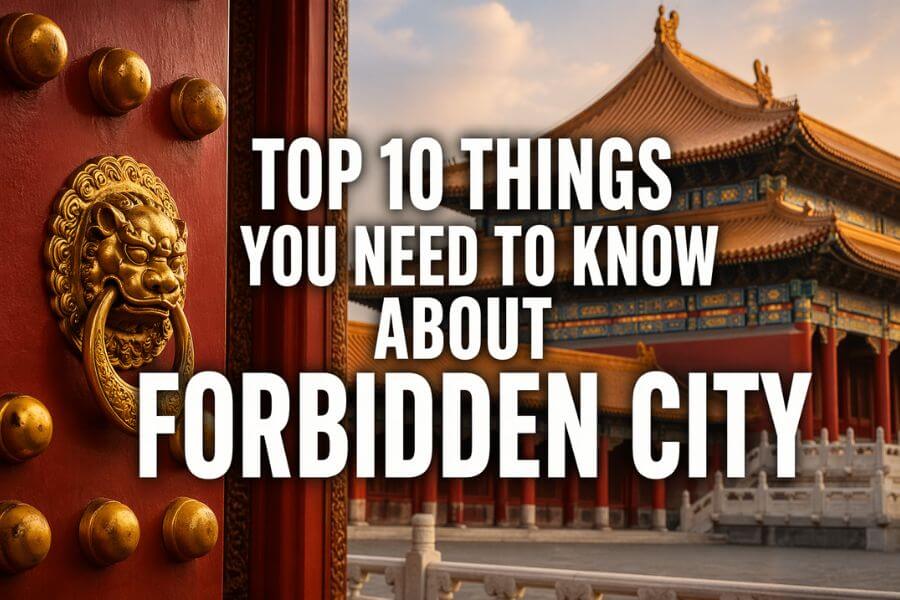
When you visit China, one place you simply cannot miss is the Forbidden City. Located in the heart of Beijing, this massive palace complex is one of the most famous historical sites in the world. It was once the home of emperors and the center of power for hundreds of years. Today, it stands as a symbol of Chinese culture, history, and architecture. As you explore its grand halls, wide courtyards, and detailed designs, you will feel like you have stepped back in time. In this guide, you will discover the top 10 things you need to know about the Forbidden City so you can fully understand and enjoy this incredible landmark.
1. It Was the Imperial Palace for Over 500 Years
The Forbidden City served as the home of Chinese emperors during the Ming Dynasty and the Qing Dynasty. For more than five centuries, it was the political and ceremonial center of China. A total of 24 emperors lived and ruled from this palace, making it one of the most important places in Chinese history. When you walk through the gates, you are entering a place where major decisions were made, ceremonies were held, and royal life unfolded behind closed doors.
2. The Name Reflects Strict Rules and Isolation
The name “Forbidden City” comes from the strict rules that once controlled access to the palace. In the past, only the emperor, his family, and selected officials were allowed to enter. Ordinary people were not permitted inside, and even high-ranking officials needed special permission. If you tried to enter without approval, you could face serious punishment. This sense of mystery and exclusivity is part of what makes the Forbidden City so fascinating today.
3. It Is One of the Largest Palace Complexes in the World
The Forbidden City is enormous, covering about 180 acres and containing over 900 buildings. It is often considered one of the largest palace complexes ever built. As you explore, you will notice long walkways, open courtyards, and grand halls that seem to stretch endlessly. Because of its size, it can take several hours to see even the main highlights, so you should plan your visit carefully.
4. It Features Stunning Traditional Chinese Architecture
One of the most impressive aspects of the Forbidden City is its architecture. The buildings are designed using traditional Chinese principles, with wooden structures, golden roofs, and red walls. The layout follows a strict north to south axis, showing balance and order. You will also notice decorative details like carved dragons, painted beams, and symbolic patterns that represent power and harmony. Every part of the design has meaning, making the entire complex a masterpiece of architecture.
5. It Is Now a World Famous Museum
Today, the Forbidden City is no longer a royal residence. Instead, it is home to the Palace Museum, which displays a huge collection of historical artifacts. Inside, you can see ancient paintings, ceramics, jade objects, and imperial treasures. This transformation from a private palace to a public museum allows you to experience history up close and learn more about China’s rich cultural heritage.
6. It Was Built with Incredible Effort and Skill
Construction of the Forbidden City began in 1406 and took about 14 years to complete. Hundreds of thousands of workers, including craftsmen, artists, and laborers, were involved in building the palace. Materials were transported from far away, and special techniques were used to create the detailed designs. When you visit, it is worth remembering the immense effort that went into creating this grand structure.
7. The Layout Reflects Power and Hierarchy
The design of the Forbidden City is not random. It clearly reflects the power structure of imperial China. The outer court was used for ceremonies and official events, while the inner court was reserved for the emperor and his family. Buildings closer to the center were more important, and their size and decoration showed status. As you walk through the complex, you can see how architecture was used to reinforce authority and order.
8. It Has Survived Wars and Major Changes
Over the centuries, the Forbidden City has faced many challenges, including wars, political changes, and natural wear. Despite these difficulties, much of the complex remains well preserved. Restoration work has helped maintain its beauty and structure, allowing you to see it much as it once was. This survival adds to its importance as a cultural treasure.
9. It Is a UNESCO World Heritage Site
The Forbidden City is recognized as a UNESCO World Heritage Site, highlighting its global significance. This status helps protect the site and ensures that it will be preserved for future generations. When you visit, you are not just exploring a historical location, but also a place that is valued by people around the world for its cultural importance.
10. Visiting Tips Can Improve Your Experience
To make the most of your visit, you should keep a few practical tips in mind:
- Arrive early to avoid large crowds
- Wear comfortable shoes because you will walk a lot
- Plan your route in advance to cover key areas
- Bring water and snacks if allowed
- Visit during spring or autumn for better weather
These simple steps can help you enjoy your time and explore the Forbidden City more comfortably.
Conclusion
The Forbidden City is much more than just an old palace. It is a powerful symbol of China’s history, culture, and architectural brilliance. From its role as the home of emperors to its transformation into a museum, it tells a story that spans centuries. When you walk through its gates, you are stepping into a world filled with tradition, power, and beauty. By understanding these key facts, you can appreciate the Forbidden City on a deeper level and make your visit truly memorable.
Frequently Asked Questions
How long should you spend at the Forbidden City?
You should plan to spend at least three to four hours exploring the main areas. If you want to see more detailed exhibits inside the Palace Museum, you may need a full day.
Is photography allowed inside the Forbidden City?
Yes, you can take photos in most outdoor areas. However, photography is usually not allowed inside certain exhibition halls to protect the artifacts.
What is the best time of year to visit the Forbidden City?
Spring and autumn are the best seasons because the weather is mild and comfortable. Summer can be very hot, and winter can be quite cold.
Can you visit the Forbidden City at night?
The Forbidden City is generally closed at night, although special evening events are sometimes held on rare occasions.
Are guided tours worth it at the Forbidden City?
Yes, a guided tour can help you understand the history and meaning behind the buildings. If you prefer to explore on your own, an audio guide is also a good option.