Key Takeaways
Before diving into the fine print, here are the most critical things you need to remember about this travel trick:
- The Magic Formula: You must travel from Country A, stop in a permitted region of China, and then fly out to Country B. Country A and Country B must be different places.
- No Round Trips: Flying from Los Angeles to Shanghai and back to Los Angeles does not qualify. You will be denied boarding at your departure airport.
- Strict Borders: You cannot wander wherever you want. You must stay inside the specific city or region where you arrived.
- Paperwork is King: You need a confirmed onward ticket with a seat assignment before you even start your journey. Standby tickets will not work.
Imagine landing in a city where ultra-modern skyscrapers rub shoulders with ancient temples, where the aroma of pan-fried dumplings fills the air, and where you can explore a whole new world without ever visiting an embassy to get a regular tourist visa. This is not a dream. It is the reality of the 144-hour visa-free transit policy in China.
If you are a traveler who loves to squeeze every bit of adventure out of a long journey, this policy is your golden ticket. It allows citizens from dozens of countries to step outside the airport gates and experience the magic of mainland China for up to six full days. Whether you want to stand on the historic stones of the Great Wall, cruise down the neon-lit riverfront of Shanghai, or feast on spicy Sichuan hot pot in Chengdu, this guide will show you exactly how to pull off this ultimate travel hack.
What Exactly Is the 144-Hour Visa-Free Transit Policy?
To understand how this policy works, you have to look closely at the word transit. In the travel world, transiting means you are passing through a place on your way to somewhere else. China created this rule to encourage international globetrotters to stop by, explore its major cities, spend some money on food and hotels, and then continue on their merry way to their final destination.
The beauty of this system is that it skips the long, expensive, and sometimes stressful process of applying for a traditional Chinese tourist visa. Usually, getting a visa involves filling out massive forms, mailing your physical passport to a consulate, paying a hefty fee, and waiting weeks for approval. With the transit policy, you bypass all of that paperwork. You simply show up at the airport, prove that you are just passing through, get a special stamp, and walk right out into the city.
However, because this is a specific legal loop-hole, the border control officers are very strict about the definitions. You cannot just use this to take a quick vacation to China and go back home. The government views your stop in China as a brief pause in a larger international journey. As long as you respect that definition, the doors are wide open for you to explore.
The Non-Negotiable Three-Country Rule
This is the absolute core of the policy, and it is the place where many eager travelers make mistakes that ruin their trips. To use the 144-hour transit rule, your flight itinerary must follow a strict linear path across three distinct geographic zones. We can think of this as a simple math problem: Zone A to Zone B to Zone C.
Defining Your Points of Origin and Destination
In this travel equation, Zone A is the country you are leaving right before you touch down in China. Zone B is the specific transit region inside China where you will spend your six days. Zone C is the next country you fly to after your time in China is up.
The golden rule is that Zone A and Zone C must be completely different countries or territories. If they are the same, your trip is considered a round-trip vacation, not a transit, and you will be barred from entering the country without a standard visa.
What Counts as a Separate Territory?
One of the coolest things about this policy is how China defines international destinations. For the purposes of this transit rule, Hong Kong, Macau, and Taiwan count as separate international destinations from mainland China. This opens up some amazing and affordable travel routes for budget-conscious adventurers.
To make this crystal clear, let us look at some real-world examples of itineraries that work perfectly, alongside some common mistakes that will get you turned away at the boarding gate.
| Route Structure | Example Itinerary | Is It Approved? | Why or Why Not? |
| Country A to China to Country B | New York to Beijing to Tokyo | Approved | Japan and the United States are different countries. This is a true transit. |
| Country A to China to Special Region | San Francisco to Shanghai to Hong Kong | Approved | Hong Kong counts as a separate international destination for this rule. |
| Special Region to China to Country B | Macau to Chengdu to Singapore | Approved | Macau and Singapore are different zones. The linear chain remains unbroken. |
| Country A to China to Country A | Seattle to Shanghai to Seattle | Denied | This is a round-trip layout. You are returning to your origin without a third zone. |
| Multi-Stop Inside China | London to Beijing to Shanghai to Seoul | Denied | You cannot fly between different transit zones inside China on this specific permit. |
The Trap of Technical Stopovers
Another detail that catches people off guard is the flight path of your airplane. When the border control officers look at your ticket, they look at the very next stop your plane makes after lifting off from China. If your flight from Shanghai to New York makes a quick one-hour stop in Beijing to change passengers or refuel, that means your immediate next destination after Shanghai is Beijing.
Even if you never get off the plane in Beijing, you have broken the transit zone rule because you moved between two different regions within mainland China. Always make sure your flight out of the transit zone goes directly to an international destination with no hidden domestic stops.
Eligible Countries and Who Can Join the Adventure
Not every passport holder in the world can use this policy. China has extended this privilege to a specific list of over fifty nations. This list generally includes countries that have strong diplomatic ties and high volumes of travel with China. The list is updated from time to time, but it consistently covers large parts of North America, Europe, and Oceania.
The Approved Nation Checklist
If your passport is issued by one of the following countries, you are eligible to apply for the 144-hour visa-free stay:
- The Americas: The United States, Canada, Brazil, Mexico, Argentina, and Chile.
- Oceania: Australia and New Zealand.
- Europe (Schengen Area): Austria, Belgium, Czech Republic, Denmark, Estonia, Finland, France, Germany, Greece, Hungary, Iceland, Italy, Latvia, Lithuania, Luxembourg, Malta, the Netherlands, Poland, Portugal, Slovakia, Slovenia, Spain, Sweden, and Switzerland.
- Europe (Other Nations): The United Kingdom, Ireland, Russia, Cyprus, Bulgaria, Romania, Ukraine, Serbia, Croatia, Bosnia and Herzegovina, Montenegro, North Macedonia, Albania, Monaco, and Belarus.
- Asia: South Korea, Japan, Singapore, Brunei, the United Arab Emirates, and Qatar.
Passport Requirements for Travelers
Even if your country is on this list, your individual passport must meet certain quality standards. First, your passport must be valid for at least three months from the day you plan to land in China. However, as a smart rule of thumb, it is always better to have at least six months of validity left on your passport whenever you travel internationally to avoid any arguments with picky airline staff.
Second, your passport must be in good physical condition. If the cover is peeling off, or if there are water stains on the bio-data page, border officials might reject it out of caution. You also need at least one or two completely blank pages left in your booklet so the officers have room to stick the large, colorful transit permit entry voucher onto your passport pages.
Understanding the Approved Transit Zones
You cannot just land in any random Chinese city and expect to stay for 144 hours. The policy is divided into specific regional zones. When you enter a zone, you agree to stay within the borders of that specific area for your entire visit. You are not allowed to take a bullet train or a domestic flight to a different province outside your designated zone.
Fortunately, these zones are massive and include some of the most exciting cultural and historical highlights in the nation. Let us break down the primary regions where you can use this policy.
The Beijing-Tianjin-Hebei Zone
This is the ultimate zone for history buffs. If you enter through Beijing Capital International Airport, Beijing Daxing International Airport, Tianjin International Airport, or the Tianjin International Cruise Home Port, you are allowed to travel freely anywhere within the municipality of Beijing, the municipality of Tianjin, and the surrounding Hebei Province.
This zone gives you full access to iconic sights like the Forbidden City, the Summer Palace, and multiple famous sections of the Great Wall of China, including Badaling and Mutianyu. You can also explore the ultra-modern port facilities and unique European-style architecture in Tianjin.
The Shanghai-Jiangsu-Zhejiang Zone
This area is the economic and cultural powerhouse of East China. You can enter through Shanghai’s Pudong or Hongqiao airports, the Shanghai Port International Cruise Terminal, or airports in nearby cities like Hangzhou and Nanjing. Once inside, you can travel across the entire Yangtze River Delta region, which includes Shanghai, Jiangsu Province, and Zhejiang Province.
This zone offers a perfect mix of shiny futuristic cities and peaceful historic hideaways. You can marvel at the towering skyscrapers of the Shanghai Bund, take a boat ride through the ancient water towns of Suzhou, or sip world-famous green tea next to the beautiful West Lake in Hangzhou. Because the high-speed rail network in this region is incredibly fast and efficient, you can easily visit three or four different cities during your six-day stay.
The Guangdong Province Zone
Located in the sunny south, this zone is perfect for food lovers and tech enthusiasts. You can enter through major hubs like Guangzhou Baiyun Airport, Shenzhen Baoan Airport, or Jieyang Chaoshan Airport. Unlike some other zones where you are limited to a couple of cities, entering here allows you to travel anywhere within the entire province of Guangdong.
Guangdong is the birthplace of Cantonese cuisine, which means your six days will be filled with amazing dim sum, roasted meats, and fresh seafood. You can explore the bustling wholesale markets of Guangzhou, check out the mind-bending electronics malls and theme parks in Shenzhen, or visit the historic colonial architecture in Kaiping. This zone is also incredibly convenient because it borders Hong Kong and Macau, making it very easy to plan your three-country flight route.
Other Major Isolated City Zones
If you want to head deeper into the heart of the country, there are several individual cities that operate their own isolated 144-hour transit zones. In these cases, you must stay strictly within the administrative boundaries of that single city.
- Chengdu (Sichuan Province): The ultimate destination to see giant pandas and eat mouth-numbing spicy food.
- Chongqing: A spectacular mountain metropolis famous for its multi-layered roads, monorails that run through apartment buildings, and incredible river night views.
- Xian (Shaanxi Province): The ancient capital of China where you can stand face-to-face with the legendary Terracotta Army.
- Kunming (Yunnan Province): Known as the City of Eternal Spring, famous for its mild weather, diverse ethnic minority cultures, and the stunning Stone Forest.
- Xiamen (Fujian Province): A beautiful coastal city known for its laid-back island vibes, beautiful beaches, and unique seafood dishes.
How Does the 144 Hours Actually Get Counted?
You might think that 144 hours means exactly six periods of twenty-four hours from the minute your plane tires touch the runway. However, the Chinese border control system actually uses a very generous counting method that often gives you a few extra bonus hours to enjoy your stay.
The Midnight Clock Rule
The most important thing to know is that your 144-hour clock does not start ticking the moment you land. Instead, it official starts at 12:00 AM (midnight) on the very next day after your arrival date.
Let us map this out with a clear example so you can see how much time you really get. Imagine you are flying from Vancouver to Seoul, and you plan to stop in Shanghai along the way. Your flight touches down at Shanghai Pudong Airport at 3:00 PM on a Tuesday afternoon.
- Tuesday (Arrival Day): You land at 3:00 PM. The rest of this day is completely free bonus time. It does not count toward your 144 hours.
- Wednesday (Day 1): The official clock begins at 12:00 AM on Wednesday morning. Your first full block of twenty-four hours runs through Wednesday night.
- Thursday (Day 2): Your second official day in the city.
- Friday (Day 3): Your third official day in the city.
- Saturday (Day 4): Your fourth official day in the city.
- Sunday (Day 5): Your fifth official day in the city.
- Monday (Day 6): Your final official day. Your total allowance ends exactly at 11:59 PM on Monday night.
In this scenario, because you landed on Tuesday afternoon and do not have to leave until late Monday night, you actually get to spend around 153 hours on the ground in China. This clever rule gives you plenty of breathing room to plan your activities without worrying about every single minute.
The Dangers of Running Out of Time
While the clock is generous, you must never abuse it. Overstaying your transit permit is a serious legal issue in China. If you miss your flight or miscalculate your time and stay even a few minutes past your deadline, you will face hefty fines, long interrogations by airport police, and potential delays that could cause you to miss future international flights. In worst-case scenarios, an overstay can lead to a black-mark on your immigration record, making it very difficult for you to ever return to China. Always book your outward flight comfortably before your time expires.
Step-by-Step Guide to Navigating the Airport
Landing in a massive foreign airport can feel overwhelming, especially when you are trying to navigate a special immigration process. However, if you follow these precise steps, you will coast through the arrival hall with total confidence.
Step 1: Inform Your Airline Before You Fly
Your journey through the visa-free system actually begins at your home airport before you even step foot on the plane. When you check in for your flight at your origin point, the airline staff will scan your passport and check your travel documents.
You must tell the agent at the counter that you are planning to enter China under the 144-hour visa-free transit policy. Show them your printed ticket showing your flight out of China to a third country. The airline needs to verify this because if China rejects you at the border, the airline is legally responsible for flying you right back to where you started, and they want to make sure your paperwork is flawless before they let you on their airplane.
Step 2: Fill Out the Special Arrival Card
When your plane lands in China and you walk off the jet bridge, follow the signs leading toward the Immigration and Border Control area. Before you join the massive lines for regular travelers, look around for a specific desk marked for Transit Passengers.
Near this desk, you will find columns of paper forms. Do not fill out the standard blue or yellow arrival cards that regular tourists use. You must locate the special transit arrival card, which is usually bright blue and white and clearly labeled as the Temporary Entry Permit Application Form. Fill out this card completely using a blue or black pen. You will need to write down your personal details, your flight numbers, your flight dates, and the exact name and address of the hotel where you will be staying in China.
Step 3: Find the Correct Immigration Line
Once your form is filled out, do not stand in the regular line for Chinese citizens or foreigners with standard visas. Look for the dedicated lanes that say “144-Hour Visa-Free Transit” or “Temporary Entry Permit.” These lines are usually much shorter, but the process takes a bit longer per person because the officers have to manually verify your onward tickets.
Step 4: Present Your Documents to the Officer
When it is your turn to step up to the counter, hand the immigration officer your passport, your blue transit application card, and your printed confirmation of your onward flight. The officer will look at the flight dates, verify that your next stop is in a different country from where you started, and take your digital fingerprints and a photo of your face.
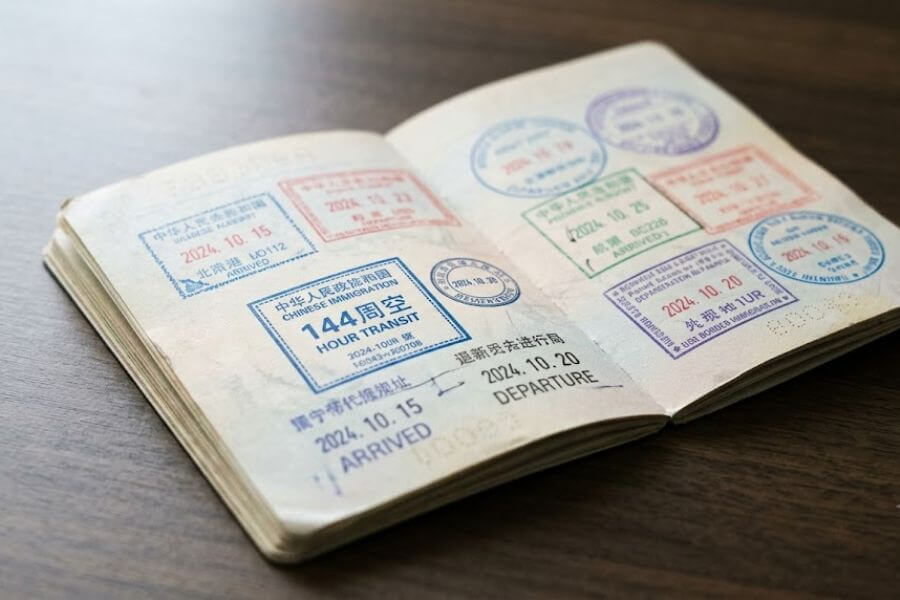
If everything looks correct, the officer will print out a large, rectangle sticker and place it directly into your passport. This sticker is your Temporary Entry Permit. It will clearly display your arrival date, your maximum departure date, and the specific region where you are allowed to stay. The officer will then stamp your passport, hand it back to you, and point you toward the baggage claim area. Congratulations, you are officially inside China!
The Secret Tricks to Finding and Booking Valid Flights
Booking flights for a three-country transit trip requires a bit more care than a standard vacation booking. You cannot always rely on basic travel search engines because they often bundle flights together in ways that can accidentally break the transit rules.
Avoid Multiple Stops Within Mainland China
As we mentioned earlier, your flight path cannot include more than one airport inside mainland China. Many cheap flights from North America or Europe to Asia involve multi-city layovers. For example, you might find a cheap ticket that goes from New York to Beijing, pauses for two hours, flies to Shanghai, stays for three days, and then goes to Seoul.
To a computer algorithm, this looks like a great deal. But to a Chinese border guard, this is an illegal itinerary because you visited two different transit zones (Beijing and Shanghai) on the same transit trip. When you are booking your tickets, always look for flights that fly directly into your chosen transit city from an international origin, and directly out of that same transit city to an international destination.
The Problem with Round-Trip Booking Engines
When you use popular flight search websites, you usually select “Round Trip” and type in your home city and your main destination. If you do this for a transit trip, the computer might create a ticket that uses the same hub twice.
To avoid this, use the Multi-City search option on flight websites. This allows you to manually input each leg of your journey as a separate flight, ensuring that you control exactly where the plane lands and where it goes next. Let us look at a smart way to structure your multi-city search inputs.
- Flight 1: Your Home City (e.g., Chicago) to Your Chosen Transit Hub (e.g., Beijing).
- Flight 2: Your Chosen Transit Hub (e.g., Beijing) to Your Next Vacation Destination (e.g., Bangkok).
- Flight 3: Your Next Vacation Destination (e.g., Bangkok) back to Your Home City (e.g., Chicago).
This structure fulfills the three-country rule perfectly and allows you to enjoy two amazing destinations for the price of one complex plane ticket.
Crucial Local Laws and Survival Rules Inside China
Once you step past the airport security gates, you are a guest in a country with unique laws and administrative systems. To keep your trip smooth and stress-free, you need to know about two major requirements that apply to every single visitor using the transit permit.
The Mandatory 24-Hour Hotel Registration Law
By law, every foreigner who stays overnight in China must register their place of residence with the local police department within twenty-four hours of arriving. This might sound intimidating, but if you are staying at a standard, licensed hotel, the process is completely automatic.
When you check in at your hotel front desk, the receptionist will ask for your passport. They will scan your temporary entry permit sticker, take a photo of your face, and upload your details directly to the local police computer database. You do not need to lift a finger.
However, if you plan to stay at an apartment rental, a small hostel, or a friend’s house, you are responsible for doing this registration yourself. You and your host must walk down to the nearest local police station with your passport, your host’s identification documents, and the property deed to register your stay manually. Because this can be a complicated and confusing process if you do not speak fluent Chinese, it is highly recommended that transit travelers stick to traditional hotels for their six-day stays.
Navigating the Digital World: Money and Apps
China has moved into a nearly paperless, cashless society. While major hotels will accept international credit cards, the vast majority of local taxi drivers, street food vendors, convenience stores, and restaurants do not accept foreign credit cards or even paper cash. Instead, everyone pays for everything using smartphone apps and QR codes.
To survive and thrive during your 144 hours, you must download and set up two vital apps before you land in China: WeChat and Alipay. Both of these apps now allow international travelers to link their foreign credit cards (like Visa or Mastercard) to their mobile accounts. Once linked, you can simply scan a vendor’s QR code to pay for a cheap bowl of noodles or a souvenir.
Additionally, you should download a reliable translation app that works offline, as well as a local map app like MetroMan to navigate the incredibly clean, safe, and fast subway systems in cities like Shanghai and Beijing.
Frequently Asked Questions
Can I use the 144-hour visa-free transit policy if I am traveling on a cruise ship or a train?
Yes, you absolutely can, but it depends entirely on the specific transit zone you select. The rules vary slightly between entry points. For instance, in the Shanghai-Jiangsu-Zhejiang zone, you can legally enter or exit through international cruise ship terminals along the Shanghai riverfront. In the Beijing-Tianjin-Hebei zone, you can enter via the massive cruise port in Tianjin. However, for most other zones, you are restricted to arriving and departing exclusively by air. International train arrivals do not currently support the 144-hour permit at most borders, so flying or cruising remains your safest and most predictable option.
What happens if my flight is delayed or canceled while I am in China and I overstay the 144 hours?
If an absolute emergency occurs, such as a major typhoon, a medical crisis, or a mechanical airline cancellation that forces your flight to stay grounded past your 144-hour limit, you will not be thrown into an airport cell, but you must act quickly. You cannot simply show up late to immigration and blame the weather. You must immediately contact your airline to get an official letter certifying the flight delay. Then, you or your hotel staff must contact the local Public Security Bureau Exit and Entry Administration office. The officers there will review your situation and issue you a special emergency visa extension that allows you to leave legally on the next available flight.
Can I visit Hong Kong and then return to mainland China under the same transit permit?
No, you cannot use a single permit to bounce back and forth. The moment you leave mainland China and enter Hong Kong, your active temporary entry permit is officially canceled and dead. If you want to return to mainland China from Hong Kong, you would have to start a brand-new transit journey that fulfills the three-country rule all over again. For example, a route of Shanghai to Hong Kong to Shanghai is illegal. However, a route of Shanghai to Hong Kong to Beijing to London would work perfectly, because each entry into mainland China is part of a separate, valid transit chain.
Is there a limit to how many times a year I can use this visa-free transit trick?
Currently, there is no official, written legal limit on how many times a year you can take advantage of the 144-hour visa-free transit rule. Some frequent business travelers and digital nomads use this policy multiple times a year to attend meetings or take quick city breaks. However, if border control officers see that your passport is completely packed with consecutive transit stamps, they might suspect that you are illegally working or living in China without the proper visa. If they suspect you are exploiting the system, they have the full legal right to deny your entry request on the spot, so it is best used for genuine holiday stopovers.