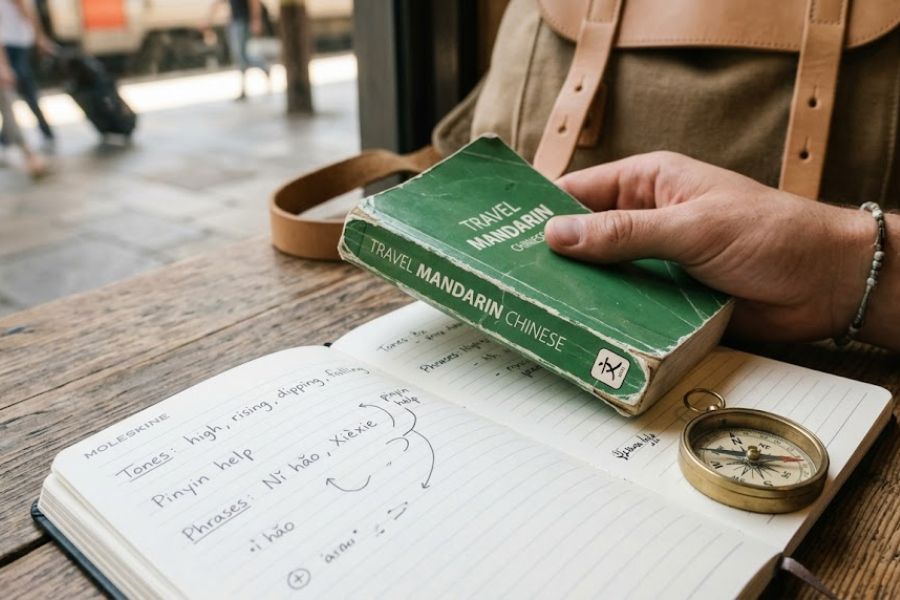
Key Takeaways for Navigating China
Before diving into the detailed strategies, here is a quick roadmap to help you map out your learning journey. This guide focuses on immediate, practical use so you can step off the plane with confidence.
- Prioritize Tones and Pinyin: Mastering the four tones prevents major communication mix-ups. Pinyin helps you read signs and menus instantly using the familiar Roman alphabet.
- Focus on High-Yield Phrases: Learn survival words for greetings, ordering food, asking for directions, and purchasing train tickets before memorizing random vocabulary.
- Embrace the Gestures: Chinese culture uses unique one-handed gestures for numbers one through ten. Learning these will save you from confusion at busy markets and restaurants.
- Leverage Digital Tools: Download mobile translation apps, offline maps, and digital payment systems beforehand, as they are essential for daily life in modern China.
Imagine stepping off a plane into a world where glowing neon signs dance in beautiful strokes, the aroma of steamed dumplings fills the air, and voices rise and fall like a musical melody. Traveling to China, Taiwan, or Singapore is an incredible adventure, but it can feel overwhelming if you cannot speak the local language. You do not need to memorize a whole dictionary to have an amazing trip. By focusing on the absolute core elements of Mandarin Chinese, you can unlock doors to hidden temples, order the best street food, and make local friends. Let us dive straight into the essential tools you need to navigate your upcoming journey with absolute ease.
Decoding the Sound System: Tones and Pinyin
The very first thing you notice when listening to Mandarin is its musical rhythm. Unlike English, where voice pitch changes your emotion, pitch changes the actual meaning of a word in Mandarin. This is a tonal language. If you say a word with the wrong pitch, you might accidentally say something completely different.
To help travelers read these sounds, the Chinese government created a system called Pinyin. This system uses the standard English alphabet to spell out the sounds of Chinese characters. It acts as your ultimate secret weapon because it lets you read street names, metro maps, and restaurant menus without needing to memorize thousands of complex characters right away.
The Four Essential Tones
Mandarin relies on four distinct pitches, plus a fifth neutral tone. Think of these tones like singing a song or expressing simple emotions in conversation.
The first tone is high and flat. Imagine singing a high note in music or saying “ahhh” at the doctor’s office. Your voice stays steady, high, and level from beginning to end. If you let your pitch drop, the word changes completely.
The second tone rises upward. This sounds exactly like you are asking a question in English, such as “What?” or “Huh?”. Start at a medium pitch and quickly slide your voice up to a higher pitch.
The third tone dips down and then curves back up. This is often the trickiest one for travelers. Imagine a gentle rollercoaster ride. Drop your voice low into your throat, then scoop it back up. It sounds a bit like a doubtful “Well…” in English.
The fourth tone drops sharply downward. This sounds like a short, angry command or a sudden exclamation like “No!”. Start very high and drop your voice down fast and forcefully.
Finally, the neutral tone is short, soft, and flat. It has no specific pitch and sounds like a quick whisper at the end of a word.
Common Pronunciation Traps
Pinyin looks like English, but some letters make completely different sounds. Recognizing these traps early will make your speech much clearer to local ears.
The letter Q sounds like the “ch” in the English word “cheese,” but you need to blow a lot of air out of your mouth while saying it.
The letter X sounds like a soft “sh” sound, but you make it by placing the tip of your tongue behind your lower front teeth. It feels like you are smiling while trying to say “sh.”
The letter Z sounds like the very end of the word “cats” or “reads.” It is a sharp “ds” sound.
The letters ZH sound like the “ch” in “choose,” but you roll the tip of your tongue slightly backward against the roof of your mouth.
Quick Tone Comparison Table
| Pinyin Word | Tone Style | Vocal Description | Actual English Meaning |
| mā | First Tone | High and level | Mother |
| má | Second Tone | Rising upward | Hemp or numb |
| mǎ | Third Tone | Dipping and scooping | Horse |
| mà | Fourth Tone | Sharp drop down | To scold |
| ma | Neutral Tone | Short and soft | Question maker |
Essential Everyday Greetings and Politeness
Once you feel comfortable with the idea of tones, it is time to practice your first real interactions. Politeness opens every single door when you are a guest in a foreign country. Local people appreciate any effort you make to speak their language, and a polite attitude ensures a warm welcome.
Saying Hello and Goodbye
The most famous greeting is nǐ hǎo, which literally translates to “you good.” You can say this to shopkeepers, hotel staff, taxi drivers, and people you meet on the street at any time of day. If you are speaking to an older person or someone in a position of high respect, like a hotel manager, you should use nín hǎo instead. This shifts the word “you” to a special respectful form.
When it is time to leave, you will say zài jiàn. This literally means “again meet” or “see you again.” It is the perfect way to wrap up a conversation at a market stall or say goodbye to your tour guide.
Showing Gratitude and Kindness
To say thank you, use the word xièxie. The first syllable uses the falling fourth tone, and the second syllable is neutral and soft. When someone says thank you to you, the correct response is bú kèqi, which means “you are welcome” or “do not be formal.”
If you accidentally bump into someone on a crowded subway train or need to squeeze past someone in a narrow market aisle, say duìbùqǐ. This means “sorry” or “excuse me.” Another useful phrase for getting someone’s attention politely is qǐng wèn, which translates to “please ask” or “may I ask.” Use this right before you ask for directions or help.
Handy Politeness Phrases
- Nǐ hǎo (Nee how) – Hello
- Nín hǎo (Neen how) – Hello (Respectful form for elders)
- Zài jiàn (Zigh jee-an) – Goodbye
- Xièxie (Shee-eh shee-eh) – Thank you
- Bú kèqi (Boo kuh-chee) – You are welcome
- Duìbùqǐ (Dway boo chee) – I am sorry
- Qǐng wèn (Cheeng wen) – Excuse me, may I ask?
Navigating Airports, Trains, and Taxis
Getting from point A to point B is one of the biggest parts of travel. Transport systems in major cities are huge, fast, and modern, but they can be confusing if you do not understand the words around you. Knowing how to name your destination and talk to drivers will make your travel days stress-free.
Talking to Taxi Drivers
When you step into a taxi, the driver will often say qǐng wù xīyān, pointing to a sign that means no smoking, or they will simply look back and wait for your destination. You should show them your map or a written address and say wǒ qù zhè lǐ, which means “I am going here.”
If you need to tell the driver where to turn, use zuǒ zhuǎn for left turn, and yòu zhuǎn for right turn. When you see your hotel or destination right ahead, you can yell out tíng chē, which means “stop the car,” or dào le, which means “arrived.”
Buying Train and Subway Tickets
Train travel is incredibly popular for moving between cities. When you walk up to a ticket counter, you need to state where you want to go and how many tickets you need. Use the formula: Target City + x nián/zhāng piào. For example, wǒ yào liǎng zhāng bēijīng de piào means “I want two tickets to Beijing.”
Subway stations have automated ticket machines that usually offer an English language option, but if you need to ask a staff member for help finding the right platform, point and ask zài nǎ lǐ, which means “where is it?”
Crucial Transportation Words
- Wǒ qù… (Waw choo…) – I am going to…
- Zhè lǐ (Juh lee) – Here
- Nǎ lǐ (Nah lee) – Where
- Zuǒ zhuǎn (Dzuo jwuan) – Turn left
- Yòu zhuǎn (Yo jwuan) – Turn right
- Tíng chē (Teeng chuh) – Stop the car
- Piào (Pee-ow) – Ticket
- Huǒchē (Hwuo chuh) – Train
- Dìtiě (Dee tee-eh) – Subway / Metro
- Chūtūchē (Choo too chuh) – Taxi
Mastering the Art of Ordering Food
One of the best reasons to travel is the food. From sizzling street skewers to steaming bowls of hand-pulled noodles, dining out is a true highlight. However, restaurant menus can look like a wall of mystery characters. Knowing a few basic words will help you get exactly what you want to eat without any unwanted surprises.
The Magic Ordering Words
When you sit down at a restaurant, you do not need complex grammar to order your food. You can simply point to an item on a menu, point to a picture, or point to a dish on a neighboring table and say wǒ yào zhè ge. This means “I want this one.” If you want a different item, point and say nà ge, which means “that one.”
To ask for the menu in the first place, catch the server’s eye and say qǐng gěi wǒ càidān, which translates to “please give me the menu.” When you are completely finished with your delicious meal and ready to pay, wave your hand gently and say mái dān, which means “bill please.”
Decoding Meat and Dietary Restrictions
If you have allergies or specific dietary habits, communicating them clearly is incredibly important. The word for meat is ròu, but different animals have specific words attached to them.
Vegetarians should learn the phrase wǒ chī sù, which means “I eat vegetarian food.” To make sure there are no hidden meat bits in your dish, you can say wǒ bù chī ròu, which means “I do not eat meat.” If you love spicy food, you will love the word là. If you cannot handle fiery spices, make sure to say bù yào là, which means “do not want spice.”
Dietary Preferences Table
| English Food Term | Pinyin Spelling | Pronunciation Guide | Travel Tip |
| Chicken | jī ròu | Jee row | Very common in stir-fry dishes. |
| Beef | niú ròu | Nee-oo row | Great in noodle soups. |
| Pork | zhū ròu | Joo row | The default meat if you just say “ròu.” |
| Fish | yú | Yoo | Often served whole during formal meals. |
| Water | shuǐ | Shway | Ask for bīng shuǐ if you want it cold. |
| Rice | mǐfàn | Mee fan | Order this to balance out spicy dishes. |
| Vegetarian | sùshí | Soo shee | Look for dedicated Buddhist restaurants. |
Asking for Directions and Finding Your Way
It is completely normal to get turned around or lost when exploring a brand new city. Streets can twist and turn, and maps sometimes show paths that look different in reality. Being able to ask local citizens for direction help will turn a stressful moment into a fun interaction.
Where is the Bathroom?
This is arguably the single most important phrase for any traveler anywhere in the world. To find a restroom, say cèsuǒ zài nǎ lǐ. This translates directly to “restroom at where?” You can also use the word wéishēngjiān instead of cèsuǒ for a slightly more formal version that means “hygiene room.”
If you are looking for specific landmarks like a train station, hotel, or scenic park, use the same sentence pattern. Just put the name of the place at the very beginning: [Place Name] + zài nǎ lǐ? For example, dìtiězhàn zài nǎ lǐ means “where is the subway station?”
Understanding the Directions You Receive
Asking the question is only half the battle; you also need to understand the answer given to you. People will often point and use directional words to show you the way.
If they say yizhí zǒu, they want you to walk straight ahead without turning. If they say guǎi, they mean turn. They might combine this with the directional words you learned for taxis, like zuǒ guǎi for turn left. When they point and say zài nà lǐ, it means “it is over there.” If it is close by, they might say zhè lǐ, meaning “right here.”
Navigation Vocabulary Checklist
- Cèsuǒ (Tsuo suwuo) – Bathroom / Restroom
- Wéishēngjiān (Way sheeng jee-an) – Bathroom (Formal)
- Dìtiězhàn (Dee tee-eh jhan) – Subway station
- Jiǔdiàn (Jee-oo dee-an) – Hotel
- Yīzhí zǒu (Ee jhee dzow) – Walk straight
- Guǎi (Gwigh) – Turn
- Qián miàn (Chee-an mee-an) – In front / Ahead
- Hòu miàn (Ho mee-an) – Behind
Shopping, Numbers, and Money Culture
Shopping at local street markets, souvenir boutiques, and night stalls is an exhilarating experience. It is a place filled with bright colors, shouting vendors, and unique treasures. To participate fully, you need to understand how numbers work, how to ask for prices, and how people actually pay for goods in modern times.
Asking for the Price
When you spot a beautiful silk scarf, a hand-carved tea set, or a tray of delicious snacks, you can find out the cost by pointing and saying zhè ge duōshǎo qián. This means “how much money is this one?”
If the price feels a bit too high for your travel budget, you can engage in friendly bargaining at street markets. Shake your hand gently and say tài guì le, which means “too expensive!” To ask for a lower price, say piányi yīdiǎn bā, which means “make it a little cheaper, please.” Keep your tone light and smiling, as bargaining should always be a fun, respectful negotiation.
Counting from One to Ten
Numbers are building blocks for prices, quantities, dates, and times. Memorizing numbers one through ten will serve you every single hour of your trip.
One is yī, a high flat sound. Two is èr, a quick downward drop. Three is sān, high and flat. Four is sì, a sharp drop down. Five is wǔ, which dips low. Six is liù, dropping down. Seven is qī, high and level. Eight is bā, high and level. Nine is jiǔ, dipping low. Ten is shí, rising upward.
Mastering Chinese Number Finger Gestures
In Western cultures, people use two hands to count up to ten. In Chinese culture, people have developed a clever system to count from one to ten using only one hand. This is incredibly helpful when your other hand is full of heavy shopping bags or tasty street snacks.
Numbers one through five look exactly like standard counting fingers. You hold up one finger for one, two fingers for two, and so on, until your whole hand is open for five.
The fun changes happen at number six. To show six, make a shape like the “hang loose” sign by extending your thumb and pinky finger while curling the middle three fingers down. For seven, pinch your thumb, index finger, and middle finger together tightly so they point down like a little bird beak. For eight, make an upside down “L” shape with your thumb and index finger, looking like a little toy gun. For nine, bend your index finger into a hook shape while curling the rest of your fingers into a fist. For ten, you can either cross your index and middle fingers together, or make a complete tight fist.
One-to-Ten Number Reference Table
| Number | Pinyin | Sound Style | Hand Gesture Description |
| 1 | yī | High flat | Index finger up |
| 2 | èr | Sharp drop | Index and middle finger up |
| 3 | sān | High flat | Three fingers extended up |
| 4 | sì | Sharp drop | Four fingers extended up |
| 5 | wǔ | Dipping | All five fingers wide open |
| 6 | liù | Sharp drop | Thumb and pinky out (Hang loose sign) |
| 7 | qī | High flat | Pinch thumb, index, and middle together |
| 8 | bā | High flat | Thumb and index finger open like an L shape |
| 9 | jiǔ | Dipping | Index finger curved into a hook shape |
| 10 | shí | Rising | Cross index and middle fingers, or make a fist |
Understanding Modern Digital Payment Systems
While cash used to be king, modern cities have shifted almost completely to a cashless society. Almost every vendor, from upscale shopping malls to tiny vegetable stalls on the street corner, uses QR codes for transactions. The two main apps are WeChat Pay and Alipay.
As a foreign traveler, you can download these apps and link your international credit card to them before your trip begins. When it is time to pay, you will either scan the vendor’s QR code or show them your personal payment code on your phone screen. If you want to know which code to scan, point to the signs and ask sǎo nǎ lǐ, which means “where do I scan?”
Handling Emergencies and Getting Urgent Help
No one wants to think about things going wrong during a vacation, but being prepared gives you ultimate peace of mind. If you lose your wallet, get separated from your travel group, or feel sudden medical illness, knowing how to call out for help will bring assistance to your side immediately.
Shouting for Immediate Attention
If you find yourself in immediate danger or witness an accident, you need a word that carries extreme urgency. Shout jiù mìng, which translates to “save life” or “help!” This word cuts through background noise and tells everyone around you that there is a serious crisis happening.
If someone is bothering you, following you, or refusing to leave you alone, say bù yào, which means “do not want,” in a loud, firm voice. You can also shout zǒu kāi, which means “go away!” This signals to bystanders that you are uncomfortable and need space.
Medical and Police Emergencies
If you feel very sick and need a doctor, say wǒ shēngbìng le, which means “I am sick.” If you need to go to a hospital immediately, say wǒ yào qù yīyuàn, which translates to “I want to go to the hospital.”
In situations involving theft or lost items, you will need to find the authorities. Ask someone gōngānfúwùzhàn zài nǎ lǐ or pàichūsuǒ zài nǎ lǐ to locate the nearest local police station. You can also tell someone bào jǐng, which means “call the police.”
Emergency Communication Kit
- Jiù mìng! (Jee-oo meeng) – Help! / Save me!
- Bào jǐng (Bao jeeng) – Call the police
- Yīyuàn (Ee yoo-an) – Hospital
- Wǒ shēngbìng le (Waw sheeng beeng luh) – I am sick
- Dàfū (Dah foo) – Doctor
- Jiùhùchē (Jee-oo hoo chuh) – Ambulance
- Zǒu kāi! (Dzow kigh) – Go away!
Smart Practice Strategies Before You Leave Home
Now that you have all the essential words and phrases in your travel toolbox, you need a plan to practice them. You do not need to study hours every day. Instead, smart, consistent habits will build your muscle memory so these sounds pop out naturally when you land.
Use the Power of Your Phone
Your smartphone is your ultimate language gym. Download flashcard apps that feature real human audio recordings. This allows you to listen to native speakers pronouncing the four tones over and over again while you walk to school, ride the bus, or wait in line.
Try setting your favorite navigation map app to speak Chinese guidance for familiar routes around your hometown. Hearing directional words like zuǒ zhuǎn and yòu zhuǎn while you walk around your own neighborhood makes those words feel normal and intuitive.
Speak Out Loud Every Single Day
Reading words silently in your head does not train your mouth, tongue, and throat muscles to make new shapes. You must speak the phrases out loud.
Practice ordering your favorite meals in front of your bedroom mirror. Say wǒ yào zhè ge while pointing at objects in your room. Act out interactions where you bargain for a lower price or ask for the location of the restroom. The more times your jaw muscles practice these movements, the less nervous you will feel using them in front of real people.
Connect with Native Speakers
If you have a local Chinatown neighborhood or a Chinese restaurant near your home, try using your new greetings. Start small by saying nǐ hǎo when you walk through the door and xièxie when you receive your food or change. Local servers are almost always delighted to hear visitors trying their native language, and their positive smiles will give you an enormous boost of personal confidence.
Frequently Asked Questions
Do I really need to learn Chinese characters to travel around major cities?
You do not need to learn to read or write complex characters for a standard tourist trip. In modern cities, almost all major public transport signs, subway maps, airport displays, and street signs feature clear Pinyin and English translations underneath the characters. Focusing your valuable energy on listening and speaking will give you much greater benefits during your daily interactions than trying to memorize written shapes.
What should I do if a local person cannot understand my pronunciation or tones?
If someone looks confused when you speak, do not panic or feel embarrassed. Take a deep breath and try saying the phrase one more time, making sure to exaggerate the high, rising, dipping, or falling shape of your tones. If they still look unsure, simply open a translation app on your phone, type your message in English, and show them the written characters on your screen. You can also use pictures or simple physical hand gestures to show what you mean.
Are translation phone apps reliable enough to replace learning the language completely?
Translation apps are fantastic tools for reading long menus, decoding museum signs, or handling complex situations, but they cannot replace basic speech. Technology can slow down, phone batteries can drain, and internet connections can drop unexpectedly in crowded underground stations. Speaking basic phrases directly shows deep respect for the local culture, sparks friendly smiles, and creates real human connections that a cold phone screen simply cannot replicate.
How many weeks ahead of my vacation should I begin studying these basics?
Starting your practice four to six weeks before your official departure date gives you plenty of time to get comfortable. Dedicating just ten to fifteen minutes every day allows your brain to absorb the unique sound system, master the four tones, and lock the vocabulary into your long-term memory without causing study burnout or stress. Consistency matters far more than long cramming sessions.
Is it considered rude to try and bargain for lower prices in stores?
Bargaining is a normal part of shopping culture, but only in specific places. You can safely negotiate prices at outdoor street markets, clothing stalls, and independent souvenir booths. However, you should never try to bargain in large department stores, modern supermarkets, upscale restaurants, or chain hotels where prices are printed clearly on official tags or modern computer receipts. Always keep your negotiations light, friendly, and smiling.