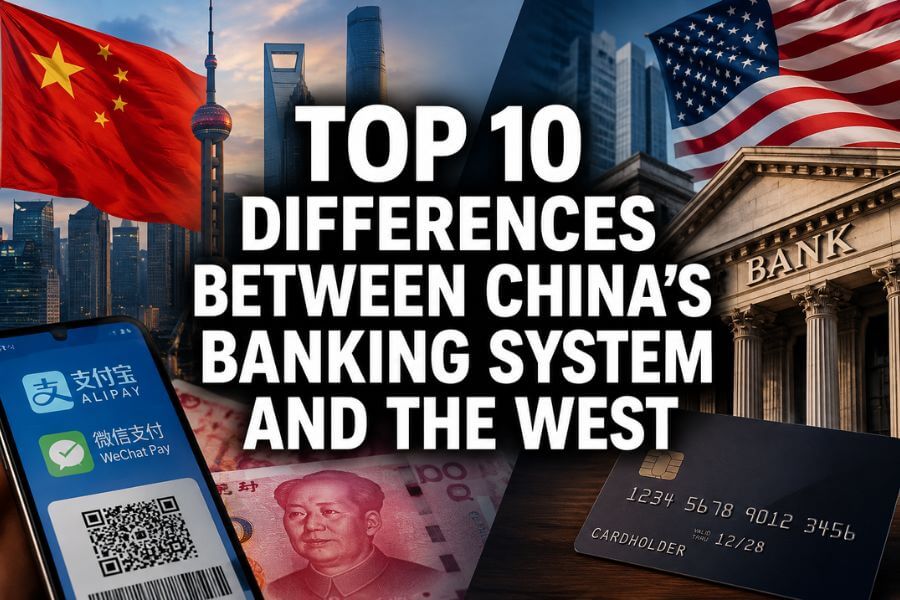
If you have ever compared banking in China with banking in the United States or Europe, you probably noticed that they operate very differently. While banks in Western countries often focus on private competition, consumer choice, and global investment, China’s banking system is much more connected to government planning and national economic goals.
Understanding these differences can help you make smarter financial decisions, especially if you plan to invest in China, work with Chinese companies, travel there, or simply learn more about how the world’s second-largest economy operates. China’s banking system is one of the biggest in the world, but it follows rules and priorities that may feel unfamiliar if you are used to Western banking.
In this guide, you will discover the top 10 differences between China’s banking system and the West. You will learn how banks are controlled, how payments work, why digital finance is growing so quickly in China, and what makes the Chinese system unique compared to countries like the United States, Canada, the United Kingdom, and many parts of Europe.
Quick Summary Table 💳
| Difference | China’s Banking System | Western Banking System |
|---|---|---|
| Government Control | Strong government influence | Major banks are state-owned |
| Digital Payments | Mobile payments dominate daily life | Cards still widely used |
| State-Owned Banks | Major banks are state owned | Many large private banks |
| Credit Systems | Social and financial data closely connected | Focus mainly on financial history |
| Foreign Access | More restrictions for foreign banks | More open international access |
| Savings Habits | High savings culture | Higher consumer spending culture |
| Loan Priorities | National economic goals influence lending | Profit and market demand guide lending |
| Currency Controls | Strict controls on money movement | Freer currency movement |
| Banking Apps | Super apps combine many services | Services often separated |
| Innovation Speed | Fast rollout of fintech systems | Slower due to regulation and legacy systems |
How We Ranked These Differences 📊
We ranked these banking differences based on several important factors that affect everyday people, businesses, and international investors.
Key Factors We Considered
- Impact on daily banking experiences
- Importance to global finance
- Differences in government involvement
- Technology adoption speed
- Consumer behavior changes
- Accessibility for foreigners
- Influence on economic growth
- Financial security and regulation
- Innovation in payment systems
- Long-term global financial influence
1. Government Control Over Banks 🏛️
One of the biggest differences between China’s banking system and the West is the level of government control.
In China, the government plays a major role in the banking industry. Many of the country’s largest banks are state-owned, including the “Big Four” Chinese banks. These banks often support national economic goals instead of focusing only on profits.
In Western countries like the United States and the United Kingdom, banks are generally privately owned businesses. While governments regulate them, they usually do not directly control how banks operate day to day.
This difference changes how lending decisions are made. In China, banks may provide loans to industries that the government wants to strengthen, such as renewable energy, infrastructure, or technology manufacturing. Even if profits are lower in the short term, national priorities often come first.
In the West, banks are more likely to focus heavily on profitability, shareholder value, and market competition. Loan approvals are often based primarily on financial risk and expected returns.
For you as a consumer or investor, this means Chinese banks may behave more predictably during national economic campaigns, while Western banks may react faster to market changes and economic pressure.
China’s system allows strong coordination between banks and government plans, but critics sometimes argue that it can reduce competition and increase financial inefficiency.
2. Mobile Payments Are Far More Dominant in China 📱
China has become one of the most cashless societies in the world.
If you visit major Chinese cities, you will quickly notice that many people rarely use physical cash or even credit cards. Instead, mobile payment platforms dominate everyday life. People use smartphones to pay for groceries, taxis, restaurants, street food, utility bills, and even small purchases from local vendors.
In many Western countries, credit and debit cards remain the primary payment method. While mobile wallets like Apple Pay and Google Pay are growing, they still have not completely replaced cards.
China’s rise in mobile payments happened extremely fast because the country skipped several stages of banking development. Instead of relying heavily on credit cards for decades, China moved directly into smartphone-based payment systems.
Chinese payment ecosystems are also more integrated into daily life. Banking, shopping, messaging, ride sharing, food delivery, and investing can all happen inside one app.
Western systems are usually more separated. You may use one app for banking, another for messaging, another for shopping, and another for transportation.
This difference creates a smoother digital experience in China, but it also raises concerns about privacy, data concentration, and surveillance.
For visitors from Western countries, China’s payment culture can feel both highly convenient and surprisingly different.
3. State-Owned Banks Dominate China’s Financial System 🏦
Another major difference is ownership structure.
China’s banking industry is heavily dominated by state-owned banks. The government has significant influence over the country’s largest financial institutions.
These banks are enormous and play a central role in funding national projects, infrastructure expansion, housing development, and industrial growth.
In the West, large banks are usually publicly traded corporations with private shareholders. Even though governments may step in during financial crises, most banks operate independently from direct state ownership.
Because China’s largest banks are state-backed, many people inside the country view them as stable and secure. Customers often believe the government will support major banks if problems occur.
In Western countries, confidence also exists, but the market environment is generally more competitive. Smaller private banks, regional banks, and online banks compete aggressively for customers.
China’s banking market has historically been less open to foreign competition as well. Western banking markets tend to allow broader international participation.
For consumers, this means China’s financial system often feels more centralized, while Western systems may offer more diversity and competition.
4. China Uses Banking to Support National Goals 🚄
Chinese banks are deeply connected to national economic planning.
In the West, banks mainly aim to maximize profits and reduce risk. Governments can influence monetary policy through central banks, but private banks still make many decisions independently.
In China, banks are often expected to support strategic national goals. These can include building infrastructure, supporting manufacturing, increasing exports, expanding clean energy, or helping economic growth during slower periods.
For example, if the Chinese government wants to stimulate the economy, banks may increase lending to targeted industries very quickly.
This approach helped China finance massive infrastructure projects, including railways, airports, highways, and urban development at remarkable speed.
Western systems may move more slowly because private banks often hesitate to lend during uncertain economic conditions.
China’s system allows rapid economic coordination, but it can also create concerns about inefficient investments and rising debt levels.
As an investor or business owner, understanding this relationship between banks and government policy is extremely important when analyzing China’s economy.
5. Credit Systems Work Differently 📈
Credit scoring in China is different from what most Western consumers are used to.
In the United States, your credit score mainly depends on financial behavior such as loan repayments, credit card usage, debt levels, and payment history.
China also tracks financial behavior, but its systems can involve broader digital data connections. Technology companies and financial platforms may use additional information to evaluate consumers.
For example, shopping behavior, mobile payment activity, and financial app usage can sometimes influence lending evaluations.
Western countries usually keep financial scoring more separate from broader lifestyle data, although data collection is expanding there as well.
China’s approach allows faster lending decisions and wider financial access for some people who may not have traditional credit histories.
However, it also raises concerns about data privacy and how personal information is used.
The idea of broader financial monitoring often feels uncomfortable to many Western consumers who are used to a stronger separation between financial data and daily digital behavior.
This difference reflects wider cultural and political differences regarding privacy, technology, and state oversight.
6. Foreign Banks Face More Restrictions in China 🌐
China’s banking market is less open to foreign banks compared to many Western economies.
In countries like the United States, Canada, and the United Kingdom, international banks can often operate relatively freely if they meet regulatory standards.
China has historically placed tighter restrictions on foreign financial institutions. Foreign banks may face limits on expansion, licensing, investment activities, and local market access.
Although China has slowly opened parts of its financial sector in recent years, domestic Chinese banks still dominate the market.
This controlled environment helps China maintain financial stability and government oversight, but it also reduces foreign competition.
Western banking systems are generally more globalized. Large international banks compete across borders and operate branches worldwide.
For foreign businesses entering China, banking regulations can feel more complicated and tightly managed.
At the same time, China’s cautious approach may reduce certain financial risks associated with rapid foreign capital movement.
This difference highlights China’s focus on financial control and economic security.
7. Chinese Consumers Save More Money 💰
Consumer financial behavior is another major difference.
Chinese households are known for having high savings rates compared to many Western countries.
Several factors contribute to this behavior. Many Chinese families save heavily for housing, education, healthcare, retirement, and family security.
Historically, consumer credit was also less common in China than in Western economies.
In countries like the United States, consumer spending plays a huge role in economic growth. Credit cards, personal loans, and installment financing are widely used.
Western consumers are generally more comfortable borrowing money for homes, cars, vacations, education, and lifestyle spending.
Chinese consumers have become more open to digital lending and consumer finance in recent years, but strong saving habits still remain an important cultural and economic feature.
This difference affects how banks operate.
Chinese banks traditionally relied heavily on customer deposits, while Western banks often generate large profits from consumer lending and credit products.
For investors, this means banking profitability models can look very different between China and the West.
8. China Maintains Strong Currency Controls 💹
China controls the movement of money across borders more strictly than many Western countries.
The Chinese government closely manages the value and flow of the yuan. There are rules limiting how much money individuals and businesses can move internationally.
Western countries like the United States generally allow freer movement of capital and currencies.
China uses these controls to protect financial stability, manage economic risks, and prevent sudden capital outflows during uncertain periods.
For example, if investors suddenly try to move large amounts of money out of the country, currency controls can help reduce financial panic.
Western economies typically rely more on market forces to determine currency movements.
For international businesses and investors, China’s controls can create additional steps when transferring money, investing abroad, or converting currencies.
Supporters argue that these controls protect China from financial shocks. Critics argue that they limit financial freedom and global integration.
Understanding these controls is very important if you plan to do business in China or invest in Chinese markets.
9. Chinese Banking Apps Are More Integrated 🤖
China’s banking and financial apps are incredibly advanced and interconnected.
Many Chinese consumers use “super apps” that combine banking, investing, shopping, messaging, insurance, transportation, and entertainment into one ecosystem.
This level of integration is still less common in the West.
In the United States and Europe, financial services are often divided between separate companies and apps. A person may use different platforms for banking, investing, shopping, food delivery, and communication.
China’s integrated digital ecosystem creates speed and convenience.
You can transfer money, pay bills, buy train tickets, order food, invest in money market funds, and communicate with friends all inside a single app.
This convenience has helped fintech growth explode in China.
However, it also increases concerns about market dominance and personal data concentration.
Western regulators are often more cautious about allowing one company to control so many parts of consumers’ digital lives.
China’s digital finance environment, therefore, feels much more unified and centralized than most Western systems.
10. Financial Innovation Moves Faster in China ⚡
China has become one of the fastest-moving financial technology markets in the world.
New banking technologies can spread across China extremely quickly because of strong smartphone adoption, large user bases, centralized coordination, and consumer openness to digital services.
Features like QR code payments, digital wallets, online lending, and digital currency experiments gained mass adoption in China much faster than in many Western countries.
Western countries often move more slowly because they have older banking infrastructure, stricter regulations, and more fragmented financial systems.
China’s rapid innovation creates exciting opportunities for businesses and consumers, but it can also increase financial risks if regulations struggle to keep up.
For example, online lending growth in China expanded very quickly before regulators introduced tighter controls.
The Chinese government has recently increased oversight of fintech companies to reduce financial risks and maintain stability.
Even so, China remains one of the global leaders in digital finance innovation.
If you compare daily banking experiences, many aspects of China’s financial technology ecosystem may feel years ahead of traditional Western banking systems.
Conclusion 🧭
China’s banking system is very different from what most people in Western countries are used to. While Western banking focuses heavily on private competition, consumer lending, and market-driven decision-making, China’s system is much more connected to government planning and national economic strategy.
These differences affect everything from how people pay for coffee to how major industries receive funding. China leads in areas like mobile payments, integrated financial apps, and fast fintech adoption, while Western systems often emphasize competition, financial openness, and private sector independence.
Neither system is perfect. China’s model offers speed, coordination, and digital convenience, but it also raises questions about privacy, regulation, and government control. Western systems provide greater market freedom and international openness, but they can sometimes move more slowly and face greater financial volatility.
As China continues to grow economically, understanding its banking system becomes increasingly important for investors, travelers, businesses, and anyone interested in global finance. The more you understand these differences, the easier it becomes to navigate the changing global economy.
Frequently Asked Questions ❓
Is China’s banking system bigger than the United States?
China has some of the world’s largest banks by total assets. The country’s banking sector is enormous and plays a major role in supporting economic growth and infrastructure development.
Can foreigners easily open bank accounts in China?
Foreigners can open bank accounts in China, but the process may involve more paperwork and identity verification compared to many Western countries. Requirements can vary between banks and cities.
Why are mobile payments so popular in China?
Mobile payments became popular because smartphone adoption grew quickly and digital payment apps offered fast, convenient alternatives to cash and cards. QR code payments are now deeply connected to everyday life in China.
Does China have credit cards like the West?
Yes, China has credit cards, but mobile payment platforms are often used more frequently for daily purchases. Credit card culture developed later in China than in many Western countries.
Is China creating a digital currency?
Yes, China has been developing and testing a central bank digital currency known as the digital yuan. It is part of the country’s broader effort to modernize payments and strengthen financial technology leadership.