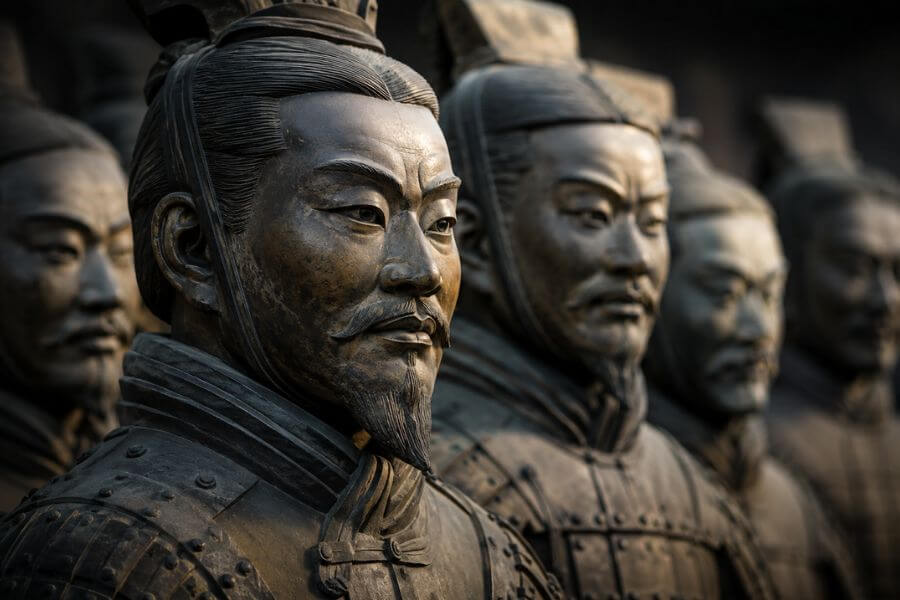
China has one of the longest and most influential histories in the world. Over thousands of years, powerful rulers, military leaders, philosophers, and reformers shaped not only China but also the course of global history. Some unified vast territories, some created lasting political systems, and others transformed culture, education, and society in ways that are still felt today.
If you want to understand how China became one of the world’s great civilizations, you need to know the people who played the biggest roles in its development. In this guide, you’ll discover ten of the most powerful historical figures in Chinese history and learn why their influence continues to matter centuries later.
Quick Summary Table 📜
| Rank | Historical Figure | Time Period | Main Achievement |
|---|---|---|---|
| 1 | Qin Shi Huang | Qin Dynasty | Unified China for the first time |
| 2 | Confucius | Spring and Autumn Period | Created influential philosophy |
| 3 | Emperor Wu of Han | Han Dynasty | Expanded China’s power and territory |
| 4 | Wu Zetian | Tang Dynasty | China’s only female emperor |
| 5 | Kublai Khan | Yuan Dynasty | Founded the Yuan Dynasty |
| 6 | Zhu Yuanzhang | Ming Dynasty | Established the Ming Dynasty |
| 7 | Kangxi Emperor | Qing Dynasty | Oversaw one of China’s golden ages |
| 8 | Sun Yat-sen | Early Republic | Helped end imperial rule |
| 9 | Mao Zedong | Modern China | Founded the People’s Republic of China |
| 10 | Deng Xiaoping | Modern China | Led economic reforms and modernization |
How We Ranked These Historical Figures 🏮
To determine the most powerful historical figures in Chinese history, we considered several important factors:
- Long-term impact on Chinese civilization
- Political and military influence
- Ability to unite or transform China
- Cultural and philosophical contributions
- Economic achievements and reforms
- Influence beyond China’s borders
- Legacy that continues into modern times
- Historical significance recognized by scholars
1. Qin Shi Huang – The First Emperor of China 👑
Qin Shi Huang stands at the top of almost every discussion about powerful Chinese leaders. Before his rise, China was divided into competing states that constantly fought one another. Through military conquest and political skill, he unified these territories in 221 BC and created China’s first centralized empire.
His accomplishments were extraordinary. He standardized weights, measures, currency, and writing systems across the empire. These reforms made trade, communication, and governance far more efficient.
He also began large construction projects, including early sections of what later became the Great Wall. Massive road networks connected different regions, helping strengthen imperial control.
Although his rule was often harsh and authoritarian, the political structure he created became the foundation for future Chinese dynasties. The very concept of a unified China owes much to Qin Shi Huang’s vision and determination.
2. Confucius – The Teacher Who Shaped Chinese Thought 📚
Unlike many people on this list, Confucius gained power through ideas rather than armies. Born in 551 BC, he became one of the most influential philosophers in world history.
His teachings emphasized morality, respect, family values, education, and responsible leadership. These principles became the foundation of Chinese society for more than two thousand years.
Confucian thought influenced government examinations, educational systems, family structures, and social behavior across East Asia. Leaders throughout Chinese history relied on his teachings to guide governance.
Even today, many cultural values in China, Korea, Japan, and Vietnam reflect Confucian ideas. Few individuals in human history have shaped the thinking of so many people for so long.
3. Emperor Wu of Han – The Builder of an Empire 🐉
Emperor Wu ruled during the Han Dynasty from 141 BC to 87 BC and transformed China into a major world power.
Under his leadership, China’s territory expanded dramatically. His military campaigns pushed Chinese influence deep into Central Asia, opening routes that later became known as the Silk Road.
Trade flourished as goods, technologies, and ideas moved between East and West. China became wealthier and more influential than ever before.
Emperor Wu also made Confucianism the official state philosophy, ensuring its dominance for centuries. His combination of military success, economic growth, and cultural influence makes him one of China’s greatest rulers.
4. Wu Zetian – China’s Only Female Emperor 🌸
Wu Zetian remains one of the most remarkable figures in Chinese history. Rising from a court position to become emperor, she broke barriers in a society largely dominated by men.
During her reign, she improved government administration and promoted talented officials regardless of family background. This helped create a more effective government.
Economic development continued under her rule, and China remained stable and prosperous. She also supported education, agriculture, and cultural growth.
While her methods were sometimes controversial, her ability to seize and maintain supreme power in a male-dominated era demonstrates extraordinary political skill.
5. Kublai Khan – The Conqueror Who Ruled China 🐎
Kublai Khan, grandson of Genghis Khan, became one of the most powerful rulers in Chinese history when he founded the Yuan Dynasty.
He completed the Mongol conquest of China and established a government that ruled over one of the largest empires in history.
Kublai Khan encouraged trade, expanded international contacts, and supported cultural exchanges between East and West. During his reign, travelers and merchants from distant lands visited China in greater numbers.
His leadership connected China to a vast network stretching across Asia and beyond, increasing China’s global influence.
6. Zhu Yuanzhang – The Founder of the Ming Dynasty 🏯
Zhu Yuanzhang’s story is one of the most dramatic in Chinese history. Born into poverty, he rose through rebellion and warfare to become the founder of the Ming Dynasty.
After driving out the Mongol rulers, he restored native Chinese rule and rebuilt the country following years of instability.
He strengthened agriculture, improved government institutions, and promoted economic recovery. His reforms helped create a strong foundation for one of China’s most successful dynasties.
The Ming Dynasty became known for stability, cultural achievements, and major construction projects, including improvements to the Great Wall.
7. Kangxi Emperor – Master of a Golden Age 🌟
The Kangxi Emperor ruled for more than sixty years and is widely regarded as one of China’s greatest emperors.
His reign brought stability, prosperity, and territorial expansion. He strengthened central authority while encouraging education, science, and culture.
Under Kangxi, the Qing Dynasty reached new heights of power. The empire expanded significantly and maintained internal peace across vast territories.
He was also known for intellectual curiosity and support for scholarship, helping create one of the most successful periods in Chinese history.
8. Sun Yat-sen – The Father of Modern China 🇨🇳
By the late nineteenth century, China’s imperial system faced enormous challenges. Sun Yat-sen emerged as a revolutionary leader who sought to modernize the country.
His efforts helped bring down the Qing Dynasty in 1911, ending over two thousand years of imperial rule.
Sun promoted ideas of nationalism, democracy, and modernization. Although he never fully realized all of his goals, his vision influenced generations of Chinese leaders.
Today, he is respected by people across different political viewpoints and is often called the Father of Modern China.
9. Mao Zedong – Founder of the People’s Republic of China 🚩
Few figures have changed China as dramatically as Mao Zedong. In 1949, he proclaimed the founding of the People’s Republic of China after decades of conflict and revolution.
Mao transformed China’s political, social, and economic systems. His leadership reshaped nearly every aspect of Chinese society.
His legacy remains complex. Supporters credit him with unifying China and improving national independence, while critics point to policies that caused major hardships.
Regardless of perspective, his influence on modern China is impossible to ignore. He remains one of the most consequential leaders in Chinese history.
10. Deng Xiaoping – Architect of China’s Economic Rise 💹
After Mao’s era, Deng Xiaoping introduced reforms that changed China’s future.
He encouraged market-oriented economic policies while maintaining political stability. These reforms opened China to global trade and investment.
Under Deng’s leadership, millions of people were lifted out of poverty, industries expanded rapidly, and China began its transformation into an economic powerhouse.
Much of modern China’s economic success can be traced directly to the decisions Deng made during the late twentieth century. His influence continues to shape China today.
Conclusion 🎯
Chinese history is filled with extraordinary individuals, but these ten figures stand above the rest because of their lasting impact on the nation and the world. From Qin Shi Huang’s unification of China to Deng Xiaoping’s economic reforms, each person transformed the course of history in a unique way.
As you look at China’s development across thousands of years, you can see how leadership, ideas, military power, and innovation combined to shape one of humanity’s greatest civilizations. Understanding these figures gives you a deeper appreciation of China’s rich history and its continuing influence in the modern world.
Frequently Asked Questions ❓
Who is considered the most powerful ruler in Chinese history?
Many historians consider Qin Shi Huang the most powerful ruler because he unified China for the first time and created the centralized system that influenced later dynasties.
Why is Confucius included among powerful historical figures if he was not a ruler?
Confucius influenced Chinese society through philosophy rather than political power. His ideas shaped education, government, family life, and culture for over two thousand years.
Was Wu Zetian a successful emperor?
Yes. Despite controversy surrounding her reign, Wu Zetian maintained stability, improved administration, and strengthened the Chinese state during her time in power.
Which historical figure had the greatest impact on modern China?
Many experts point to Mao Zedong and Deng Xiaoping. Mao established modern China politically, while Deng transformed it economically.
Why are military leaders important in Chinese history?
Military leaders often unified divided regions, defended the empire, expanded territory, and created the stability needed for economic and cultural growth.