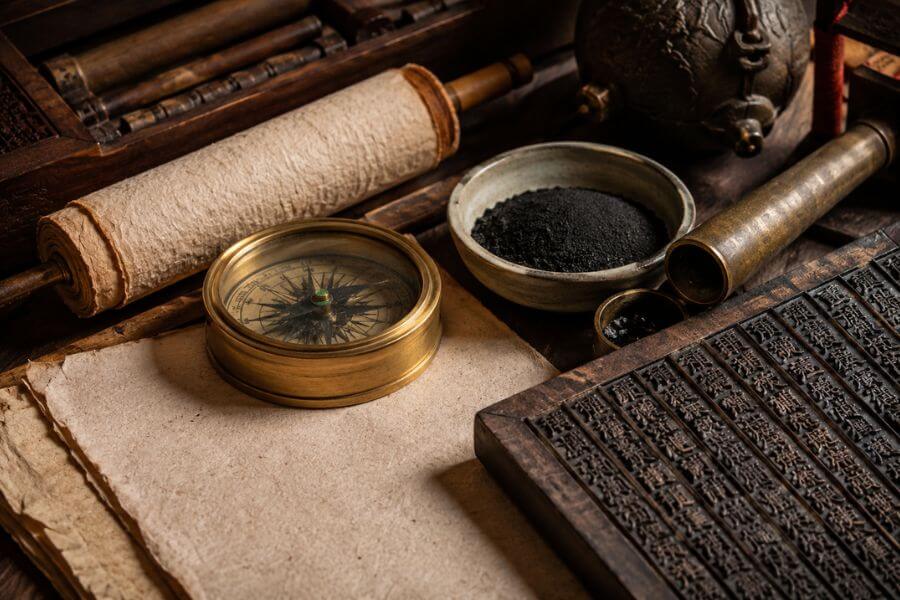
When you think about inventions that changed human history, you might picture modern technology such as smartphones or computers. However, many of the innovations that shaped today’s world were created thousands of years ago in ancient China.
Ancient Chinese inventors, scholars, and craftsmen developed groundbreaking tools, materials, and technologies that transformed communication, navigation, warfare, education, trade, and everyday life. Some of these inventions spread across continents and became essential parts of civilization.
In this guide, you’ll discover the 10 greatest ancient Chinese inventions that changed the world. These innovations helped shape the modern age and continue to influence how you live today.
Quick Summary Table 📋
| Rank | Invention | Approximate Period | Global Impact |
|---|---|---|---|
| 1 | Paper | Han Dynasty | Revolutionized writing and education |
| 2 | Printing | Tang and Song Dynasties | Enabled mass distribution of knowledge |
| 3 | Compass | Han Dynasty | Changed navigation and exploration |
| 4 | Gunpowder | Tang Dynasty | Transformed warfare worldwide |
| 5 | Silk Production | Ancient China | Created global trade networks |
| 6 | Porcelain | Tang and Song Dynasties | Influenced art and manufacturing |
| 7 | Seismograph | Han Dynasty | Improved earthquake detection |
| 8 | Wheelbarrow | Han Dynasty | Increased transportation efficiency |
| 9 | Cast Iron Technology | Zhou Dynasty | Advanced construction and industry |
| 10 | Mechanical Clock Innovations | Song Dynasty | Improved timekeeping systems |
How We Ranked These Inventions ⭐
To identify the greatest ancient Chinese inventions, we considered several important factors:
- Long-term impact on world civilization
- Influence on science and technology
- Contribution to education and knowledge
- Effect on global trade and commerce
- Historical significance
- Adoption by other cultures and nations
- Lasting relevance in modern society
- Ability to transform everyday life
1. Paper 📜
Paper stands as one of the most important inventions in human history. Before paper became widely available, people wrote on bamboo strips, silk, animal skins, or other expensive materials.
During the Han Dynasty, the court official Cai Lun improved paper-making techniques using bark, hemp, cloth scraps, and fishing nets. The result was a cheaper and more practical writing surface.
The invention of paper dramatically changed how information was stored and shared. Governments could keep better records, scholars could write more books, and education became more accessible.
As paper-making spread throughout Asia, the Middle East, and Europe, it fueled scientific discoveries, literature, religion, and government administration.
Without paper, the development of modern education and knowledge sharing would have been much slower.
2. Printing 🖨️
Printing changed the world by making information available to far more people than ever before.
Ancient Chinese craftsmen first developed woodblock printing, where entire pages were carved into wooden blocks. Later, innovators created movable type printing systems that allowed individual characters to be rearranged and reused.
Printing enabled books, calendars, religious texts, and government documents to be produced in large quantities.
For the first time in history, knowledge could spread quickly across regions and social classes. This helped improve literacy rates and encouraged intellectual growth.
Modern publishing, newspapers, magazines, and even digital printing can trace their roots back to these early Chinese innovations.
3. Compass 🧭
The compass changed how humans explored the world.
Early Chinese compasses were made using naturally magnetic lodestones. Initially, they were used for fortune-telling and geographic alignment before becoming valuable navigation tools.
Once sailors began using compasses at sea, travel became safer and more reliable. Ships no longer needed to rely solely on stars or visible landmarks.
The compass played a major role in the growth of international trade, exploration, and maritime empires.
Many of history’s greatest voyages would not have been possible without this invention.
Even today, modern navigation systems owe a debt to the ancient Chinese discovery of magnetism and directional guidance.
4. Gunpowder 💥
Gunpowder began as an accidental discovery by Chinese alchemists searching for substances that could extend life.
Instead, they created a mixture capable of producing powerful explosions.
At first, gunpowder was used in fireworks and ceremonial displays. Over time, military leaders recognized its potential and incorporated it into weapons.
The invention eventually led to rockets, cannons, bombs, and firearms that transformed warfare around the world.
Gunpowder altered military strategy, changed the balance of power between nations, and influenced the rise and fall of empires.
Few inventions have had such a profound impact on global history.
5. Silk Production 🧵
For thousands of years, China closely guarded the secrets of silk production.
Silk was prized for its softness, strength, and beauty. It became one of the most valuable luxury goods in the ancient world.
Demand for silk helped create extensive trade routes connecting China with Central Asia, the Middle East, and Europe. These routes became known as the Silk Road.
Beyond economics, silk encouraged cultural exchange between different civilizations. Ideas, religions, technologies, and artistic styles traveled alongside silk goods.
The silk industry helped establish China as one of the world’s most influential economic powers.
6. Porcelain 🏺
Chinese porcelain became famous across the world for its elegance, durability, and craftsmanship.
Made from refined clay and fired at extremely high temperatures, porcelain was stronger and more beautiful than many other ceramic products available at the time.
Foreign merchants eagerly purchased Chinese porcelain, and it became a symbol of wealth and sophistication.
The popularity of porcelain influenced manufacturing techniques across Europe, the Middle East, and Asia.
Today, many fine dishes, decorative items, and ceramics still use methods inspired by ancient Chinese porcelain makers.
7. Seismograph 🌋
One of the most remarkable scientific achievements of ancient China was the invention of the seismograph.
Created by the scientist Zhang Heng during the Han Dynasty, this device could detect distant earthquakes even when people could not feel them.
The instrument used an ingenious mechanical design that indicated the direction of seismic activity.
This allowed government officials to respond more quickly to disasters and provide assistance to affected regions.
The seismograph demonstrated an advanced understanding of natural phenomena and laid the foundation for modern earthquake monitoring systems.
8. Wheelbarrow 🚜
The wheelbarrow may seem simple, but it dramatically improved transportation and labor efficiency.
Before its invention, moving heavy loads required significant manpower or animals.
Chinese engineers designed wheelbarrows that allowed a single person to transport large amounts of goods with relative ease.
The invention proved useful in agriculture, construction, military logistics, and trade.
Its practical design spread across the world and remains useful today.
Many modern transportation tools are based on the same basic principles introduced by ancient Chinese inventors.
9. Cast Iron Technology ⚒️
Ancient China became a leader in metalworking through the development of advanced cast iron production techniques.
Chinese metalworkers learned how to melt iron at high temperatures and pour it into molds to create tools, weapons, farming equipment, and construction materials.
This technology significantly increased manufacturing capabilities and improved agricultural productivity.
Strong iron tools allowed farmers to cultivate larger areas of land and support growing populations.
Cast iron also contributed to infrastructure development and military strength, making it one of China’s most important technological achievements.
10. Mechanical Clock Innovations ⏰
Long before modern clocks existed, Chinese inventors were developing sophisticated timekeeping systems.
One of the most famous examples was the astronomical clock tower created by Su Song during the Song Dynasty.
These mechanical devices combined gears, water power, and engineering expertise to track time and observe celestial movements.
Accurate timekeeping improved government administration, scientific observation, and daily life.
The principles behind these inventions influenced future clock-making developments around the world.
Modern mechanical engineering owes much to these early Chinese innovations.
Conclusion 🚀
Ancient China gave the world many inventions that transformed human civilization. From paper and printing to the compass and gunpowder, these innovations shaped how people communicate, travel, learn, trade, and build societies.
What makes these inventions remarkable is not just their age but their lasting influence. Thousands of years later, many of their core ideas remain part of everyday life.
When you look at modern education, global trade, navigation systems, engineering, and communication technologies, you can still see the legacy of ancient Chinese creativity and innovation.
These inventions remind you that some of history’s greatest breakthroughs came from curious minds determined to solve problems and improve the world.
Frequently Asked Questions ❓
Which ancient Chinese invention had the greatest impact on humanity?
Many historians consider paper to be the most influential because it made knowledge sharing, education, government record-keeping, and communication far more accessible. Without paper, the spread of ideas would have been much slower.
Why are paper, printing, the compass, and gunpowder called the Four Great Inventions?
These inventions are known as the Four Great Inventions because they had an extraordinary influence on world civilization. They transformed communication, exploration, education, and warfare on a global scale.
How did Chinese inventions spread to other countries?
Most inventions spread through trade routes, diplomatic exchanges, migration, and cultural interactions. The Silk Road played a particularly important role in sharing Chinese technologies with other civilizations.
Are any ancient Chinese inventions still used today?
Yes. Paper, printing principles, compasses, wheelbarrows, porcelain, and many engineering concepts developed in ancient China continue to be used in modern forms.
What made ancient China such an innovative civilization?
Ancient China benefited from strong governments, large populations, advanced education systems, skilled craftsmen, and a culture that valued learning and problem-solving. These factors encouraged technological innovation over many centuries.