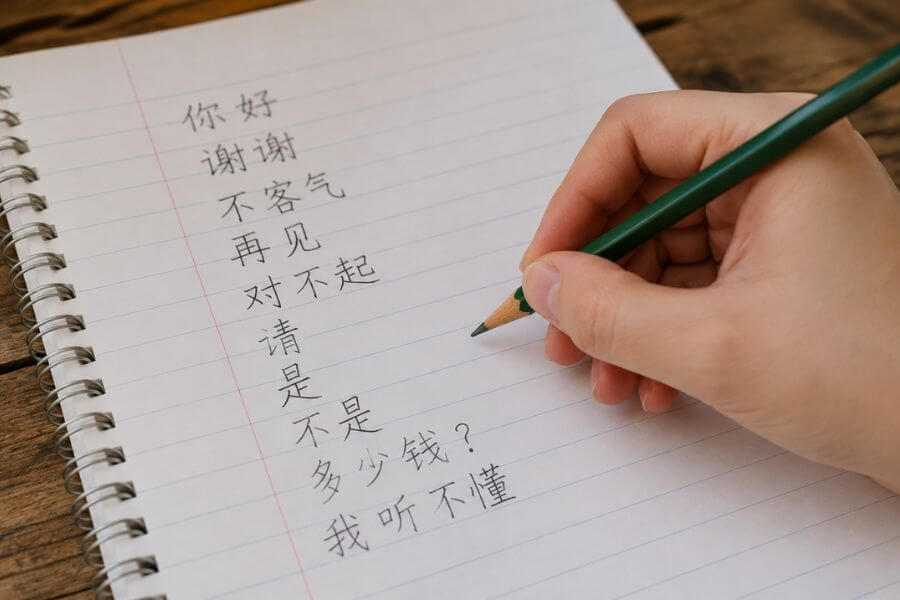
Learning Chinese can seem challenging at first, but you do not need to memorize thousands of words to start communicating. A small group of useful phrases can help you greet people, ask simple questions, show politeness, and handle everyday situations with confidence.
Whether you plan to travel to China, speak with Chinese friends, or begin your language-learning journey, knowing the most common Chinese phrases will give you a strong foundation. These phrases are used every day by millions of people and are among the first expressions that beginners should learn.
In this guide, you will discover 10 of the most common Chinese phrases for absolute beginners, what they mean, and how to use them naturally in conversation.
Quick Summary Table 📚
| Rank | Chinese Phrase | Pinyin | English Meaning |
|---|---|---|---|
| 1 | 你好 | Nǐ hǎo | Hello |
| 2 | 谢谢 | Xièxie | Thank you |
| 3 | 不客气 | Bú kèqi | You’re welcome |
| 4 | 再见 | Zàijiàn | Goodbye |
| 5 | 对不起 | Duìbuqǐ | Sorry |
| 6 | 请 | Qǐng | Please |
| 7 | 是 | Shì | Yes / To be |
| 8 | 不是 | Bú shì | No / Not |
| 9 | 多少钱? | Duōshao qián? | How much does it cost? |
| 10 | 我听不懂 | Wǒ tīng bù dǒng | I don’t understand |
How We Ranked These Phrases 🎯
We selected these beginner-friendly Chinese phrases using several important factors:
- Everyday usefulness
- Frequency in real conversations
- Ease of pronunciation for beginners
- Importance for travel situations
- Value for building basic conversations
- Ability to help you communicate quickly
- Relevance in both formal and casual settings
- Usefulness for learning more Chinese later
1. 你好 (Nǐ hǎo) – Hello 👋
If you learn only one Chinese phrase today, make it “Nǐ hǎo.”
This phrase means “hello” and is the standard greeting used throughout the Chinese-speaking world. It is often the first phrase taught to beginners because it is simple, useful, and easy to remember.
You can use it when:
- Meeting someone for the first time
- Entering a store
- Greeting a friend
- Starting a conversation
Example:
Person A: 你好!(Nǐ hǎo!)
Person B: 你好!(Nǐ hǎo!)
Even though native speakers sometimes use more casual greetings, “Nǐ hǎo” is always a safe and polite choice for beginners.
2. 谢谢 (Xièxie) – Thank You 🙏
Good manners are important in every language, and “Xièxie” is one of the most useful words you can learn.
You can use it whenever someone helps you, gives you something, answers a question, or provides a service.
Common situations include:
- Receiving directions
- Buying food
- Getting assistance at a hotel
- Receiving a compliment
Example:
Server: Here is your order.
You: 谢谢!(Xièxie!)
Using this phrase regularly makes conversations friendlier and more respectful.
3. 不客气 (Bú kèqi) – You’re Welcome 😊
After someone says “Xièxie,” a common response is “Bú kèqi.”
This phrase literally means something similar to “don’t be so polite,” but it functions as “you’re welcome” in English.
You may hear it often in restaurants, shops, schools, and daily conversations.
Example:
Person A: 谢谢!
Person B: 不客气!
Learning both “thank you” and “you’re welcome” helps you participate naturally in polite exchanges.
4. 再见 (Zàijiàn) – Goodbye 🚪
When ending a conversation, “Zàijiàn” is the phrase you need.
It means “goodbye” or “see you again.”
This phrase is appropriate in almost every situation:
- Leaving a store
- Ending a phone call
- Saying goodbye to friends
- Finishing a meeting
Example:
You: 谢谢!
Store employee: 不客气!
You: 再见!
Store employee: 再见!
It is easy to remember and extremely useful.
5. 对不起 (Duìbuqǐ) – Sorry 💬
Mistakes happen when learning a language, and this phrase can help you handle them politely.
“Duìbuqǐ” means “sorry” or “I apologize.”
Use it when:
- Accidentally bumping into someone
- Interrupting a conversation
- Making a mistake
- Arriving late
Example:
You accidentally step on someone’s foot.
You: 对不起!(Duìbuqǐ!)
People generally appreciate the effort and politeness.
6. 请 (Qǐng) – Please 🎁
The word “Qǐng” means “please” and is commonly used when making requests.
Adding this word can make your speech sound more polite and respectful.
Examples:
- 请坐 (Qǐng zuò) – Please sit.
- 请问 (Qǐngwèn) – Excuse me, may I ask?
- 请帮我 (Qǐng bāng wǒ) – Please help me.
This small word can make a big difference in how your conversations are received.
7. 是 (Shì) – Yes / To Be ✔️
“Shì” is an essential word in Chinese because it often means “to be” and can also indicate agreement in certain situations.
You will hear and use it frequently in basic conversations.
Examples:
- 我是学生。(Wǒ shì xuésheng.) – I am a student.
- 是。(Shì.) – Yes.
Because it appears in so many sentences, learning it early is extremely helpful.
8. 不是 (Bú shì) – No / Not ❌
The phrase “Bú shì” means “not” or “no.”
It is often used to disagree politely or correct information.
Examples:
- 不是。(Bú shì.) – No.
- 我不是老师。(Wǒ bú shì lǎoshī.) – I am not a teacher.
Together, “Shì” and “Bú shì” allow you to answer many simple questions.
9. 多少钱? (Duōshao qián?) – How Much Does It Cost? 🛍️
This phrase is especially valuable for travelers and shoppers.
“Duōshao qián?” means “How much does it cost?”
You can use it when:
- Shopping at markets
- Buying souvenirs
- Ordering food
- Checking prices
Example:
You point to an item and ask:
多少钱?
The seller will then tell you the price.
Learning this phrase can make shopping much easier and more enjoyable.
10. 我听不懂 (Wǒ tīng bù dǒng) – I Don’t Understand 🎧
Every beginner needs a way to explain when they do not understand something.
This phrase literally means “I cannot understand what I hear.”
Use it when:
- Someone speaks too quickly
- You encounter unfamiliar words
- Directions are unclear
- Conversations become difficult
Example:
Person: Speaks rapidly in Chinese.
You: 我听不懂。
This phrase often encourages people to slow down or simplify their language.
Conclusion 🚀
Learning Chinese does not require memorizing hundreds of phrases on day one. By focusing on a handful of common expressions, you can start communicating almost immediately.
The 10 phrases in this guide cover greetings, politeness, shopping, apologies, and basic conversation skills. They are practical, widely used, and easy for beginners to remember.
Practice them regularly, say them out loud, and try using them whenever you have the chance. As your confidence grows, these phrases will become the building blocks for longer and more natural conversations in Chinese.
Frequently Asked Questions ❓
How long does it take to memorize these Chinese phrases?
Most beginners can memorize these 10 phrases within a few days of consistent practice. Using them in real conversations helps them stick much faster.
Should I learn Chinese characters or pinyin first?
Many beginners start with pinyin because it helps with pronunciation. Once you feel comfortable speaking, you can gradually learn the Chinese characters.
Are these phrases understood throughout China?
Yes. These phrases are part of Standard Mandarin and are widely understood across China and in many Chinese-speaking communities around the world.
What is the best way to practice beginner Chinese phrases?
Speaking them aloud daily, listening to native speakers, and using language-learning apps are some of the most effective methods for beginners.
Can I travel in China knowing only these phrases?
These phrases will help you handle many basic situations, such as greetings, shopping, thanking people, and asking simple questions. However, learning additional vocabulary will make your trip even easier and more enjoyable.