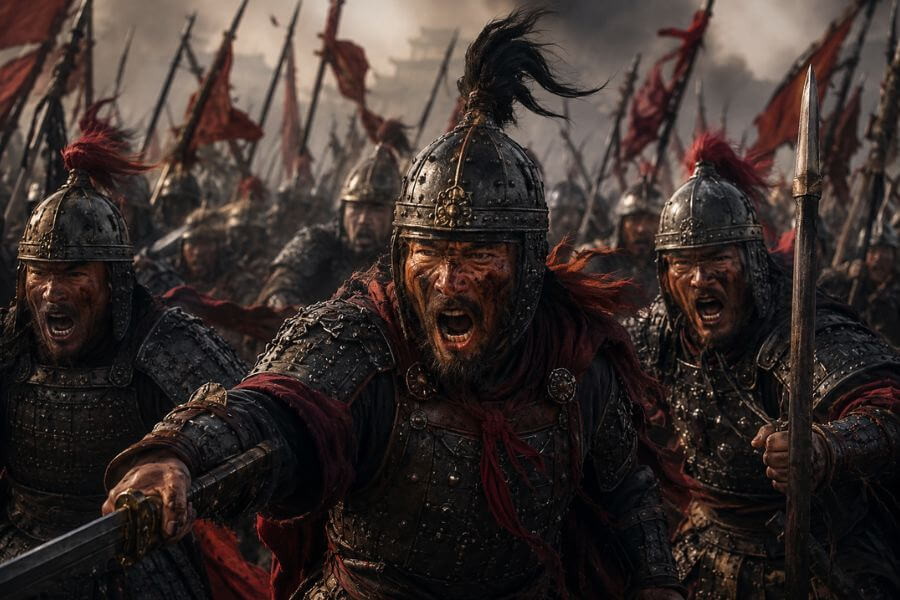
China has one of the longest and richest histories in the world. Across thousands of years, powerful kingdoms, ambitious emperors, and rival warlords fought massive battles that changed the course of history. Some of these conflicts were so large that they involved hundreds of thousands of soldiers. Others became legendary because of brilliant military strategies, heroic leaders, or devastating losses.
If you want to understand how China evolved into the nation it is today, studying its most famous battles is a great place to start. These clashes shaped dynasties, redrew borders, and influenced Chinese culture for centuries.
In this guide, you’ll discover ten of the bloodiest and most famous battles in Chinese history, learn why they mattered, and see how their impact can still be felt today.
Quick Summary Table 🏯
| Rank | Battle | Approximate Date | Main Opponents | Why It Is Famous |
|---|---|---|---|---|
| 1 | Battle of Changping | 260 BC | Qin vs Zhao | One of history’s deadliest battles |
| 2 | Battle of Red Cliffs | 208-209 AD | Cao Cao vs Sun Quan and Liu Bei | Inspired the Romance of the Three Kingdoms |
| 3 | Battle of Guandu | 200 AD | Cao Cao vs Yuan Shao | Decisive victory through strategy |
| 4 | Battle of Talas | 751 AD | Tang China vs Abbasid Caliphate | Major East-West confrontation |
| 5 | Battle of Fei River | 383 AD | Former Qin vs Eastern Jin | Stunning underdog victory |
| 6 | Battle of Yamen | 1279 AD | Yuan Dynasty vs Southern Song | Ended the Song Dynasty |
| 7 | Battle of Mobei | 119 BC | Han Dynasty vs Xiongnu | Expanded Han influence deep into Central Asia |
| 8 | Battle of Xiangyang | 1267-1273 AD | Mongols vs Southern Song | Opened the path to Mongol conquest |
| 9 | Battle of Suiyang | 757 AD | Tang defenders vs Yan rebels | Legendary defense during rebellion |
| 10 | Battle of Kunyang | 23 AD | Xin Dynasty vs Han restoration forces | Small army defeated overwhelming odds |
How We Ranked These Battles 🎯
We used several important factors when selecting and ranking these historic battles:
- Historical impact on China
- Number of casualties and overall bloodshed
- Military innovation and strategy
- Influence on dynasties and political power
- Long-term cultural significance
- Recognition in Chinese history and literature
- Importance in shaping future events
- Lasting reputation among historians
1. Battle of Changping (260 BC) ☠️
The Battle of Changping is often considered the bloodiest battle in ancient Chinese history.
The conflict took place during the Warring States period between the State of Qin and the State of Zhao. Both states were competing for dominance as China moved toward eventual unification.
At first, Zhao successfully defended its territory. However, Qin secretly replaced its commander with the brilliant general Bai Qi. Using deception and superior tactics, Bai Qi trapped the Zhao army.
The result was catastrophic. Historical records claim that hundreds of thousands of Zhao soldiers were captured. Many were later executed after the battle. While exact numbers remain debated, the casualties were enormous.
This victory severely weakened Zhao and cleared the path for Qin’s future conquest of rival states. Just decades later, Qin unified China under the rule of the First Emperor.
Why it matters:
- One of the deadliest battles ever recorded
- Helped Qin become the dominant Chinese state
- Changed the balance of power across China
- Demonstrated the importance of military strategy over numbers
2. Battle of Red Cliffs (208-209 AD) 🔥
Few battles are as famous in Chinese culture as the Battle of Red Cliffs.
Near the end of the Han Dynasty, the powerful warlord Cao Cao attempted to unite China under his control. He marched south with a massive army to defeat the allied forces of Liu Bei and Sun Quan.
Although Cao Cao’s army greatly outnumbered the alliance, several factors worked against him. His troops were unfamiliar with southern waterways, disease spread through the camps, and the alliance used a devastating fire attack against Cao Cao’s fleet.
The fire destroyed much of the northern fleet and forced Cao Cao to retreat.
The battle prevented Cao Cao from conquering southern China and eventually led to the Three Kingdoms period.
Why it matters:
- One of China’s most legendary battles
- Inspired countless books, films, and television dramas
- Created the foundation for the Three Kingdoms era
- Showed how smart tactics can defeat larger armies
3. Battle of Guandu (200 AD) 🛡️
The Battle of Guandu was fought between Cao Cao and Yuan Shao, two of the most powerful leaders during the collapse of the Han Dynasty.
Yuan Shao possessed greater resources, more soldiers, and stronger territorial control. Most observers expected him to win easily.
Instead, Cao Cao relied on intelligence gathering, surprise attacks, and precise planning. He launched a successful strike against Yuan Shao’s supply depot at Wuchao, destroying critical provisions.
Without supplies, Yuan Shao’s massive army fell apart.
The victory transformed Cao Cao into the dominant force in northern China.
Why it matters:
- One of the greatest strategic victories in Chinese history
- Demonstrated the importance of logistics
- Helped Cao Cao establish political dominance
- Changed the future of the Han Dynasty
4. Battle of Talas (751 AD) 🌍
The Battle of Talas was one of the most important international conflicts involving China.
The Tang Dynasty fought forces from the Abbasid Caliphate in Central Asia. The battle occurred near the Talas River in modern-day Central Asia.
Initially, the Tang army fought effectively, but allied forces unexpectedly switched sides during the conflict. This betrayal contributed significantly to the Chinese defeat.
The battle reduced Tang influence in Central Asia and strengthened Islamic influence in the region.
The clash is also famous because many historians associate it with the spread of papermaking technology westward.
Why it matters:
- Major encounter between Chinese and Islamic powers
- Shifted influence in Central Asia
- Symbolized growing connections between East and West
- Had lasting cultural and economic consequences
5. Battle of Fei River (383 AD) 🌊
The Battle of Fei River is remembered as one of history’s most dramatic upsets.
The Former Qin state assembled a huge army and sought to conquer the Eastern Jin Dynasty. The invading force reportedly numbered several times larger than the defending army.
Despite the odds, the Eastern Jin commanders used psychological tactics and careful planning.
When the Jin forces requested that the enemy move back slightly to allow a river crossing, confusion spread among the Former Qin troops. Panic quickly turned into a full retreat.
The retreat became a disaster, leading to the collapse of the invasion.
Why it matters:
- One of the greatest underdog victories ever recorded
- Preserved southern Chinese independence
- Prevented a major political unification
- Became a classic example of military psychology
6. Battle of Yamen (1279 AD) 🚢
The Battle of Yamen marked the dramatic end of the Southern Song Dynasty.
The Song fleet made its final stand against the advancing Mongol-led Yuan forces. The battle occurred at sea in southern China.
The Song commanders chained many of their ships together to strengthen their defensive formation. Unfortunately, this reduced mobility and created major vulnerabilities.
The Yuan fleet eventually broke through.
When defeat became inevitable, loyal officials reportedly chose death rather than surrender. The young Song emperor also died during the collapse.
Why it matters:
- Ended the Southern Song Dynasty
- Completed the Mongol conquest of China
- Established Yuan rule over the entire country
- Symbolized loyalty and sacrifice
7. Battle of Mobei (119 BC) 🐎
The Han Dynasty spent decades fighting the powerful Xiongnu confederation along China’s northern frontier.
The Battle of Mobei was one of the most successful Han campaigns against these nomadic rivals.
Led by famous generals Wei Qing and Huo Qubing, Han forces launched deep attacks into enemy territory. Their operations disrupted Xiongnu power and forced many groups to retreat.
The victory strengthened Han security and expanded Chinese influence across important trade routes.
Why it matters:
- Weakened a major northern threat
- Expanded Han power into Central Asia
- Improved border security
- Supported the growth of Silk Road trade
8. Battle of Xiangyang (1267-1273 AD) 🏹
The Siege and Battle of Xiangyang lasted for years and became one of the most important campaigns of the Mongol conquest.
Xiangyang was a heavily fortified city that protected access to the Southern Song heartland.
The Mongols introduced advanced siege technologies, including powerful counterweight trebuchets. These weapons gradually broke the city’s defenses.
After Xiangyang fell, Mongol forces gained a clear path deeper into Song territory.
Why it matters:
- Opened the door to final Mongol victories
- Showed the growing importance of siege warfare
- Demonstrated technological innovation
- Directly contributed to the fall of the Song Dynasty
9. Battle of Suiyang (757 AD) 🏰
The Battle of Suiyang took place during the devastating An Lushan Rebellion.
A relatively small Tang force defended the city of Suiyang against a much larger rebel army.
The defenders held out for months despite starvation, exhaustion, and overwhelming pressure. Their resistance delayed rebel advances at a critical moment.
Although the city eventually fell, the defenders bought valuable time for the Tang forces elsewhere.
Their courage became legendary in Chinese history.
Why it matters:
- Famous for extraordinary determination
- Slowed a major rebellion
- Helped preserve the Tang Dynasty
- Became a symbol of loyalty and sacrifice
10. Battle of Kunyang (23 AD) ⚡
The Battle of Kunyang occurred during the collapse of the Xin Dynasty.
Wang Mang’s government sent a huge army to crush Han restoration forces. The defenders were heavily outnumbered and appeared doomed.
Instead of surrendering, the Han forces launched aggressive attacks against the larger enemy army.
Strong leadership, poor enemy coordination, and high morale allowed the smaller force to achieve a shocking victory.
The defeat severely weakened Wang Mang’s rule and accelerated the restoration of the Han Dynasty.
Why it matters:
- One of China’s greatest military surprises
- Helped restore Han rule
- Demonstrated the value of leadership
- Changed the political future of China
Conclusion 🏮
The bloodiest and most famous battles in Chinese history were more than simple military clashes. They determined which dynasties would rise or fall, influenced trade routes, inspired legendary stories, and shaped the identity of China for centuries.
From the staggering losses at Changping to the brilliant tactics at Red Cliffs and the heroic resistance at Suiyang, these battles reveal how leadership, strategy, technology, and determination can alter the course of history.
When you explore these historic conflicts, you gain a deeper understanding of China’s remarkable past and the events that helped build one of the world’s oldest civilizations.
Frequently Asked Questions ❓
Which battle is considered the bloodiest in Chinese history?
The Battle of Changping is generally regarded as the bloodiest battle in ancient Chinese history. Historical accounts describe extremely high casualties, making it one of the deadliest military conflicts ever recorded.
Why is the Battle of Red Cliffs so famous?
The Battle of Red Cliffs is famous because it stopped Cao Cao’s attempt to unify China and led to the Three Kingdoms period. It also became one of the most celebrated events in Chinese literature and popular culture.
Did the Mongols conquer all of China through a single battle?
No. The Mongol conquest of China took decades and involved many campaigns and battles. Important victories such as Xiangyang and Yamen played major roles in completing the conquest.
Which Chinese battle is known for an underdog victory?
The Battle of Fei River is often considered China’s greatest underdog victory. A much smaller Eastern Jin force defeated a far larger invading army through clever tactics and psychological pressure.
Are casualty numbers from ancient Chinese battles reliable?
Not always. Many ancient records may have exaggerated troop numbers and casualties. Historians often compare multiple sources and archaeological evidence to estimate more realistic figures, but exact numbers remain debated in many cases.