Modern Chinese history is full of dramatic turning points that still spark debate around the world today. Some moments changed the country’s economy, while others shaped politics, culture, education, and everyday life for millions of people. If you want to understand modern China, you need to understand the events that created strong opinions both inside and outside the country.
Many of these moments remain sensitive topics because they involve power struggles, social change, economic reform, protests, and human suffering. Some people see these events as necessary steps toward national growth, while others view them as painful mistakes with long-lasting consequences.
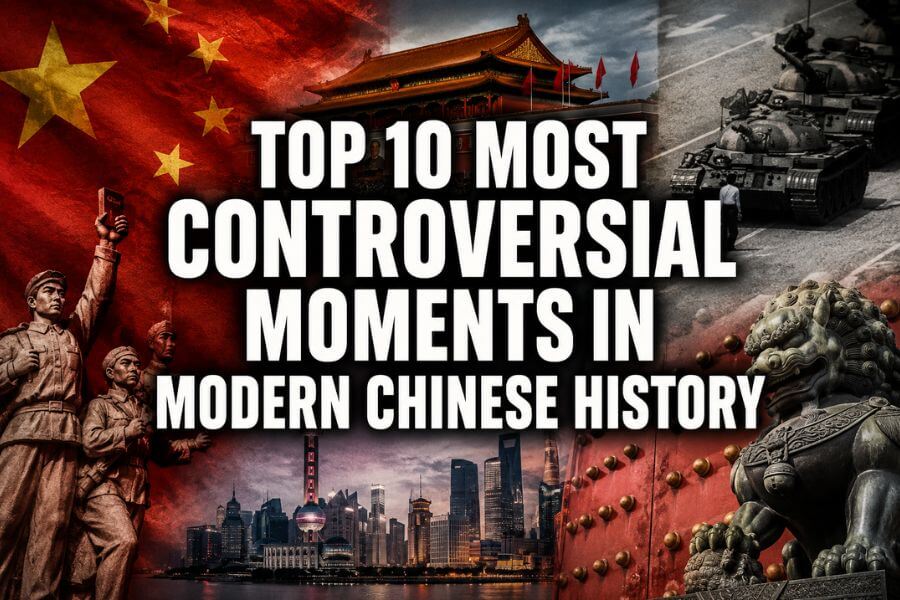
In this article, you will explore the top 10 most controversial moments in modern Chinese history, why they mattered, and how they continue to influence China today.
Quick Summary Table 📚
| Rank | Historical Moment | Time Period | Why It Was Controversial |
|---|---|---|---|
| 1 | The Cultural Revolution | 1966 to 1976 | Massive political chaos and persecution |
| 2 | Tiananmen Square Protests | 1989 | Government crackdown on protesters |
| 3 | The Great Leap Forward | 1958 to 1962 | Economic disaster and widespread famine |
| 4 | Hong Kong Handover and Protests | 1997 onward | Conflict over freedoms and political control |
| 5 | One Child Policy | 1979 to 2015 | Strict population control and social impact |
| 6 | Xinjiang Policies | 2010s onward | International debate over human rights |
| 7 | China’s Entry into the WTO | 2001 | Economic growth versus labor concerns |
| 8 | The SARS Outbreak Response | 2003 | Criticism over information control |
| 9 | Internet Censorship and the Great Firewall | 2000s onward | Debate over free speech and stability |
| 10 | COVID-19 Lockdowns | 2020 to 2022 | Harsh restrictions and public frustration |
How We Ranked These Moments 🔍
We ranked these controversial events using several important factors:
- Historical impact on China and the world
- Number of people affected
- Political and social consequences
- International reactions and criticism
- Long-term influence on Chinese society
- Level of public debate and disagreement
- Economic and cultural effects
- Ongoing relevance in modern discussions
1. The Cultural Revolution 🎭
The Cultural Revolution is widely considered one of the most chaotic periods in modern Chinese history. It began in 1966 under Mao Zedong and lasted for about ten years.
The official goal was to protect communist ideology and remove capitalist influences from society. In reality, the movement created nationwide fear, violence, and instability. Millions of students joined groups called the Red Guards, who targeted teachers, intellectuals, government officials, and even family members accused of having the wrong political beliefs.
Schools and universities shut down for years. Historical artifacts, books, temples, and cultural treasures were destroyed. People were publicly humiliated, beaten, imprisoned, or sent to rural labor camps.
Supporters at the time believed the movement would create equality and a revolutionary spirit. Critics argue that it destroyed education, culture, and trust within society. Even today, discussions about the Cultural Revolution remain extremely sensitive.
The event still shapes how many Chinese people think about politics, authority, and social stability.
2. Tiananmen Square Protests 🚩
The 1989 protests in Tiananmen Square remain one of the most internationally discussed moments in Chinese history.
The protests began after the death of reform-minded official Hu Yaobang. Students gathered in Beijing demanding political reform, less corruption, greater freedom of speech, and more government accountability.
Over time, the protests grew larger and attracted workers, journalists, and ordinary citizens. The demonstrations lasted for weeks and gained worldwide attention.
Eventually, the Chinese government declared martial law. Military forces entered Beijing, leading to violent clashes. The exact number of deaths remains disputed.
This moment became controversial for several reasons. Internationally, many people condemned the crackdown and viewed it as a violation of human rights. Inside China, public discussion of the event became heavily restricted.
For many observers, Tiananmen Square became a symbol of the conflict between political control and demands for reform.
3. The Great Leap Forward 🌾
The Great Leap Forward was an economic campaign launched by Mao Zedong in 1958.
The goal was ambitious. China aimed to rapidly transform from an agricultural society into an industrial superpower. Large farming collectives were created, and people were encouraged to produce steel in small backyard furnaces.
However, the campaign quickly failed. Poor planning, unrealistic production targets, and false reporting caused major economic problems. Food production collapsed in many regions.
The result was one of the deadliest famines in human history. Historians estimate that tens of millions of people died from starvation and related causes.
The controversy surrounding the Great Leap Forward continues because people disagree about responsibility, government transparency, and historical interpretation. Some argue it was driven by unrealistic ideology, while others focus on leadership failures and political pressure.
This period permanently changed China’s approach to economic policy and governance.
4. Hong Kong Handover and Protests 🏙️
When Hong Kong was returned from British rule to China in 1997, many people hoped the “one country, two systems” framework would protect the city’s freedoms and unique identity.
For years, Hong Kong maintained different legal and political systems compared to mainland China. However, tensions increased as many residents feared growing political influence from Beijing.
Large protests broke out multiple times, especially during the 2014 Umbrella Movement and the massive 2019 demonstrations against an extradition bill.
Supporters of stronger government control argued it was necessary for national unity and stability. Critics believed the changes threatened free speech, democratic rights, and local autonomy.
The controversy gained international attention because Hong Kong had long been seen as a global financial center with relatively open freedoms compared to mainland China.
Today, opinions remain deeply divided over whether recent policies restored order or weakened civil liberties.
5. The One Child Policy 👶
China introduced the One Child Policy in 1979 to slow rapid population growth. For decades, many families were limited to having only one child.
Government officials believed strict population control was necessary to reduce poverty, improve living standards, and support economic development. The policy did help reduce birth rates significantly.
However, the human cost became highly controversial.
Some families faced heavy fines, forced abortions, or pressure from local authorities. Traditional preference for sons also contributed to gender imbalance, as many families wanted male children.
The policy created long-term social challenges, including an aging population and a shrinking workforce. Many only children also experienced intense family pressure because they carried the hopes of parents and grandparents.
China officially ended the One Child Policy in 2015, but its effects are still visible today.
The debate continues over whether the economic benefits justified the social and emotional consequences.
6. Xinjiang Policies 🕌
Policies in Xinjiang have become one of the most controversial international issues involving China in recent years.
The Chinese government says its actions are necessary to fight terrorism, separatism, and religious extremism. Authorities have promoted security measures, surveillance systems, and educational programs aimed at maintaining stability.
Critics, including many foreign governments and human rights organizations, argue that these policies violate religious freedom and human rights, especially regarding the Uyghurs ethnic minority.
Reports about detention centers, surveillance, and cultural restrictions have led to strong international debate.
China strongly rejects many foreign accusations and argues that outside critics misunderstand the situation or interfere in domestic affairs.
This controversy has affected diplomacy, trade discussions, and China’s global image.
7. China’s Entry into the WTO 💼
China joined the World Trade Organization in 2001, marking a major turning point in the global economy.
The move helped transform China into a manufacturing powerhouse. Millions of people escaped poverty as factories expanded, exports increased, and cities grew rapidly.
Many companies around the world benefited from cheaper products and stronger trade relationships with China.
Still, the decision sparked major controversy.
Critics argued that foreign companies lost jobs because manufacturing moved to China. Others believed China did not fully follow free market rules after joining the WTO.
Inside China, rapid industrial growth also created environmental problems, worker concerns, and rising inequality between urban and rural areas.
For supporters, WTO membership represented China’s successful integration into the global economy. For critics, it changed international trade in ways that harmed workers in many countries.
8. The SARS Outbreak Response 🦠
The SARS outbreak in 2003 was one of the first major global health scares of the 21st century.
The disease spread from China to several countries, causing fear and economic disruption. Early in the outbreak, Chinese authorities faced criticism for not sharing information quickly enough.
As international concern grew, the government eventually took stronger action by increasing transparency, closing schools, and implementing public health measures.
The controversy centered around censorship, crisis management, and public trust.
Many people believed earlier communication could have reduced the spread of the disease. Others argued that the crisis forced China to improve its healthcare monitoring systems.
The SARS experience later influenced how China responded to future health emergencies.
9. Internet Censorship and the Great Firewall 🌐
China’s internet controls, often called the Great Firewall, remain one of the most debated digital policies in the world.
Many foreign websites and social media platforms are blocked in mainland China. The government says online regulation helps maintain social stability, national security, and protection from harmful information.
Critics argue that the restrictions limit free speech and access to information.
Chinese internet users often rely on domestic platforms instead of global services. Companies such as Tencent and Baidu became extremely powerful partly because of this digital environment.
The controversy reflects a larger global debate about how governments should balance security, misinformation, and freedom of expression online.
China’s approach remains very different from internet policies in many Western countries.
10. COVID-19 Lockdowns 😷
China’s response to the COVID-19 pandemic became one of the most discussed public health strategies in the world.
The government introduced strict lockdowns, travel restrictions, mass testing, and quarantine systems under its “Zero COVID” policy.
Supporters argued these measures saved lives during the early stages of the pandemic. China initially reported lower death numbers compared to some other countries.
However, the strict rules also caused frustration among many residents. Long lockdowns affected businesses, mental health, travel, and access to daily necessities in some cities.
Rare public protests appeared in several areas during late 2022, showing growing public exhaustion.
The debate surrounding China’s COVID policies reflects larger questions about personal freedom, public safety, government authority, and economic priorities.
Even after restrictions ended, the impact on society and the economy continued.
Conclusion 🧭
Modern Chinese history is filled with events that continue to shape politics, culture, economics, and international relations today. These controversial moments are important because they reveal how quickly a nation can change under pressure, leadership decisions, and public demands.
Some people see these events as necessary sacrifices for national strength and stability. Others view them as painful examples of political mistakes or restricted freedoms. In many cases, both perspectives exist at the same time.
By learning about these moments, you gain a deeper understanding of modern China and the forces that continue to influence one of the world’s most powerful countries.
History is rarely simple. The most controversial moments are often the ones that leave the deepest mark on future generations.
Frequently Asked Questions ❓
Why is modern Chinese history considered controversial?
Modern Chinese history includes revolutions, political campaigns, economic reforms, protests, and strict government policies that affected millions of people. Different groups often interpret these events in very different ways, which creates ongoing debate.
Why are some historical topics sensitive in China?
Certain events are viewed as politically sensitive because they involve criticism of leadership, government decisions, or national unity. Public discussion about these topics may be limited in some situations.
Did controversial events help China become economically powerful?
Some controversial policies and reforms did contribute to China’s rapid industrial growth and modernization. However, critics argue that economic progress sometimes came with major social or human costs.
How does the Chinese government view these events today?
The government often emphasizes national stability, economic development, and social unity when discussing historical events. Official narratives may differ from international interpretations.
Why do international opinions about China vary so much?
Different countries and organizations focus on different issues, including economics, trade, human rights, national security, and political systems. These priorities shape how people interpret China’s actions and history.