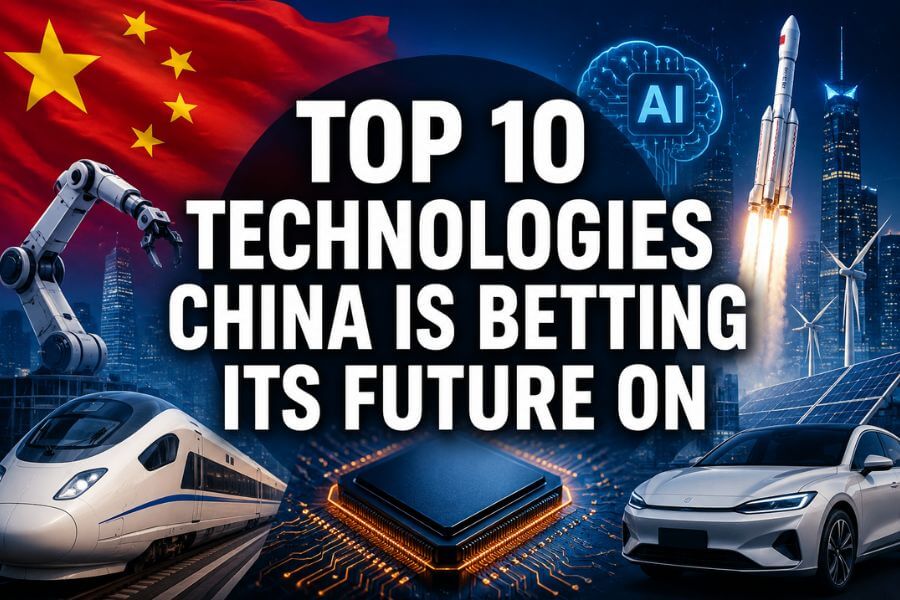
China is investing huge amounts of money, talent, and government support into technologies that could shape its future for decades. From artificial intelligence to clean energy, the country is trying to become a global leader in industries that may define the next era of economic and political power.
If you look closely, you can already see these changes happening around you. Chinese companies are building advanced electric cars, launching satellites, creating powerful AI systems, and expanding smart manufacturing faster than many countries expected. These technologies are not only about business profits. They are also tied to national security, economic growth, global influence, and long-term independence from foreign technology.
In this article, you will explore the top 10 technologies China is betting its future on and why each one matters so much.
Quick Summary Table 🌏
| Rank | Technology | Why China Is Investing Heavily |
|---|---|---|
| 1 | Artificial Intelligence | To lead future industries and automation |
| 2 | Semiconductor Manufacturing | To reduce dependence on foreign chips |
| 3 | Electric Vehicles | To dominate the future car market |
| 4 | Renewable Energy | To secure energy independence |
| 5 | Quantum Technology | To gain computing and security advantages |
| 6 | 5G and 6G Networks | To power smart cities and connected industries |
| 7 | Robotics and Automation | To solve labor shortages and boost productivity |
| 8 | Space Technology | To expand scientific and strategic influence |
| 9 | Biotechnology | To improve healthcare and food security |
| 10 | High Speed Rail and Smart Infrastructure | To modernize transportation and logistics |
How We Ranked These Technologies 🧠
We ranked these technologies based on several important factors:
- Government investment levels
- Long-term economic impact
- National security importance
- Global competitiveness
- Job creation potential
- Export opportunities
- Influence on future industries
- Speed of development inside China
- Ability to reduce dependence on foreign countries
- Importance in China’s national development plans
1. Artificial Intelligence 🤖
Artificial intelligence is probably the biggest technology race in the world right now, and China wants to be at the center of it. The country sees AI as a tool that can transform nearly every industry, from healthcare and transportation to finance and manufacturing.
Chinese companies are developing AI chatbots, facial recognition systems, autonomous driving software, and advanced data analysis tools. The government has also made AI development a national priority, pushing universities and private companies to accelerate innovation.
One reason China is moving so aggressively is the massive amount of data available inside the country. Large populations and digital lifestyles create huge datasets that help train AI systems faster and more effectively.
AI is also deeply connected to military development, cybersecurity, and economic growth. China believes that nations leading in AI may gain enormous strategic advantages in the future.
You are likely to see Chinese AI technology become more common globally in areas like smart devices, e-commerce, healthcare diagnostics, and automated factories.
2. Semiconductor Manufacturing 💻
Semiconductors are the tiny chips that power smartphones, computers, electric vehicles, military systems, and AI servers. Without them, modern technology simply cannot function.
For years, China relied heavily on imported chips from foreign companies. That created a major weakness because trade restrictions and sanctions could disrupt supply chains. As a result, China is investing billions of dollars into building its own semiconductor industry.
The goal is simple. China wants to design and manufacture advanced chips domestically instead of depending on other countries.
This is not easy because semiconductor manufacturing is one of the most difficult industries in the world. It requires advanced machinery, highly skilled engineers, and years of research.
Still, China continues to build chip factories, support local companies, and train semiconductor experts at a rapid pace. If successful, this industry could become one of the foundations of China’s future economy.
3. Electric Vehicles 🚗
China has become one of the biggest electric vehicle markets on Earth. The country believes EVs are not just the future of transportation but also a chance to lead a major global industry.
Chinese automakers are producing affordable EVs at a massive scale. Companies are competing in battery technology, charging infrastructure, and smart vehicle software.
One reason China moved quickly into EVs is that it saw an opportunity. Traditional gasoline car markets were dominated by older foreign brands, but electric vehicles allowed newer Chinese companies to compete more aggressively.
China also wants cleaner cities with less pollution and lower dependence on imported oil. EV adoption supports both goals.
Today, many Chinese EV brands are expanding internationally and challenging established automakers around the world. If this trend continues, China could become the dominant force in future transportation technology.
4. Renewable Energy ☀️
China is investing heavily in solar panels, wind turbines, hydroelectric systems, and energy storage technology. The country understands that future economic strength depends heavily on reliable and sustainable energy.
China already produces huge amounts of solar panels and controls large parts of the global clean energy supply chain. This gives Chinese manufacturers strong advantages in pricing and production scale.
Renewable energy also helps China reduce air pollution and lower dependence on imported fossil fuels. Energy security is a major concern for any large economy, especially one with enormous industrial demand.
Battery storage technology is another important area. Renewable energy works best when electricity can be stored efficiently for later use. China is pushing hard into large-scale battery development to support both renewable energy and electric vehicles.
As clean energy demand rises globally, China hopes to become the world’s leading supplier of renewable technology products.
5. Quantum Technology 🔬
Quantum technology sounds futuristic, but China is already treating it as a serious strategic priority. Quantum computing, quantum communication, and quantum encryption could completely change computing and cybersecurity in the future.
Quantum computers may eventually solve problems that current computers cannot handle efficiently. That includes scientific simulations, advanced AI training, logistics optimization, and encryption cracking.
China has already invested heavily in quantum research labs, universities, and communication networks. The country launched quantum communication satellites and continues to test secure data transmission systems.
Even though practical quantum computing is still developing, China believes early investment could create major long-term advantages.
You can think of quantum technology as a high-risk but potentially revolutionary bet that could reshape future science and national security.
6. 5G and 6G Networks 📡
Fast internet infrastructure is becoming more important every year, and China wants to lead the world in communication technology.
The country expanded 5G networks extremely quickly and is already researching future 6G systems. These networks are important because they support smart cities, self-driving cars, industrial automation, remote healthcare, and advanced digital services.
Chinese technology companies became major global players in telecommunications equipment, helping China expand its influence internationally.
Faster wireless networks also support the growth of the digital economy. Factories, transportation systems, and businesses increasingly rely on real-time data and connected devices.
China sees advanced communication networks as critical infrastructure for future economic competitiveness.
7. Robotics and Automation ⚙️
China’s workforce is changing. Labor costs are rising, and the population is aging. To maintain industrial productivity, the country is investing heavily in robotics and automation.
Factories across China are becoming more automated with robotic arms, smart assembly systems, and AI-driven manufacturing tools.
Automation helps companies produce goods faster, reduce errors, and lower long-term labor costs. It also improves competitiveness in global manufacturing markets.
China is especially focused on industrial robots, warehouse automation, and service robots. In the future, robots may become common in healthcare, delivery services, restaurants, and elder care.
The government views automation as necessary for maintaining economic growth as demographic changes reshape the labor market.
8. Space Technology 🌌
China’s space ambitions have grown rapidly over the past two decades. The country now sees space technology as both a scientific mission and a strategic industry.
Chinese space programs include satellite networks, lunar exploration, Mars missions, and plans for future space stations and deep space research.
Satellites are especially important because they support navigation, communication, weather forecasting, agriculture, and military operations.
China also wants to inspire national pride and showcase technological strength through major space achievements.
As commercial space industries grow globally, China hopes to become a major competitor in satellite manufacturing, launch services, and future space technologies.
9. Biotechnology 🧬
Biotechnology became even more important after the global pandemic showed how critical healthcare innovation can be.
China is investing heavily in medical research, pharmaceutical development, genetic engineering, agricultural biotechnology, and vaccine production.
The country wants stronger domestic healthcare capabilities and reduced dependence on foreign pharmaceutical companies.
Biotechnology also supports food security. China must feed a massive population while dealing with limited farmland and environmental pressures. Agricultural biotechnology could improve crop production and efficiency.
In the future, biotech may become one of the most important industries for both healthcare and economic growth worldwide, and China wants to be prepared.
10. High Speed Rail and Smart Infrastructure 🚄
China already operates one of the largest high-speed rail networks in the world, but the country is continuing to invest heavily in transportation and smart infrastructure.
Modern transportation systems improve economic efficiency by moving people and goods faster across large distances. This supports manufacturing, trade, tourism, and urban development.
China is also combining transportation with smart technology. Many infrastructure projects now include AI systems, digital monitoring, automated traffic control, and intelligent logistics networks.
These investments help connect cities, reduce travel times, and strengthen internal economic activity.
China also exports infrastructure expertise to other countries through international development projects, helping expand its global influence.
Conclusion 🌟
China is placing enormous bets on technologies that could shape the next generation of global power and economic leadership. Artificial intelligence, semiconductors, renewable energy, robotics, biotechnology, and advanced infrastructure are not isolated industries. They are deeply connected parts of a larger national strategy.
The country wants technological independence, stronger global influence, and long-term economic growth. That is why China continues investing aggressively even in industries that may take years to fully mature.
Whether China ultimately dominates these sectors or faces stronger global competition, one thing is clear. The technologies being developed today will likely influence the world economy, global politics, and everyday life for decades to come.
If you want to understand where the future may be heading, watching China’s technology strategy is a very good place to start.
Frequently Asked Questions ❓
Why is China investing so heavily in technology?
China sees advanced technology as essential for economic growth, national security, and global competitiveness. Technology leadership can strengthen industries, military capabilities, and international influence.
Which technology sector is China strongest in right now?
China is currently very strong in electric vehicles, renewable energy manufacturing, high-speed rail, and telecommunications infrastructure. These industries already have large-scale global influence.
Why are semiconductors so important to China?
Semiconductors power nearly all modern electronics. China wants domestic chip production to reduce dependence on foreign suppliers and protect itself from trade restrictions.
Could China become the global leader in artificial intelligence?
It is possible. China has major advantages, including a huge market, strong government support, large amounts of data, and rapidly growing AI companies. However, competition from other countries remains intense.
How does technology fit into China’s long-term economic plans?
China views advanced technology as the foundation of future economic growth. The country wants to move beyond low-cost manufacturing and become a global leader in innovation, high-value industries, and next-generation infrastructure.