China has one of the longest and richest histories in the world. For thousands of years, powerful dynasties ruled the land, shaping its culture, government, technology, economy, and way of life. Many of the traditions, inventions, and ideas that people associate with China today can be traced back to these ruling periods.
If you want to understand Chinese history, learning about its most important dynasties is the perfect place to start. Each dynasty left a unique mark, from building massive infrastructure projects and expanding trade routes to creating artistic masterpieces and developing groundbreaking inventions.
In this guide, you’ll discover the 10 most important Chinese dynasties, why they mattered, and how they helped shape not only China but the world.
Quick Summary Table 🏯
| Rank | Dynasty | Years | Why It Matters |
|---|---|---|---|
| 1 | Han Dynasty | 206 BC – AD 220 | Established Chinese identity and expanded the Silk Road |
| 2 | Tang Dynasty | AD 618 – 907 | Golden age of culture, trade, and innovation |
| 3 | Ming Dynasty | AD 1368 – 1644 | Built much of the Great Wall and expanded maritime power |
| 4 | Qing Dynasty | AD 1644 – 1912 | Last imperial dynasty and largest territorial expansion |
| 5 | Zhou Dynasty | 1046 BC – 256 BC | Birthplace of major Chinese philosophies |
| 6 | Qin Dynasty | 221 BC – 206 BC | Unified China for the first time |
| 7 | Song Dynasty | AD 960 – 1279 | Era of major technological advancement |
| 8 | Yuan Dynasty | AD 1271 – 1368 | Mongol rule connected China to wider global trade |
| 9 | Shang Dynasty | 1600 BC – 1046 BC | Earliest dynasty with strong historical evidence |
| 10 | Sui Dynasty | AD 581 – 618 | Reunified China and built the Grand Canal |
How We Ranked These Dynasties 🔍
We ranked these dynasties based on several important factors:
- Historical significance
- Influence on modern Chinese culture
- Political and military achievements
- Economic growth and trade impact
- Technological and scientific innovations
- Contributions to art, literature, and philosophy
- Lasting influence on world history
- Size and strength of the empire
- Impact on future dynasties
- Legacy that remains visible today
1. Han Dynasty ⚔️
The Han Dynasty is often considered one of the greatest periods in Chinese history. In fact, the majority ethnic group in China today is known as the Han people, showing just how influential this dynasty became.
During the Han Dynasty, China expanded its borders significantly and developed a strong central government. The famous Silk Road flourished, connecting China with Central Asia, the Middle East, and Europe. This trade route allowed goods, ideas, religions, and technologies to spread across continents.
The Han period also saw major advancements in science, mathematics, medicine, and engineering. Paper was invented during this era, transforming communication and record-keeping.
The government introduced civil service systems that influenced Chinese administration for centuries. Confucianism became the guiding philosophy of government and education.
Without the Han Dynasty, Chinese civilization would look very different today.
2. Tang Dynasty 🎨
The Tang Dynasty is widely viewed as China’s cultural golden age. It was a time when poetry, art, music, architecture, and literature flourished.
The capital city of Chang’an became one of the world’s largest and most cosmopolitan cities. Merchants, scholars, diplomats, and travelers from many countries visited the city, creating a vibrant multicultural environment.
Trade along the Silk Road reached new heights, bringing wealth and international influence to China. The government was strong and relatively stable, allowing economic growth and cultural creativity to thrive.
Many famous Chinese poets, including Li Bai and Du Fu, lived during this period. Their works are still studied and admired around the world today.
The Tang Dynasty helped establish China as one of the most advanced civilizations of its time.
3. Ming Dynasty 🚢
The Ming Dynasty is famous for restoring Chinese rule after the Mongol-led Yuan Dynasty. It became one of China’s most prosperous and stable periods.
The Ming emperors strengthened the economy, improved agriculture, and expanded manufacturing. Chinese porcelain became highly sought after around the world and remains famous today.
The dynasty is also known for the great voyages led by explorer Zheng He. His massive treasure fleets sailed across Asia, Africa, and the Indian Ocean, showcasing China’s naval capabilities.
Much of the Great Wall that tourists visit today was built or rebuilt during the Ming era. The Forbidden City in Beijing was also constructed during this dynasty.
The Ming Dynasty left behind some of China’s most iconic landmarks and cultural achievements.
4. Qing Dynasty 👑
The Qing Dynasty was China’s final imperial dynasty. It ruled for nearly three centuries and expanded China’s territory to its greatest historical size.
Under Qing rule, China controlled vast regions that included Tibet, Xinjiang, Mongolia, and Taiwan. The empire became one of the largest and most populous states in the world.
The early Qing period experienced economic prosperity and population growth. Literature, painting, and scholarship flourished.
However, the dynasty later faced major challenges, including foreign invasions, internal rebellions, and economic difficulties. These struggles eventually led to the fall of imperial rule in 1912.
Despite its decline, the Qing Dynasty played a major role in shaping modern China’s borders and political development.
5. Zhou Dynasty 📜
The Zhou Dynasty lasted longer than any other major Chinese dynasty. Its influence on Chinese thought and culture remains enormous.
Many of China’s most important philosophies emerged during this period. Thinkers such as Confucius and Laozi developed ideas that continue to influence Chinese society today.
Confucianism emphasized morality, education, and proper relationships. Daoism encouraged harmony with nature and balance in life.
The concept known as the “Mandate of Heaven” also emerged during the Zhou Dynasty. This idea suggested that rulers governed with divine approval and could lose power if they ruled poorly.
The intellectual achievements of the Zhou period laid the foundation for Chinese civilization.
6. Qin Dynasty 🏛️
Although it lasted only about 15 years, the Qin Dynasty changed China forever.
Before the Qin Dynasty, China consisted of competing states that frequently fought one another. Qin Shi Huang successfully conquered these rivals and became the first emperor of a unified China.
The dynasty standardized writing systems, currency, weights, and measurements. These reforms helped create a more unified and efficient state.
The Qin government also began large construction projects, including early sections of the Great Wall.
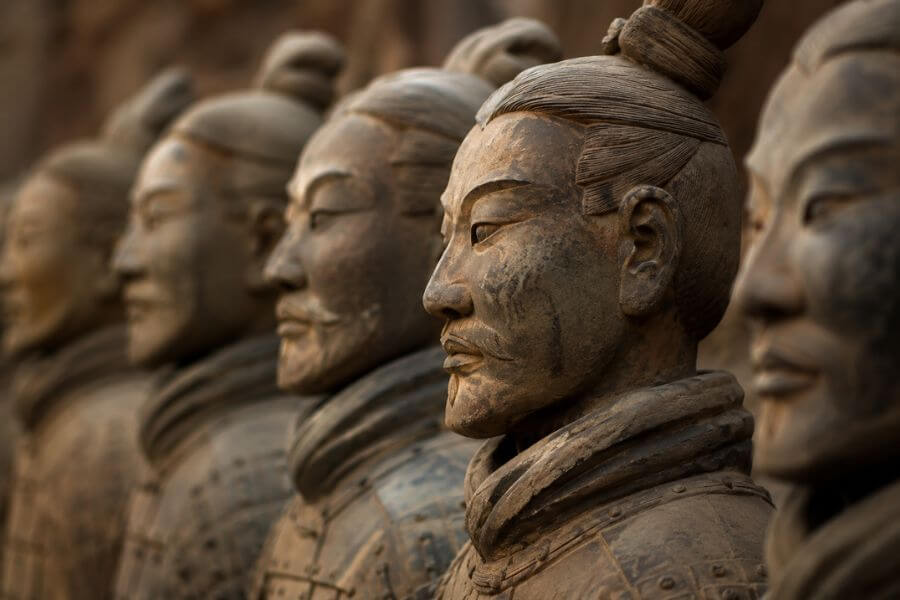
Perhaps its most famous legacy is the Terracotta Army, a massive collection of life-sized clay soldiers buried with the first emperor.
The Qin Dynasty established the basic framework for future Chinese empires.
7. Song Dynasty 💡
The Song Dynasty was one of the most innovative periods in world history.
Chinese inventors made remarkable advances in technology, science, and engineering. Gunpowder weapons improved significantly, movable type printing expanded access to information, and the magnetic compass revolutionized navigation.
The economy grew rapidly as cities expanded and trade increased. Some historians consider Song China one of the world’s most advanced economies of its time.
Education and scholarship were highly valued, leading to major achievements in literature, philosophy, and art.
The Song Dynasty demonstrated how innovation and economic growth can transform a society.
8. Yuan Dynasty 🐎
The Yuan Dynasty was founded by Kublai Khan, grandson of the famous Mongol leader Genghis Khan.
This dynasty marked the first time all of China was ruled by a foreign power. While Mongol rule was sometimes controversial, it connected China more closely with the wider world.
Trade expanded significantly along routes linking Asia, Europe, and the Middle East. Travelers such as Marco Polo visited China during this period and shared stories about its wealth and sophistication.
The Yuan Dynasty encouraged international exchange, helping ideas, technologies, and goods move across continents.
Its influence extended far beyond China’s borders.
9. Shang Dynasty 🔮
The Shang Dynasty is the earliest Chinese dynasty supported by extensive archaeological evidence.
It is known for its advanced bronze casting, military organization, and religious practices. Skilled artisans created beautiful bronze vessels that continue to impress historians and archaeologists.
The Shang people also developed early forms of Chinese writing. Oracle bones containing inscriptions provide valuable information about their society, beliefs, and government.
Many aspects of later Chinese culture can be traced back to foundations established during the Shang period.
The dynasty represents an important starting point in recorded Chinese history.
10. Sui Dynasty 🌉
The Sui Dynasty was short-lived, but its impact was enormous.
After centuries of division and conflict, the Sui rulers successfully reunited China. This reunification paved the way for the highly successful Tang Dynasty that followed.
One of the dynasty’s greatest achievements was constructing the Grand Canal, one of the largest engineering projects in ancient history. The canal connected northern and southern China, improving transportation, trade, and communication.
The Sui government also introduced reforms that strengthened central authority.
Although the dynasty lasted only a few decades, its accomplishments had long-lasting effects.
Conclusion ⭐
Chinese history spans thousands of years, and its dynasties played a major role in shaping one of the world’s oldest civilizations. From the philosophical foundations of the Zhou Dynasty to the technological breakthroughs of the Song Dynasty and the global influence of the Ming and Tang dynasties, each era contributed something unique.
If you’re beginning your journey into Chinese history, these ten dynasties provide the best foundation for understanding how China evolved into the nation it is today. Their achievements continue to influence culture, politics, technology, and society across the world.
Frequently Asked Questions ❓
Which Chinese dynasty lasted the longest?
The Zhou Dynasty lasted the longest, ruling for nearly 800 years from approximately 1046 BC to 256 BC. Its long reign allowed it to shape many aspects of Chinese culture and philosophy.
Which Chinese dynasty built the Great Wall?
Several dynasties contributed to the Great Wall, but much of the structure visible today was built during the Ming Dynasty. The Qin Dynasty also constructed early defensive walls.
Why is the Han Dynasty considered so important?
The Han Dynasty helped define Chinese identity, expanded trade through the Silk Road, strengthened government institutions, and promoted Confucian values that influenced China for centuries.
Which dynasty was ruled by the Mongols?
The Yuan Dynasty was established by Kublai Khan and ruled by the Mongols. It was the first foreign-led dynasty to govern all of China.
What ended the era of Chinese dynasties?
The Qing Dynasty ended in 1912 following political unrest, reform movements, and revolutionary activity. Its collapse marked the end of more than two thousand years of imperial rule in China.