Key Takeaways for Your China Money Strategy
- Go Digital First: China runs on mobile apps. Download Alipay and WeChat Pay before you leave home. Link your home credit or debit card to both apps to pay for almost everything, from street food to bullet train tickets.
- Carry a Backup Card: Keep a Visa or Mastercard credit card handy for larger hotels, upscale restaurants, and big department stores.
- Bring Some Cash: Cash is still legal and accepted by law. Carry around 500 to 1,000 Chinese Yuan in paper money for emergencies, small family-run shops, or situations where your phone battery dies.
- Use Bank ATMs: Withdraw cash only at official bank branches like the Bank of China. Avoid independent, non-bank ATMs to keep your card safe and reduce fees.
- Inform Your Bank: Tell your home bank your travel dates so they do not freeze your cards when you try to pay for a dumpling meal in Shanghai or Beijing.
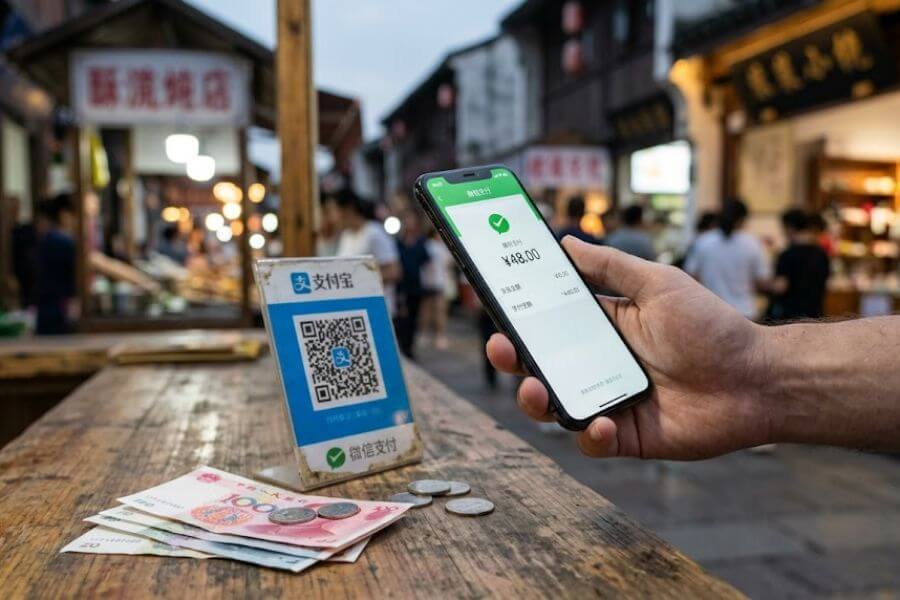
Imagine walking down a bright, neon-lit street in Shanghai. You smell fried dumplings, hear the hum of electric scooters, and find a tiny food stall with the best food in the neighborhood. You reach for your wallet to pull out a paper bill, but the owner points to a small plastic square with a printed pattern on it. Everyone else in line simply taps their phone, a soft chime rings out, and they walk away with their delicious meal. Welcome to China, a place where paper bills feel like history and your smartphone is your new wallet. Navigating this high-tech money world can feel a bit confusing at first glance, but once you know the basic steps, you will pay for things just like a local resident. Let us dive into exactly how money works here so you can enjoy your adventure without any payment stress.
The Reality of Cash in the Digital Age
For decades, packing a thick stack of paper bills was the number one rule for international travel. In China, that rule has completely changed. The country has skipped past credit cards and gone straight into a mobile-first world. Today, almost every transaction happens through a quick scan of a telephone screen.
You might wonder if paper cash is completely dead. The short answer is no, but it is definitely resting. By law, businesses in China must accept the official physical currency. If you hand a shop owner a crisp paper bill, they are legally supposed to take it. However, many small shops, taxi drivers, and street vendors rarely see cash anymore. This means they might not have the correct paper change to give back to you if you hand them a large bill.
Carrying only cash can slow you down. It can make a simple purchase feel awkward as a clerk searches through drawers for old coins. Still, having a small amount of paper money in your pocket is a smart safety net. Phones can run out of battery power, cellular data networks can drop out in deep subway stations, and sometimes a payment app might experience a temporary glitch. Think of cash as your spare tire, you hope you do not need it, but you are glad it is there just in case.
Meet the Chinese Yuan
Before you learn how to spend your money, you need to understand what the money actually looks like and what it is called. The official currency of China is the Renminbi, which translates to the peoples currency. You will often see this written as RMB on signs and banking forms.
However, when people talk about prices or count out money, they use the word Yuan. You can think of Renminbi as the official name of the money system, similar to Sterling in the United Kingdom, while Yuan is the actual unit of currency, just like the Pound. In daily spoken language, locals often use the word Kuai, which is a casual term for money, much like saying bucks in the United States.
The international currency code you will spot at exchange desks and on your banking apps is CNY. The currency uses the same symbol as the Japanese Yen, which is a capital letter Y with two horizontal lines through the middle.
Understanding the Paper Bills
Chinese paper money comes in several bright colors and specific sizes. The front side of every modern bill features a portrait of Mao Zedong, a famous historical leader of the country. The back side of each bill shows a beautiful famous landmark or natural wonder from different regions of China. Learning to spot these colors quickly will help you manage your paper wallet with confidence.
- One One-Yuan Bill: This is a small yellowish-green bill. The back features the serene Three Pools Mirroring the Moon at the famous West Lake in Hangzhou.
- Five-Yuan Bill: This bill has a distinct purple color. The reverse side displays the rugged and sacred Mount Tai, a historic mountain located in Shandong province.
- Ten-Yuan Bill: This bright blue note shows the breathtaking Kuimen Gate, which is the dramatic entrance to the Three Gorges along the Yangtze River.
- Twenty-Yuan Bill: This brownish-orange bill is very famous among travelers. The back shows a fisherman on a bamboo raft drifting down the Li River in Guilin.
- Fifty-Yuan Bill: This bill is green and showcases the grand Potala Palace, an impressive hillside fortress located in Lhasa, Tibet.
- One-Hundred-Yuan Bill: This is the largest paper bill in circulation. It is bright red and features the Great Hall of the People located in Beijing.
Exploring the Smaller Coins
While coins are becoming quite rare in big modern cities, you might still receive a few of them when you get change in smaller towns or at older markets. The most common coins you will encounter represent small fractions of a single Yuan.
- One-Yuan Coin: This is a silver-colored coin made of nickel-plated steel. It has a simple numeral one on the front and a chrysanthemum flower on the back.
- Five-Jiao Coin: One Jiao is worth one-tenth of a Yuan, so a five-jiao coin is worth half of a Yuan. It has a golden brass color and features a lotus flower.
- One-Jiao Coin: This is a tiny, lightweight aluminum or steel coin. It features an orchid flower and is worth one-tenth of a single Yuan.
The Two King Apps of Mobile Payments
If you want to travel through China without friction, you must download two specific apps onto your smartphone: Alipay and WeChat. These are not just payment systems, they are giant digital ecosystems that control daily life. Locals use them to talk to friends, order food delivery, book doctor appointments, rent shared bicycles, and call taxis.
For a long time, international tourists could not use these apps because they required a local Chinese bank account and a local phone number. Fortunately, that barrier is gone. Today, both platforms allow travelers to link international credit cards and debit cards directly to the app interface.
When you want to buy something, the process happens in one of two ways. In the first method, you tap a button to show your personal payment code on your screen, and the shop clerk scans it with their handheld digital device. In the second method, you use your phone camera to scan a printed square code displayed on the counter or wall of the shop, enter the price manually, and authorize the payment. It takes just a few seconds from start to finish.
Setting Up Your Alipay Account
Alipay, known as Zhifubao in Chinese, is often the preferred choice for foreign visitors because its international registration process is very reliable and user-friendly.
- Download the App: Find Alipay in your regular app store on Apple or Android devices. Look for the blue icon with a white Chinese character inside it.
- Register Your Phone: Open the app and select the international version if prompted. Enter your home phone number. You will receive a text message with a short confirmation code to verify your identity.
- Add Your Cards: Navigate to the wallet section of the app and select the option to add a bank card. Enter your standard Visa, Mastercard, or Discover card details.
- Verify Identity: To comply with financial laws, the app will ask you to upload a clear picture of your passport information page. This process is secure and usually takes anywhere from a few minutes to a few hours to get approved.
Setting Up Your WeChat Pay Account
WeChat, known as Weixin, is primarily a giant messaging app that includes a built-in digital wallet called WeChat Pay. It is incredibly popular, so having it as a second option ensures you can pay anywhere.
- Install WeChat: Download the green WeChat app from your mobile store. Create a basic user profile using your regular phone number.
- Locate the Wallet: Find the section labeled Me, then tap on Services, and look for the Wallet icon. If you do not see it, you may need to switch the app language settings to English.
- Link International Card: Click on the cards option and input your foreign credit card number, expiration date, and security code.
- Complete Identification: Just like Alipay, you will need to fill out your legal name exactly as it appears on your passport and submit a photo for identity verification.
Crucial App Tips and Rules for Smooth Payments
While mobile apps make spending money incredibly easy, there are a few important rules, limits, and fees you must understand to avoid unexpected surprises on your bank statements.
First, let us talk about transaction fees. When you buy something that costs less than two-hundred Yuan, neither Alipay nor WeChat Pay will charge you an extra fee. You pay the exact price of the item. However, if your single transaction total is two-hundred Yuan or higher, both apps will add a three percent service charge to the bill.
To avoid paying this extra fee constantly, you can split large purchases when possible. For example, if you are buying souvenirs with a friend, pay for your items separately so each bill stays below the two-hundred threshold. For large payments like hotel stays, it is usually better to hand over your actual physical credit card instead of using the app code.
Second, be aware of transaction caps. International cards linked to these apps generally have a single transaction limit of around three-thousand Yuan. There is also an annual spending limit of approximately fifty-thousand dollars across the account. These limits are very generous and are more than enough for a normal vacation or business trip.
Third, look out for foreign transaction fees from your home institution. Even if the Chinese app does not charge a fee for small purchases, your home bank might charge a one to three percent fee for converting US dollars into Chinese currency. It is best to link a card that offers zero foreign transaction fees to your mobile apps.
Finally, always have a backup plan for internet connectivity. Mobile wallets require an active internet connection to generate new codes or scan store codes. If your international roaming plan fails or you enter a basement shop with zero signal, you will not be able to use the app. Keep some paper cash ready for these exact moments.
| App Feature | Alipay International | WeChat Pay International |
| Primary App Use | Shopping, Travel, Mini-programs | Messaging, Social Media, Payments |
| Setup Ease | Very direct, specific tourist path | Good, requires activating wallet |
| Small Fee Limit | Zero fees under 200 Yuan | Zero fees under 200 Yuan |
| Large Fee Rate | 3 percent for 200 Yuan or more | 3 percent for 200 Yuan or more |
| Passport Needed | Yes, photo upload required | Yes, photo upload required |
| Card Compatibility | Visa, Mastercard, Diners, Discover | Visa, Mastercard, JCB |
Using Physical Credit and Debit Cards
While mobile apps rule the country, you should not leave your plastic credit cards at home. Physical cards still play a significant role in a well-planned travel strategy, especially when it comes to high-value transactions.
When you check into a mid-range or luxury hotel, the front desk will usually ask for a credit card to place a temporary security deposit hold for your room. Trying to do this with cash requires giving up a large amount of paper money that you will have to carry around again at the end of your trip. A physical credit card handles this process smoothly.
Major international hotel chains, fine dining establishments, upscale western boutiques, and central airline ticket offices readily accept foreign credit cards. Look for stickers on the entrance doors or near the cash register displaying the logos of Visa, Mastercard, or American Express.
However, do not expect your physical card to work at standard local spots. Regular grocery stores, high-speed train station snack bars, public bus fare boxes, and regional museums will almost never accept a physical foreign credit card. Their card terminals are wired exclusively for UnionPay, which is the domestic card network of China. If your card does not have that specific logo, the machine will reject it.
Mastering ATMs and Cash Withdrawals
When you need to get physical paper money, using a local automated teller machine is often the most convenient and cost-effective method. ATMs are everywhere in major Chinese cities, located inside bank lobbies, shopping malls, subway stations, and international airport terminals.
The key to a safe and successful ATM experience is choosing the right bank. You should always look for machines operated by large, state-owned financial institutions. These banks are highly secure, have English language options on their screens, and accept international debit networks.
Top Trusted Banks for Foreign Cards
- Bank of China: This is the most reliable option for international travelers. Their machines almost always accept foreign cards and have clear English instructions. Look for the red, circular logo that resembles an ancient coin.
- Industrial and Commercial Bank of China: Known as ICBC, this is one of the largest banks in the world. Their network is massive, making it easy to find a branch in almost any city or large town.
- China Construction Bank: Another massive institution with a strong network of reliable ATMs that work well with international cards.
- Agricultural Bank of China: While common in big cities, these are especially useful if you are traveling out into more rural areas or visiting smaller scenic villages.
Step-by-Step ATM Guide
Using a Chinese ATM is very straightforward, but the order of steps can sometimes surprise you.
First, examine the machine for signs that show it connects to your card network, such as Visa, Mastercard, Plus, or Cirrus. Walk inside an actual bank lobby to use the machine if possible. Lobby machines are safer from tampering devices and have bank security staff nearby.
Second, insert your card into the slot. Some machines will take your card completely inside, while others will hold it in place. Wait a brief moment for the introductory screen to load.
Third, look for a button that says English. Tap that button immediately to change all the text on the screen. Do not worry if you accidentally press the wrong button, you can always hit the red cancel key to get your card back and start over.
Fourth, type in your personal identification number using the physical keypad. Most Chinese ATMs expect a six-digit PIN. If your home bank code is only four digits long, simply type in your four numbers and press the green enter or confirm key. In most cases, the machine will accept it perfectly. If it fails, do not guess multiple times, contact your home bank to ask for assistance.
Fifth, select the withdrawal option. The screen will display several standard cash amounts in Yuan, such as one-hundred, five-hundred, or one-thousand. Select your desired amount or type in a custom number. Remember that ATMs only give out large one-hundred-yuan notes or fifty-yuan notes. You cannot get small change from a machine.
Sixth, take your cash and your card. This is the most critical part of the process. Many Chinese ATMs will give you your cash first, and then ask if you want to perform another transaction. If you walk away with just the cash, the machine might swallow your card after a few seconds for safety reasons. Always ensure you have both your paper money and your plastic card in your hand before you leave the window.
Keeping ATM Fees Low
When you use an international debit card, you will likely face two different fees. The first fee comes from the Chinese bank operating the ATM, though many large state banks do not charge an international fee at all. The second fee comes from your own bank at home, which often charges a flat fee for overseas withdrawals plus a small percentage of the total amount.
To keep these costs as low as possible, avoid making frequent small withdrawals. Taking out fifty Yuan five times will cost you much more in flat fees than taking out two-hundred-fifty Yuan once. Calculate how much cash you might need for a week and pull it out in a single transaction.
Another vital trap to avoid is a system called dynamic currency conversion. Sometimes, the ATM screen will ask if you want to settle the transaction in your home currency, like US dollars, instead of local Chinese Yuan. It might sound convenient, but it allows the local bank to use a terrible exchange rate that steals a portion of your money. Always choose to be charged in local currency, which is CNY or Yuan. Let your own bank handle the conversion, as they will give you a much fairer market rate.
| Bank Name | Logo Colors | English Availability | Best For |
| Bank of China | Red and White | Excellent | All international tourists |
| ICBC | Red and Black | Excellent | City travel and large malls |
| China Construction Bank | Blue and White | Very Good | General backups in urban zones |
| Agricultural Bank of China | Green and White | Good | Rural journeys and small towns |
Exchanging Physical Currency
If you prefer to bring cash from home to exchange for Chinese Yuan once you arrive, you have a couple of main options. While this method is less common now due to mobile apps, it remains a valid way to fund your trip.
The absolute worst place to exchange your money is at the airport arrival terminal desks. These kiosks are run by independent exchange companies that pay high rent to operate in the airport. To make a profit, they offer terrible exchange rates and add large hidden processing fees to your transaction. If you must use them, exchange only a tiny amount, like twenty dollars, to get enough cash for a quick taxi ride to your hotel.
For the best exchange rates, head directly to a large downtown branch of the Bank of China. The process here is safe and official, but it requires patience. You will need to take a paper ticket from a machine and wait in line for a teller.
When your number is called, walk up to the counter and present your physical passport. You cannot exchange money without your official passport document. The teller will inspect your home bills carefully. Ensure your cash notes are clean, crisp, and completely free of rips, pen marks, or heavy folds. Chinese banks are incredibly strict and will reject any bill that looks old or damaged.
You will need to fill out a detailed form with your local hotel address and contact information. The clerk will process the paperwork, double-check the daily exchange rate on their computer, and hand you your fresh Chinese Yuan along with an official paper receipt. Keep this receipt safe in your bag. If you have leftover Yuan at the end of your holiday, you will need to show this original receipt to convert the money back into your home currency before you fly away.
Handling Money at Entry Ports and Transit Hubs
The moment you step off your plane or train into China, you need to make immediate financial decisions. Handling your money correctly in these first few hours sets a smooth tone for the rest of your travel journey.
Major international airports in cities like Beijing, Shanghai, Guangzhou, and Chengdu are very well-equipped for arriving tourists. As soon as you clear customs and collect your baggage, look around the main arrival hall. You will easily spot official bank ATMs and clearly marked money exchange counters.
Before you leave the airport terminal, complete three specific tasks. First, use a Bank of China ATM to pull out some initial physical cash. Having a few hundred Yuan in your pocket provides instant peace of mind. Second, connect your smartphone to the free airport wireless internet network so you can open your Alipay or WeChat apps. Use this connection to ensure your linked cards are working correctly without any error messages. Third, use your mobile app or cash to buy a local transportation card or a ticket for the airport express train line.
If you arrive by train from Hong Kong or enter through a land border crossing, the setup might be slightly smaller, but the same basic rules apply. Look for official bank signs before you step into a local taxi or bus line. Taking twenty minutes to secure cash and test your digital apps in the safety of the transit hub will save you from stressful situations later in the bustling streets.
Common Money Scams and Safety Practices
China is generally an incredibly safe country for international travelers. Violent crime is extremely rare, and street cameras keep public areas very secure. However, petty financial crimes and clever tourist scams still exist, especially in busy holiday areas and near major transportation hubs. Being aware of these tricks allows you to protect your funds easily.
The Counterfeit Cash Swop
This is an old trick that usually happens in local taxis or crowded street markets. You hand a driver a crisp, genuine one-hundred-yuan bill to pay for a cheap fare. The driver takes the bill, hides it quickly under the dashboard, and then hands a bill back to you. They claim that your bill is fake or too wrinkled, and demand that you give them a different one.
In reality, the driver has performed a quick sleight of hand. They kept your good bill and handed you a worthless counterfeit bill that they already had hiding in their vehicle. To avoid this scam, pay for taxis using the built-in ride functions inside Alipay, or look closely at the serial number of your large bills before you hand them over. If you must use a large cash bill, tell the driver the exact amount out loud as you hand it to them.
The Tea House Scam
This scam frequently targets solo travelers or small groups of friends walking around famous tourist zones, such as the Bund in Shanghai or the Houhai lake district in Beijing.
A friendly young local resident, often claiming to be a university student looking to practice their English language skills, will approach you. They will strike up an engaging conversation, offer to show you a hidden local viewpoint, and eventually suggest visiting a traditional tea house or a cozy local bar to experience a local ceremony.
You sit down, enjoy some small cups of tea or snacks, and have a pleasant conversation. However, when the bill arrives, it is astronomical, often costing hundreds or thousands of dollars. The staff will block the door and demand that you pay the bill using your credit card or mobile phone app.
Never follow strangers to a specific restaurant, bar, or tea house that they suggest. If someone invites you to drink tea, politely decline and suggest going to a well-known international coffee shop chain instead. If they refuse, walk away immediately.
Safe Digital Behavior
As your phone becomes your main financial tool, keeping your device secure is just as important as locking a physical safe.
- Enable Strong Security: Use facial recognition, fingerprint locks, or complex alphanumeric passcodes on your phone lock screen and inside your individual payment apps.
- Guard Your Payment Code: When you open Alipay or WeChat to show your personal payment code, do not hold your screen out openly where random people or overhead cameras can see it. Malicious individuals can sometimes scan your displayed code from a distance using a hidden device before the cashier does. Only open the barcode screen when you are standing directly in front of the payment counter.
- Avoid Public Networks for Banking: Never open your sensitive home banking accounts or transfer large sums of money between cards while connected to unsecured public wireless networks at cafes or train stations. Use a secure cellular data connection or a trusted network to protect your data from electronic snooping.
Tipping Customs and Etiquette
One of the most pleasant surprises for travelers visiting China is the complete absence of a tipping culture. Unlike in North America, tipping is not expected, required, or even traditional in daily life.
When you finish a delicious meal at a local restaurant, you pay the exact total listed on the final bill. Leaving extra coins or paper notes on the table will confuse the waiting staff. In many cases, a worried waiter will chase you down the street to return the money you accidentally left behind.
The same zero-tipping rule applies to standard city taxi drivers, hotel bellhops, spa workers, and salon staff. The price quoted to you is the final price you are expected to pay.
There are only two main exceptions to this rule. The first exception involves high-end international tour packages. If you hire a private driver or a personal English-speaking tour guide for an entire day of sightseeing, a small voluntary tip is appreciated to reward excellent service. The second exception is found at luxury international cruise ships or ultra-exclusive western resorts where a service fee is automatically added directly to your room statement.
Budgeting for Your Chinese Adventure
To help you plan your savings and understand the general cost of living, let us look at what a typical day of expenses looks like across three different travel styles. China offers incredible value, allowing you to enjoy a wonderful time whether you are watching every penny or looking to splurge on luxury.
The Backpacker Budget
If you want to keep costs low, you can travel through China very affordably. Staying in a clean, highly rated hostel dorm bed costs around eighty to one-hundred-fifty Yuan per night.
For food, sticking to local noodle shops, dumpling stalls, and bakery counters will cost you roughly twenty to forty Yuan per meal. Riding the modern subway system or public buses costs just two to six Yuan per trip. If you focus on free public parks, historic neighborhoods, and affordable museum entries, a daily budget of two-hundred to three-hundred-fifty Yuan is perfectly doable.
The Mid-Range Explorer
For a highly comfortable vacation experience, look at a mid-range budget. A private room in a modern three-star or four-star hotel runs between three-hundred and six-hundred Yuan per night.
Dining at sit-down restaurants, ordering popular local dishes, and enjoying a casual evening drink will cost about sixty to one-hundred-twenty Yuan per meal. You can mix subway rides with regular city taxi journeys, which usually cost fifteen to forty Yuan for a cross-town trip. Adding entrance tickets for famous major attractions like the Forbidden City or the Great Wall will bring your daily spending budget to around five-hundred to nine-hundred Yuan.
The Luxury Traveler
If you want to experience the finest things the country has to offer, the sky is the limit. Five-star international hotels and historic boutique properties start around one-thousand Yuan and can go much higher per night.
Meals at award-winning restaurants, fine dining establishments, and upscale international spots cost upwards of three-hundred Yuan per person. Hiring a private car with a dedicated driver for your daily sightseeing needs costs about eight-hundred to one-thousand-five-hundred Yuan per day. With premium show tickets, exclusive guided tours, and high-end shopping, a luxury budget starts around two-thousand Yuan per day.
Frequently Asked Questions
Can I use Apple Pay or Google Pay in China?
You cannot use Google Pay at all because Google services are generally blocked by the internet framework in China. Apple Pay does exist in the country, but it is linked almost exclusively to domestic Chinese UnionPay cards. You cannot reliably use a foreign credit card loaded onto Apple Pay at a standard local shop counter. Stick to using Alipay and WeChat Pay for your mobile transaction needs, as they are universally supported across the entire nation.
What should I do if my smartphone stops working or runs out of battery?
If your phone dies, do not panic. This is the exact moment where your backup paper cash becomes incredibly valuable. Pull out your paper money to pay for your meal, taxi ride, or hotel room. If you do not have cash on you, look for a convenience store or a hotel lobby. Most public spots in China have shared power bank rental stations where you can rent a small portable battery for a tiny fee. If your phone is completely dead, a clerk can often help you plug it in for a few minutes so you can regain enough power to access your digital wallet.
Can I link my home debit card to Alipay and WeChat Pay instead of a credit card?
Yes, you can successfully link many standard international debit cards that feature a Visa or Mastercard logo to both mobile applications. The setup steps are exactly identical to adding a standard credit card. However, keep in mind that some home banks might view frequent small international digital charges on a debit card as suspicious activity. It is always a smart idea to notify your bank about your travel plans before you depart, or link a credit card as a secondary option in case your debit card gets temporarily blocked by your bank security systems.
How do I pay for rides on the subway and city buses?
You do not need to buy old paper tickets or search for coins to use public transport anymore. Both Alipay and WeChat Pay have built-in transport sections often called Transport Code or Travel Cards. You simply select the city you are currently visiting inside the app, activate the free transit feature, and a unique transportation barcode will appear on your screen. You scan this code at the subway turnstile gates or when stepping onto a public city bus. The correct fare is automatically calculated and deducted from your linked bank card, making city travel incredibly fast and pleasant.
Can leftover Chinese Yuan be taken out of the country?
Yes, you are legally allowed to carry physical Chinese currency out of the country when you fly home, but there is a strict legal limit. You can carry up to twenty-thousand Yuan in paper cash across the border without declaring it to customs officials. If you have more than that amount, you must fill out official declaration forms. It is generally best to exchange your leftover paper money back into your home currency at the airport bank before you clear security, or spend it on gifts and treats at the duty-free shops before your final departure.