Imagine stepping beneath the bustling streets of a massive, glowing city. Above you, towering skyscrapers reach into the clouds, and neon signs light up the sky. Below you, a hidden world moves millions of people every single day with incredible speed and perfect timing. Welcome to the world of Chinese metro systems.
If you are planning a trip to China, you might feel a little nervous about how you will get around. The cities are gigantic, the crowds can look intimidating, and the language is completely different from English. But here is a secret that seasoned travelers know: the subway networks in China are some of the cleanest, fastest, and most user-friendly transportation systems on the planet. Whether you are exploring the historic alleys of Beijing, the futuristic waterfront of Shanghai, or the food-filled streets of Guangzhou, the underground train is your best friend.
This guide will show you exactly how to conquer the subway systems like a local pro. You will learn everything from buying your very first ticket to navigating the massive transfer stations without getting lost. Let us dive straight into the underground world and get you ready for your big adventure.
Key Takeaways for Your Metro Adventure
Before we explore every single detail, here is a quick summary of the most important things to keep in mind when using the metro systems in China.
- Get a Transit App Early: Download Alipay or WeChat before you leave home. These apps let you generate a digital metro code on your phone that you can scan at the turnstiles in almost every Chinese city. It saves you from waiting in ticket lines.
- Security Checks are Mandatory: Every single subway station requires you to pass through a security checkpoint. Your bags will go through an X-ray machine, and you will walk through a metal detector. Give yourself a few extra minutes for this step.
- English is Everywhere: Do not worry about not speaking Chinese. All station signs, ticket machines, maps, and audio announcements are in both Mandarin Chinese and English.
- Color-Coded Lines Save the Day: Every subway line has its own distinct color and number. If you can follow colors and numbers, you can easily navigate even the largest stations.
- Keep Your Ticket Until the End: If you buy a plastic single-journey ticket token, you must scan it to enter the station and insert it into the slot to leave the station. Do not lose it during your ride.
The Big Three Networks: Beijing, Shanghai, and Guangzhou
While dozens of cities in China have incredible subway systems, you will most likely spend a lot of time in the three largest hubs: Beijing, Shanghai, and Guangzhou. Each system has its own unique personality, but they all share the same high standards of cleanliness and efficiency. Let us look at what makes each of these massive networks special and how they compare to one another.
The Beijing Subway: Navigating the Imperial Capital
The Beijing Subway is a massive grid that reflects the historical layout of the city. It is one of the busiest metro networks in the entire world. The lines here are designed around concentric rings that match the ancient city walls and modern ring roads.
When you ride the Beijing Subway, you are literally traveling beneath centuries of history. For example, Line 1 cuts straight through the heart of the city from east to west, taking you directly to Tiananmen Square and the Forbidden City. Line 2 is a loop line that follows the old inner city wall, making it excellent for tourists who want to see historical sites.
Because Beijing is the political capital, security is exceptionally tight. You will notice more security staff here than in other cities, especially at stations near major government buildings or famous tourist landmarks. The trains are modern, well-ventilated, and feature digital screens that show you exactly which station is next, along with which side the doors will open on.
The Shanghai Metro: A Futuristic Super-Network
If you want to see a system that feels like it belongs in a science-fiction movie, the Shanghai Metro will blow your mind. It is currently the longest subway network in the world by route length. It stretches from the historic center all the way out to distant suburbs, water towns, and even connects directly to neighboring provinces.
Shanghai uses a mix of underground lines and elevated tracks that rise high above the city streets, giving you amazing views of the futuristic skyline. Line 2 is the most famous line for travelers because it connects Shanghai Hongqiao International Airport on the west side to Pudong International Airport on the east side, passing right through major shopping districts like Nanjing Road and crossing under the Huangpu River to the Lujiazui financial zone.
The transfer stations in Shanghai can be absolutely enormous. Stations like People’s Square or Century Avenue handle hundreds of thousands of people every hour. Fortunately, the walking paths between lines are clearly marked with bright floor arrows and overhead signs, so you just need to follow your color to stay on track.
The Guangzhou Metro: The Southern Trading Hub
The Guangzhou Metro is the lifeline of southern China’s most bustling commercial hub. It connects the ancient parts of the city with the gleaming new financial district known as Zhujiang New Town. It also links directly to the neighboring city of Foshan, making it a true regional network.
Guangzhou’s trains are unique because many lines use a slightly different design with wider trains or specialized moving systems to handle the heavy tropical humidity and massive crowds. Line 3 is famous for being incredibly busy, as it connects the main airport directly to the city center and the iconic Canton Tower.
One thing you will notice in Guangzhou is the language. While announcements in Beijing and Shanghai are made in Mandarin and English, Guangzhou adds a third language: Cantonese. This gives the system a unique regional flavor and helps you experience the local culture of southern China right from your train seat.
Quick Comparison of the Big Three Systems
| Feature | Beijing Subway | Shanghai Metro | Guangzhou Metro |
| Layout Style | Grid-based and ring loops | Hub-and-spoke with giant loops | Linear lines connecting regions |
| Languages Used | Mandarin, English | Mandarin, English | Mandarin, English, Cantonese |
| Famous Tourist Line | Line 1 and Line 2 | Line 2 and Line 10 | Line 3 and Line 5 |
| Unique Highlight | Deep historical connections | Longest network in the world | Connects to multiple cities |
| Security Level | Exceptionally strict | Standard thorough | Standard thorough |
Before You Go: Essential Apps and Digital Prep
In modern China, your smartphone is your ultimate tool for survival and navigation. The days of carrying paper maps and giant wallets full of coins are mostly gone. To make your subway experience as smooth as possible, you should set up a few specific applications on your phone before you even arrive at the station.
Setting Up Your Mobile Wallet for Metro Access
The absolute best way to ride any metro in China is by using a smartphone payment system. The two main platforms are Alipay and WeChat Pay. As an international traveler, you can download these apps from your usual app store and link your international credit card to them.
Once your app is set up, look for the section called Transport or Travel. Inside this menu, you can select the city you are currently visiting and activate the digital metro card. This generates a unique QR code on your screen. When you get to the subway turnstile, you simply hold your phone screen over the scanner. The gate opens instantly, and the correct fare is automatically deducted from your account when you scan out at your destination. This eliminates the need to buy individual tickets for every single ride.
Navigation Apps that Work Perfectly in China
You might be used to using your favorite global map application at home, but some of those services do not work well or are out-of-date inside China. Instead, you should download alternative navigation tools that offer precise subway routing.
Apple Maps works incredibly well inside China and provides clear, updated English maps of all subway systems, including exit numbers and transfer times. Another fantastic option is an app called MetroMan. This specific app is dedicated entirely to Chinese subway systems. It lets you choose your starting station and ending station, then shows you the fastest route, the ticket cost, how many stops are in between, and exactly which train car you should board to be closest to your next transfer point.
Step-by-Step Guide: Entering the Station and Buying Tickets
Now that your phone is packed with the right apps, it is time to take your first physical steps into a station. Let us walk through the process from the moment you see the subway sign on the street to the moment you step onto the platform.
Spotting the Station Entrance
Subway entrances in China are marked by tall pillars or street signs featuring the specific logo of the city’s metro system. For example, London has the famous roundel and New York has green globes, but Chinese cities use creative geometric designs. Beijing uses a blue square enclosing the letter B and a circle, Shanghai uses a red circle with an stylized white M, and Guangzhou uses a red creative design that looks like a goat or a track.
Each entrance is assigned a letter, such as Exit A, Exit B, or Exit C. Pay close attention to these letters. A single station can have over a dozen exits spread across several city blocks. Knowing the correct exit letter for your hotel or museum will save you from crossing dangerous intersections on the street level later.
Passing Through the Security Checkpoint
As soon as you walk down the stairs or take the escalator into the station concourse, you will face the security zone. This is a standard part of daily life in China, so do not let it alarm you.
You must place all backpacks, purses, suitcases, and large shopping bags onto the conveyor belt of the X-ray machine. Small waist bags or items in your pockets can usually stay on your person. While your bag goes through the machine, you will walk through a metal detector frame. A polite security guard might use a handheld wand to pat down your sides, or they may ask you to take a sip from your water bottle to prove it is safe. The whole process takes less than thirty seconds if there is no line.
Purchasing a Single-Journey Ticket
If you choose not to use the digital QR codes on your phone, you will need to buy a physical ticket from the automated machines. These large touchscreen kiosks are usually lined up against the walls before the turnstiles.
The default screen will be in Chinese, but you will see a prominent button in the upper-right or lower-right corner labeled English. Tap that button, and the entire interface will instantly translate. From there, you can select the specific line number you want on the touch map, then tap the exact station name of your destination. The machine will calculate your fare based on the distance. You can select how many tickets you need and pay using cash, coins, or by scanning the machine screen with your Alipay or WeChat app. The machine will then drop a plastic card or a round plastic token into the dispensing tray.
Passing the Turnstiles and Finding the Platform
With your ticket token in hand or your phone app open to the transport code, you are ready to enter the paid area of the station. This part is fast-paced, so it helps to know exactly what to do with your hands.
Scanning In Safely
Approach any open turnstile that shows a bright green arrow. If a turnstile has a red cross, it means it is blocked or being used for people walking in the opposite direction.
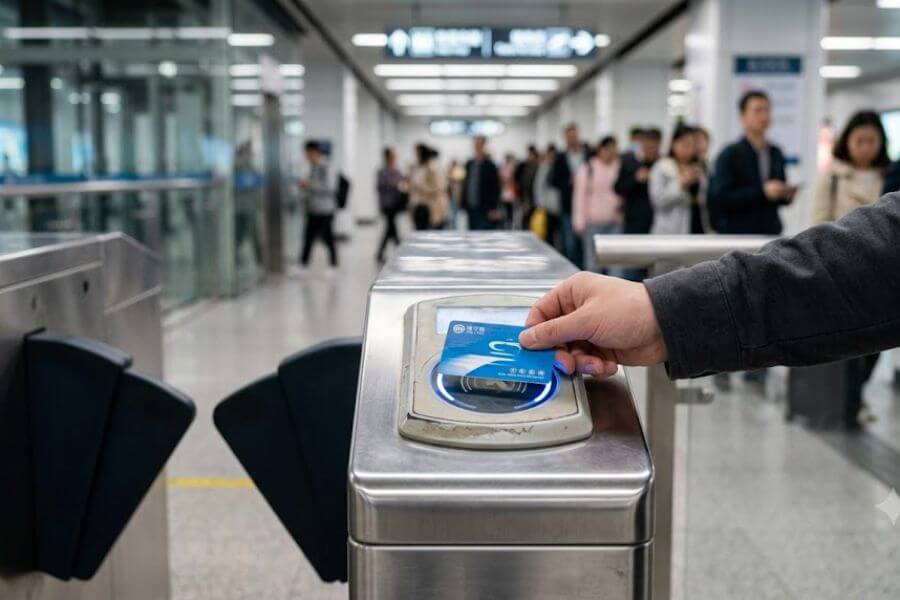
If you are using a plastic ticket card or token, press it flat against the blue or green sensor pad on top of the turnstile. Do not drop it into any slots yet. If you are using your phone, hold the screen about three inches above the glass scanner window. You will hear a cheerful beep, the small screen on the gate will display your current card balance, and the plastic barriers or doors will snap open. Walk through promptly, as the gates close quickly behind you to prevent tailgating.
Deciding Which Platform to Choose
Once you are past the gates, look up. You will see large signs hanging from the ceiling listing line numbers and direction arrows. Follow the color that matches the line you want to ride.
When you reach the actual platforms, you will usually find tracks on both sides of a central island. You need to figure out which direction you are traveling. Look at the large signboards mounted above the safety doors or on the pillars. These signs will show the current station name highlighted in bold, with an arrow pointing toward a list of all upcoming stations. Find your destination on that list. If your destination is listed on the sign, you are on the right side. If it is not listed, simply walk over to the opposite side of the platform.
Waiting for the Train and Boarding Etiquette
Subway stations in China are masterclasses in organization. The platforms are designed to keep massive crowds moving safely and efficiently, and there are visual clues everywhere to help you stand in the right spot.
Standing in the Right Zone
Look down at the floor right in front of the glass platform edge doors. You will see brightly colored arrows painted on the ground. There are usually two diagonal arrows pointing away from the doors and one straight arrow pointing toward the center of the doors.
The diagonal arrows show where passengers should wait in line. By standing to the left and right sides of the doors, you leave a clear path down the middle for the people who are trying to exit the train. Lining up properly is highly encouraged. When the train arrives, wait patiently until the exiting passengers have completely cleared out before you make your move to step inside.
Understanding the Platform Safety Doors
Almost every modern metro station in China features full-height glass barrier walls that separate the platform from the tracks. These safety doors prevent accidental falls and keep the stations temperature-controlled.
When the train arrives, it will line up perfectly with these glass barriers. Once the train comes to a complete stop, the train doors and the platform doors will slide open at the exact same time. A loud beeping sound or flashing red lights will warn you when the doors are about to close. If you hear the warning sound, do not try to run through the closing doors. The trains run so frequently that another one will arrive in just a couple of minutes.
Riding the Train: Announcements, Transfers, and Exits
Once you are inside the train car, you can finally take a breath and relax. The hard part is over, and now you just need to enjoy the smooth, air-conditioned ride until you reach your stop.
Keeping Track of Your Stop
Staying informed while on board is incredibly simple because the trains are packed with helpful technology. Look above the doors or along the ceilings of the car. You will find either an LED map with glowing lights or a high-definition digital screen.
The glowing lights or screen maps display every station along the line. Stations you have already passed will usually be unlit or colored red, the station you are currently arriving at will flash rapidly, and upcoming stations will be brightly lit or colored green. Listen closely to the audio announcements. They are always read out clearly in Mandarin first, followed by an English translation. The announcer will say something like: “We are arriving at West Nanjing Road. Please prepare to exit on the left side.”
Executing a Flawless Line Transfer
If your journey requires you to switch from one line to another, you do not need to exit the station or pass through turnstiles again. You will do the entire transfer within the underground walkways.
When you step off the train at a transfer station, look for signs labeled Transfer or Transfer to Line X, where X is the number of the line you need. These signs are highly visible and are always color-coded to match the destination line. Sometimes you will just need to walk down a set of stairs located right in the middle of the platform. Other times, you might walk through a long, wide pedestrian tunnel equipped with moving walkways. Simply follow the overhead pointers until you arrive at the new platform.
Scanning Out and Exiting the Station
When you arrive at your final destination, follow the overhead signs that point toward the Exit gates. You will face a line of turnstiles similar to the ones you used to enter.
This is where your ticket type matters. If you used a mobile app QR code, simply scan your phone screen over the sensor again, and the gate will open. If you used a physical single-journey plastic card or token, you must look for a small slot on the front of the turnstile. Insert your card or drop your token directly into that slot. The machine eats the ticket so it can be recycled for future riders, and the gate opens to let you through. If you accidentally used the wrong ticket or have an insufficient balance, the gate will beep loudly and turn red. If this happens, do not panic. Just walk over to the nearby Customer Service Desk, and a helpful agent will adjust your card for a small fee.
Practical Tips for a Smooth Journey
To truly ride like a local, there are a few extra tips and tricks that will help you avoid stress and make your journey far more comfortable.
Avoiding the Peak Rush Hours
Chinese cities have massive populations, and the subway systems experience extreme surges of passengers twice a day. The morning rush hour typically lasts from 7:30 AM to 9:30 AM, and the evening rush hour runs from 5:30 PM to 7:30 PM.
During these windows, stations near business districts or major residential complexes can become incredibly packed. Station staff might even set up temporary metal zig-zag barriers outside the entrances to slow down the flow of people entering the building. If you are traveling with large heavy luggage, young children, or elderly family members, try to schedule your sight-seeing trips between 10:00 AM and 4:00 PM. During the middle of the day, the trains are peaceful, spacious, and you will easily find an open seat.
Finding Essential Station Facilities
Subway stations in China are designed to be highly convenient public spaces. Almost every modern station contains public restrooms. These are usually located near the ends of the platforms or right outside the paid turnstile boundaries, and they are clearly marked with standard international symbols.
You will also find helpful amenities like automated bank ATMs, convenience stores where you can grab a cold milk tea or snack, and even automated umbrella rental kiosks. If you ever feel lost, confused, or have a medical issue, look for the glass Customer Service center located near the turnstiles. The staff members are trained to help travelers, and even if they do not speak fluent English, they can use translation devices on their phones to assist you with a warm smile.
Frequently Asked Questions
What should I do if I lose my single-journey token or ticket while riding the train?
If you look through your pockets and realize your plastic ticket or token is completely gone, do not worry. Walk directly to the glass Customer Service Desk located right next to the exit turnstiles. Explain to the staff member that you lost your ticket. They will ask you where you boarded the train, calculate the fare from that station, and have you pay for a replacement exit pass. It is a straightforward fix, so there is no need to panic.
Are children allowed to ride the subway for free in Chinese cities?
Yes, young children can ride the metro for free, but the rule is based on height rather than age. In most major Chinese cities, children who are shorter than 1.3 meters (about 4 feet 3 inches) can enter through the wide manual service gate next to the turnstiles for free when accompanied by an adult who has a valid ticket. If a child is taller than that limit, they will need to have their own standard ticket or mobile transit code.
Can I bring my large rolling luggage and suitcases onto the subway trains?
You are absolutely welcome to bring large luggage on the metro. Millions of travelers use the subway to get to airports and high-speed train stations every day. Just remember that your bags must go through the security X-ray machine before you enter. To make your life easier, look for the elevators located near the station entrances and platforms so you do not have to haul heavy suitcases up and down long flights of stairs or escalators.
Do the subway systems run twenty-four hours a day?
No, metro systems in China do not operate all night. Most networks begin running around 5:30 AM or 6:00 AM, and the final trains usually finish their runs between 11:00 PM and midnight. The exact closing times vary depending on the specific line and whether it is a weekday or a weekend. It is always a smart idea to check the schedule on your navigation app if you plan on staying out late into the evening.
What items are strictly prohibited from being brought past the subway security checkpoints?
Because safety is a top priority, certain everyday objects cannot be taken onto the trains. Prohibited items include large kitchen knives, tools like hammers or saws, explosive materials like fireworks, and highly flammable liquids. This flammable rule also applies to common personal care items like large aerosol spray cans of hairspray or deodorant if they carry a small flammable warning symbol on the back of the bottle. Small personal pocket knives or normal-sized cosmetics are perfectly fine.