Quick Guide to Your China Adventure
Before diving into the full guide, here is a quick overview of what you need to know to make your first trip to China a massive success.
| Phase | Main Focus | Top Tip |
| Preparation | Visas and Apps | Download WeChat, Alipay, and a translation app before you leave home. |
| Week 1 | History and Icons | Explore Beijing and Xi’an to see the Great Wall and Terracotta Warriors. |
| Week 2 | Nature and Modern Life | Visit Guilin for beautiful hills and Shanghai for futuristic skyscrapers. |
| Budgeting | Daily Expenses | Food and trains are affordable, but high-quality hotels and flight tickets add up. |
Planning a two-week trip to a country this big can feel like a giant puzzle. You might wonder how to get around, what foods to try, and how to see the best sights without getting overwhelmed. Do not worry. This guide will walk you through every single step. You will learn how to prepare your bags, which cities to visit, and how to navigate daily life like a pro. Get ready to plan the ultimate vacation.
The Perfect 2-Week Route for First-Timers
When you visit China for the first time, you want to see the classic sights. This specific route takes you from the ancient capital in the north down to the ultra-modern coast in the east. It gives you a perfect mix of history, culture, nature, and big-city energy.
Days 1 to 4: The Historic Capital of Beijing
Your journey begins in Beijing, the political and cultural heart of the nation. This city has served as the capital for centuries, leaving behind some of the most spectacular monuments on earth.
When you land on Day 1, give yourself time to rest. The time zone change can make you feel sleepy, so take a easy walk around a local neighborhood. Look for the narrow alleys called hutongs. These old residential areas feature gray brick walls and red wooden doors. They offer a peek into how families have lived for generations. For dinner, treat yourself to authentic Peking duck. This famous dish features crispy skin and juicy meat wrapped in thin pancakes with sweet bean sauce and cucumber strips.
On Day 2, wake up early to visit Tiananmen Square. This massive public space sits right in front of the Forbidden City. The Forbidden City was the imperial palace for twenty-four emperors during the Ming and Qing dynasties. As you walk through the huge red gates, you will see bright yellow roof tiles, carved marble pathways, and grand wooden halls. It feels like stepping straight into a movie set. Spend a few hours exploring the hidden courtyards and checking out the ancient clocks and pottery on display.
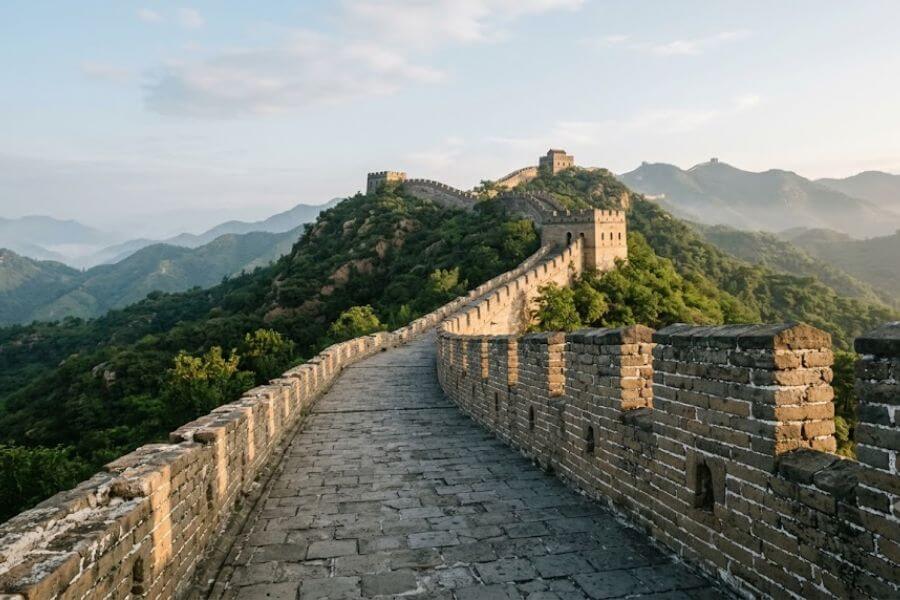
Day 3 is the big moment: visiting the Great Wall of China. There are several sections you can visit from Beijing. For a first-time trip, the Mutianyu section is an incredible choice. It is fully restored, less crowded than other spots, and surrounded by thick green forests. You can ride a cable car up to the top of the mountain to save your energy. Walking along the stone path between the watchtowers feels magical. When you are ready to head down, you can take a thrilling toboggan slide all the way to the bottom.
On Day 4, visit the Summer Palace. This was the luxury playground where the royal family escaped the heat of the city. It features a giant human-made lake called Kunming Lake and a beautiful hill covered in temples. You can rent a small pedal boat to cruise around the water or walk along the Long Corridor, which is covered in thousands of colorful paintings. In the afternoon, board a high-speed bullet train to your next destination: Xi’an.
Days 5 to 7: The Ancient Treasures of Xi’an
Xi’an was the starting point of the ancient Silk Road trading route. It is a city bursting with diverse cultures and mind-blowing archeological finds.
Start Day 5 by meeting the Terracotta Army. In 1974, local farmers digging a well accidentally discovered thousands of life-sized clay soldiers, horses, and chariots buried underground. They were created to protect China’s first emperor in the afterlife. Every single soldier has a unique face, hairstyle, and uniform. Standing in the giant viewing pits and looking down at this ancient army is a memory you will never forget.
On Day 6, explore the heart of the city. Xi’an is one of the few places in the world that still has its complete ancient City Wall standing. The wall is wide, flat, and forms a giant square around the old town center. The best way to experience it is by renting a bicycle at the South Gate and riding the entire nine-mile loop. It takes about two hours and gives you amazing views of old rooftops on one side and modern high-rises on the other.
In the evening, head over to the Muslim Quarter. This lively neighborhood is a paradise for food lovers. The narrow streets are packed with neon signs, steaming giant pots, and friendly vendors. Try the famous biangbiang noodles, which are thick, hand-pulled noodles tossed in chili oil and garlic. Another must-try snack is roujiamo, a savory flatbread stuffed with juicy minced meat that tastes like a traditional Chinese hamburger.
Day 7 gives you time to see the Giant Wild Goose Pagoda, a simple stone tower built during the Tang dynasty to store ancient Buddhist texts. The square around the pagoda features beautiful fountains that dance to music at night. After a relaxing afternoon, hop onto an overnight train or take a quick flight down south to Guilin.
Days 8 to 10: The Dreamy Landscapes of Guilin and Yangshuo
After exploring two giant cities filled with history, it is time to experience the breathtaking natural beauty of the countryside. Guilin is famous for its unique karst mountains, which look like giant green sugar cones rising out of the ground.
On Day 8, arrive in Guilin and check out the Reed Flute Cave. Inside this natural underground cavern, colorful lights illuminate incredible formations of stalactites and stalagmites. It looks like a magical wonderland hidden deep inside the rock. Afterward, walk by the twin sun and moon pagodas that sit beautifully in the middle of a calm lake downtown.
Day 9 is all about the Li River cruise. You will board a boat in the morning for a four-hour trip down the river to the small town of Yangshuo. As the boat glides through the water, you will pass local fishermen on bamboo rafts, water buffalo cooling off in the river, and endless rows of green peaks. The scenery is so beautiful that it is actually printed on the back of the Chinese twenty-yuan bill. Keep your camera ready.
Spend Day 10 exploring Yangshuo and the surrounding countryside. Rent a bicycle or a small electric scooter to zoom past bright green rice paddies. If you feel adventurous, you can try rock climbing on the limestone cliffs or take a cooking class to learn how to make local dishes like beer fish. In the evening, watch the famous outdoor light show held right on the river, where hundreds of local actors dance on the water under the real mountains.
Days 11 to 14: The Futuristic Metropolis of Shanghai
Your final stop is Shanghai, a dazzling city that shows you where China is heading in the future. It is a massive hub of finance, fashion, and food.
On Day 11, catch a flight from Guilin to Shanghai. Once you check into your hotel, head straight to the Bund. This is a famous waterfront promenade along the Huangpu River. On one side of the walkway, you will see grand colonial buildings that look like they belong in Europe. On the other side, you will see the dazzling skyline of Pudong, featuring ultra-modern skyscrapers like the Oriental Pearl TV Tower with its pink spheres, and the twisted Shanghai Tower, which is one of the tallest buildings in the world.
Spend Day 12 exploring the contrasts of Shanghai. Start at Yu Garden, a classic garden filled with zigzag bridges, traditional pavilions, and ponds crowded with bright orange koi fish. Right outside the garden is a busy bazaar where you can shop for souvenirs and try pan-fried pork buns. In the afternoon, walk through the French Concession neighborhood. This area features leafy streets lined with beautiful trees, cozy cafes, and unique boutiques.
Day 13 is perfect for a day trip to Suzhou or Zhouzhuang. These are historic water towns located just a short train ride outside Shanghai. They are often called the Venice of the East because they are built around network channels of canals. You can ride in a wooden gondola boat rowed by a local guide, drift under ancient stone arches, and admire old white-walled houses with black tiled roofs.
On Day 14, enjoy your last morning doing some shopping on Nanjing Road, one of the busiest shopping streets in the world. Grab some final gifts for your friends and family, like green tea or silk scarves. Head to the airport using the Maglev train, a super-fast futuristic train that uses magnetic levitation to fly along the tracks at over two hundred miles per hour. It is the perfect ending to an unforgettable trip.
Smart Travel Preparations Before You Leave
Visiting China requires more advance planning than a standard vacation. Because the country uses a unique digital setup, you must complete several crucial steps before you board your plane.
Securing Your Travel Documents
First, check your passport. It must be valid for at least six months beyond your planned return date, and it needs to have empty pages for stamps. Most international travelers need a tourist visa to enter. You will need to fill out a detailed form online, print it out, and submit it to a visa application center or embassy. You must provide copies of your round-trip flight tickets and your hotel bookings for the entire two-week stay. Start this process at least two months before your trip so you do not have to worry about delays.
Setting Up Your Digital Wallet
China is a cashless society. Almost everyone pays for everything using their mobile phones, from fancy dinners to tiny bottles of water from street vendors. Cash is still accepted by law, but many places might not have change to give you, and credit cards from other countries are rarely accepted outside large international hotels.
To survive and thrive, you must download two essential phone apps: Alipay and WeChat. Both apps allow foreign travelers to link international credit cards. Once you set them up and verify your identity with your passport, you can scan QR codes to pay for items instantly. This makes shopping and dining incredibly easy and smooth.
Staying Connected to the Internet
You will want to share photos with your family and look up directions while exploring. However, many websites and communication tools from Western countries do not work inside China due to local internet filters. This includes popular search engines, map tools, and social networks.
To stay connected to your favorite apps, buy an eSIM card online that includes a built-in virtual private network or look for data roaming packages from your home cell provider that specifically bypass these blocks. Download a reliable translation app that works offline, as well as a local map app that has English labels.
Packing the Essential Items
When packing your bags, remember that you will be doing a lot of walking, especially at historic spots like the Great Wall and the Forbidden City. Bring comfortable athletic shoes with good grip.
Pack a variety of layers. The weather can change quickly, especially when traveling from the cooler north down to the tropical south. Bring a small umbrella for sudden rain showers, a portable power bank to keep your phone charged all day, and small packs of tissues and hand sanitizer. Many public restrooms do not provide toilet paper, so having your own pack is a lifesaver.
Mastering Transportation and Getting Around
Navigating a massive country might seem scary, but China has one of the most advanced and efficient transportation networks in the entire world.
Riding the Bullet Trains
The high-speed rail system is the absolute best way to travel between major cities. These bullet trains are clean, punctual, and quiet. They move at speeds of around two hundred miles per hour, allowing you to watch the beautiful countryside fly past your window.
You should book your train tickets online a few weeks in advance, as popular routes can sell out quickly. When you arrive at the train station, you will need to show your passport to pass through security and enter the platforms. Your passport acts as your digital ticket, so keep it handy.
Using the City Subways
Once you are inside a big city like Beijing or Shanghai, the subway system is your best friend. The stations are sparkling clean, safe, and easy to use. All the signs, maps, and ticket machines have clear English translations.
You can buy single-ride tickets using cash or your phone app at the station kiosks, or you can use the transport section inside your Alipay app to scan a digital subway card directly at the turnstiles. This saves you from waiting in lines during the busy rush hour.
Catching Local Taxis
Taxis are plentiful and affordable. However, most drivers do not speak English. To avoid communication trouble, use the ride-hailing feature inside Alipay, which works exactly like ride services in the West. You type in your destination in English, the app converts it for the driver, and it calculates the fare automatically. If you hail a regular taxi on the street, make sure to have the name and address of your destination written down in Chinese characters on your phone screen.
Embracing the Local Culture and Food
Chinese culture is deeply rooted in hospitality, respect, and a deep love for sharing incredible meals. Understanding a few basic customs will help you feel welcome and comfortable.
Important Etiquette Tips
When meeting people, a polite nod or a simple handshake is the standard greeting. If you are handing someone an item, like your passport, a business card, or a gift, always use both hands. This simple gesture shows high respect.
When dining with others, never stick your chopsticks vertically straight down into a bowl of rice, as this looks like an ancient funeral ritual and is considered bad luck. Instead, rest them flat across the side of your bowl or on the small ceramic holder provided.
Navigating the Food Scene
Food is an adventure all on its own. Every region has its own unique flavors and cooking styles. Do not be afraid to try local restaurants, even if they look small and simple.
| Region | Primary Flavor Profile | Famous Dish to Try |
| Beijing (North) | Savory and rich | Peking roasted duck with pancakes |
| Xi’an (West) | Spicy and cumin-spiced | Hand-pulled noodles and lamb soup |
| Guilin (South) | Fresh and sour | Rice noodles with roasted meats |
| Shanghai (East) | Sweet and delicate | Soup dumplings filled with hot broth |
When eating soup dumplings, which are called xiaolongbao, do not bite them in half right away, or the hot soup inside will splash out. Instead, place the dumpling on a large spoon, poke a small hole in the dough to let the steam escape, sip the delicious broth first, and then eat the rest of the dumpling. It is an amazing culinary experience.
Money, Budgeting, and Smart Shopping
Managing your funds properly ensures you do not run into any unexpected surprises during your two-week vacation.
Understanding the Currency
The official currency is the Renminbi, which is commonly called the Yuan. Notes come in bright colors, ranging from one to one hundred yuan, and they all feature a portrait of Mao Zedong. While you will use mobile payments for almost everything, it is still a smart idea to carry a small amount of cash, perhaps three hundred to five hundred yuan, tucked away in your wallet for emergencies. You can withdraw cash easily at major banks using international debit cards.
The Art of Bargaining
When you visit souvenir markets, like the famous Silk Market in Beijing or the bazaars in Shanghai, bargaining is a normal part of the shopping experience. Sellers will often state a starting price that is much higher than the actual value of the item.
Be polite, smile, and offer a lower price, usually starting at about half of what they originally asked. If the price is too high, you can simply walk away. Many times, the seller will call you back and agree to your offer. Remember to keep the interaction friendly and fun. Do not try to bargain in regular grocery stores, modern shopping malls, or restaurants, as prices there are strictly fixed.
Staying Safe and Healthy on the Road
China is generally an incredibly safe place for international tourists. Violent crime is rare, and cities are well-lit and heavily patrolled at night. However, you should still practice standard travel common sense.
Guarding Your Belongings
In crowded tourist areas like train stations, street markets, or popular squares, keep a close eye on your personal belongings. Wear your backpack on your front in heavy crowds and keep your phone in a secure front pocket rather than your back pocket. Be aware of overly friendly strangers who approach you asking to practice their English or inviting you to a traditional tea ceremony or an art gallery nearby. These can sometimes be traps to make you pay an expensive bill. Always stick to established, well-reviewed businesses.
Staying Healthy and Hydrated
Do not drink the tap water directly from the sink. Even local people always boil their water first or buy bottled water. Bottled water is cheap and available at every street corner store. Most hotels provide a clean electric kettle in your room so you can make hot tea or boil water for brushing your teeth.
When it comes to food, look for busy restaurants where you see lots of local families dining. High turnover means the ingredients are fresh and safe to eat.
Frequently Asked Questions
What is the absolute best time of year to take a 2-week vacation to China?
The best seasons to visit are autumn, from September to November, and spring, from April to May. During these months, the weather is comfortable, skies are often clear, and you will avoid the intense heat of summer and the freezing winds of winter. Try your best to avoid traveling during the first week of October, which is the National Day Golden Week holiday. Millions of local tourists travel during this time, making trains, hotels, and sights incredibly crowded and more expensive.
Do I need to speak fluent Mandarin to travel around China successfully?
No, you do not need to speak fluent Mandarin. In major cities like Beijing and Shanghai, younger people and workers in tourism, hotels, and transit stations speak basic English. All major street signs, subway maps, and train announcements are bilingual. However, learning a few simple phrases like ni hao for hello and xie xie for thank you is deeply appreciated by locals. For deeper conversations or ordering food at local restaurants, your mobile translation app will be your best friend.
Is a 2-week trip enough time to see the main highlights of the country?
Two weeks is the perfect amount of time for a first-time visit. While China is too massive to see entirely in one trip, a fourteen-day itinerary allows you to explore the major historical, cultural, and modern highlights without feeling rushed. It gives you enough time to experience the distinct personalities of several regions, from the ancient northern plains to the southern river valleys and the eastern coast.
How do I handle medical emergencies or find pharmacies during my vacation?
Major cities have international hospitals with English-speaking doctors and staff. Your hotel front desk can assist you in calling a medical professional or directing you to the nearest clinic. For minor health issues like a cold or an upset stomach, local pharmacies are common and marked with a green cross sign. It is a good idea to bring a small personal supply of familiar over-the-counter medicines from home, as the brands and ingredients available locally might be different from what you use.